Scabious
Scabious plants, which belong to the honeysuckle family, are primarily native to temperate regions of Eurasia and the Mediterranean. Additionally, various…
In which regions or habitats are scabious plants commonly found?
Scabious plants, which belong to the honeysuckle family, are primarily native to temperate regions of Eurasia and the Mediterranean. Additionally, various species are commonly found in the mountainous areas of eastern Africa.1
These plants include both annual and perennial herbs, with some varieties widely cultivated as garden plants due to their distinctive flower heads.1
What are the different species of scabious plants, and how do they vary?
The genus Scabiosa comprises approximately 30 species of annual and perennial herbs. While they share common traits like basal leaf rosettes and crowded, five-lobed flower heads, they vary significantly in size, leaf structure, and bloom characteristics.1
Key species include:
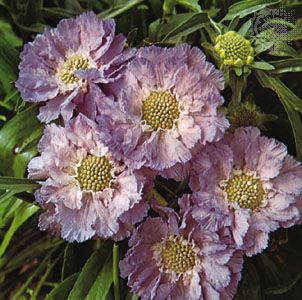
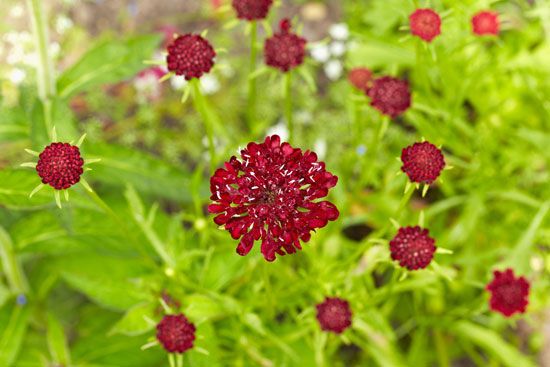
- Pincushion flower (Scabiosa atropurpurea): A southern European annual reaching 1 meter (3 feet) in height. It features deeply cut basal leaves and produces fragrant, 5-cm flower heads in a variety of colors, including white, rose, crimson, blue, and deep mahogany purple.1
- Small scabious (S. columbaria): A perennial native to Eurasia and Africa that grows to 60 cm (24 inches). It is distinguished by toothed, elongate oval basal leaves and light blue flowers measuring 3.5 cm across.1
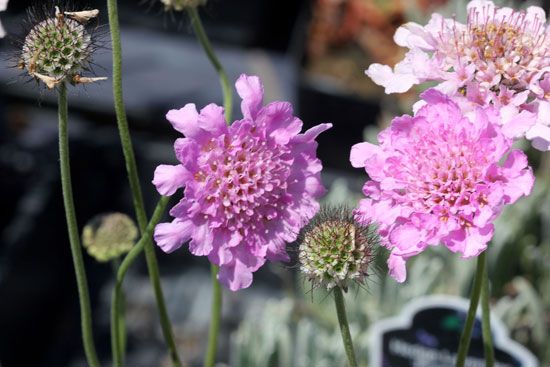
- Perennial scabious (S. caucasica): Native to southeastern Europe, this species reaches 75 cm (29.5 inches). It is characterized by narrow, smooth-margined basal leaves and produces notably large, light blue flowers up to 8 cm across.1
Note that the “devil’s bit scabious” is excluded from this genus, as it belongs to the related genus Succisa.1
What is the scientific classification of scabious plants?
Scabious plants belong to the genus Scabiosa, which is classified within the honeysuckle family (Caprifoliaceae).21
While some older or alternative classifications have historically placed the genus within the teasel family (Dipsacaceae), modern botanical consensus—supported by molecular and morphological evidence—groups these plants under the broader Caprifoliaceae, which falls within the order Dipsacales.342
The genus Scabiosa is closely related to other genera such as Dipsacus (teasel). It is important to note that while the common name “scabious” is often applied to these plants, some species previously associated with the group, such as the “devil’s bit scabious,” are now classified in the related genus Succisa.21
How did scabious plants get their name, and what does it mean?
The name “scabious” is derived from the Medieval Latin scabiosa, which is the feminine form of the Latin adjective scabiosus. This term is etymologically linked to the Latin verb scabere, meaning “to scratch”.345
Historically, the plant was associated with the treatment of scabies—a contagious skin condition characterized by intense itching and crusting—due to the belief that the plant could cure such skin ailments. The name reflects this traditional medicinal use, as the term scabies itself shares the same root related to the act of scratching.45
Sources
- Scabious — Encyclopædia Britannica
- Caprifoliaceae — Encyclopædia Britannica
- scabiosa — Merriam-Webster
- scabious — Merriam-Webster
- sweet scabious — Merriam-Webster
- scabies — Merriam-Webster
Published on · 2 min read