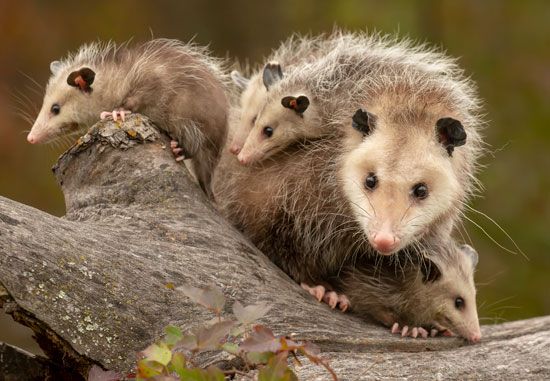
Thick-tailed Opossum
The thick-tailed opossum (Lutreolina) possesses several adaptations that allow it to thrive in its environment. These South American marsupials are primarily…
Are there any unique behaviors or adaptations that help the thick-tailed opossum survive in its environment?
The thick-tailed opossum (Lutreolina) possesses several adaptations that allow it to thrive in its environment. These South American marsupials are primarily adapted for life along rivers, streams, and periodically flooded grasslands, such as the savanna and pampas habitats.1
Key characteristics and behaviors include:
- Physical Build: They have a minklike appearance and are fiercely carnivorous, which helps them survive as predators in their respective habitats.12
- Tail Structure: Their tails are thickly haired at the base, a feature that distinguishes them from many other opossum species.1
- Habitat Flexibility: While they are primarily associated with marshes and watercourses, they are resilient enough to enter urban areas.2
- Reproductive Strategy: They typically produce two litters per year, which supports population stability in their dynamic, often flooded environments.1
Although some other opossums, such as the fat-tailed mouse opossum, store fat in their tails to survive, the thick-tailed opossum is specifically noted for its aggressive, predatory nature and its ability to navigate both aquatic-adjacent and human-altered landscapes.123
How long do thick-tailed opossums typically live, both in the wild and in captivity?
Sorry, the Britannica knowledge base does not contain information regarding the typical lifespan of thick-tailed opossums in the wild or in captivity. While data is available for other species, such as the woolly opossum, specific longevity records for the genus Lutreolina are not provided in the current search results.
How does the thick-tailed opossum compare to other marsupial species found in its region?
The thick-tailed opossum (Lutreolina) is distinct among South American marsupials due to its specialized morphology and aggressive, carnivorous nature. When compared to other regional species, several key differences emerge:
- Physical Appearance and Niche: Unlike the more common mouse opossums, which are agile climbers often found in trees or cacti, the thick-tailed opossum is a terrestrial, minklike predator adapted for life in marshes and along watercourses. While it shares its environment with various species, its appearance is uniquely characterized by a tail that is thickly haired at the base, contrasting with the slender, prehensile tails of many other opossums.153
- Comparison to the Water Opossum: While both the thick-tailed opossum and the water opossum (yapok) frequent aquatic environments, the water opossum is the only marsupial truly adapted for a semiaquatic life, possessing webbed hind toes and dense, oily fur. The thick-tailed opossum lacks these specific aquatic adaptations, though it remains highly resilient in periodically flooded grasslands.31
- Behavioral Traits: Many American opossums, such as the Virginia opossum, are known for their ability to feign death or utilize specialized toxins to neutralize venom. In contrast, the thick-tailed opossum is noted primarily for its fierce, carnivorous behavior, filling a predatory role that differs from the more omnivorous or insectivorous diets of many other Didelphidae members.312
What is the conservation status of the thick-tailed opossum, and are there any threats to its population?
The current Britannica knowledge base does not contain information regarding the specific conservation status or identified threats to the population of the thick-tailed opossum. While these animals are known to inhabit savanna and grassland environments and have been observed entering cities, there is no documented data available in our records concerning their vulnerability or current population trends.12
Sources
- thick-tailed opossum — Encyclopædia Britannica
- opossum — Encyclopædia Britannica
- mouse opossum — Encyclopædia Britannica
- woolly opossum — Encyclopædia Britannica
- marsupial — Encyclopædia Britannica
Published on · 2 min read