Urn Moss
Urn moss refers to any plant within the genus Physcomitrium (subclass Bryidae), which are mosses characterized by their distinct urn-shaped or top-shaped…
What is Urn moss?
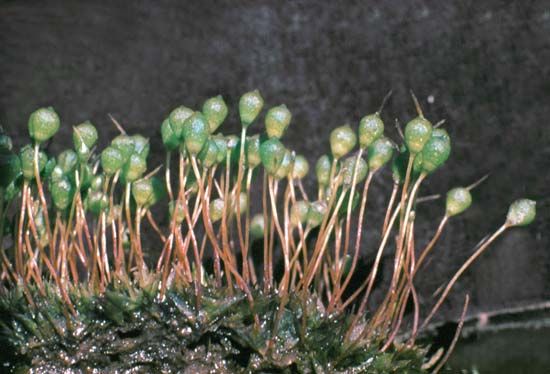
Urn moss refers to any plant within the genus Physcomitrium (subclass Bryidae), which are mosses characterized by their distinct urn-shaped or top-shaped capsules, also known as spore cases.12
These plants typically feature bright green rosettes of phyllids (leaves) and produce dark brown capsules borne on short stalks called setae. The capsules are covered by lobed, hoodlike structures. Among the approximately 68 species in this genus, P. pyriforme—sometimes referred to as top moss—is the most common variety found in North America.1
Like other mosses, urn mosses undergo an alternation of generations in their life cycle, transitioning between a gametophyte stage, which produces sex organs, and a sporophyte stage, which produces spores.3
What are the main differences between mosses and other types of plants?
Mosses differ from other plants—specifically vascular plants—primarily in their lack of complex internal transport systems and their distinct life cycle stages.
Key Differences
- Vascular Tissue: Unlike vascular plants, which possess specialized xylem and phloem for transporting water and nutrients, mosses are nonvascular. While some larger mosses contain central strands of water-conducting cells called hydroids, they lack the complex tissue organization found in ferns, gymnosperms, and angiosperms.567
- Dominant Life Stage: In mosses, the gametophyte (the leafy, photosynthetic stage) is the long-lived, dominant generation. In contrast, vascular plants have a dominant sporophyte generation.56
- Reproductive Structures: Mosses lack true roots, stems, and leaves; instead, they have rootlike rhizoids and stemlike or leaflike structures (phyllids). Furthermore, mosses rely on water for their flagellated sperm to reach the egg, a trait reflecting their evolutionary history.86
- Sporophyte Dependency: The moss sporophyte is typically dependent on the gametophyte for water and nutrients, whereas in vascular plants, the gametophyte is usually dependent on the sporophyte.56
How do bryophytes like urn moss reproduce without seeds?
Bryophytes, such as urn moss, reproduce through an alternation of generations that relies on spores rather than seeds. This cycle involves two distinct phases:115
Sexual Reproduction
- Gametophyte Phase: The leafy, dominant stage of the moss produces sex organs—the antheridia (male) and archegonia (female).1213
- Fertilization: When moisture from rain or heavy dew is present, biflagellate sperm are released and swim to the archegonia to fertilize the egg.gonia to fertilize the egg.1213
- Sporophyte Phase: The resulting zygote develops into a sporophyte, which remains attached to the gametophyte. This structure produces spores via meiosis within a capsule.1213
Asexual Reproduction
Bryophytes can also reproduce vegetatively, bypassing the sexual cycle entirely:
- Fragmentation: Pieces of the gametophyte can grow into new, complete plants.11
- Gemmae: Some species produce specialized cell clusters called gemmae that detach and develop into new gametophytes.11
- Regeneration: Fragments of stems, leaves, or rhizoids can regenerate new gametophytic tissue.3
What role do mosses play in their natural ecosystems?
Mosses play vital roles in their natural ecosystems, acting as foundational organisms that influence soil development, hydrology, and nutrient cycling.
Key Ecological Contributions
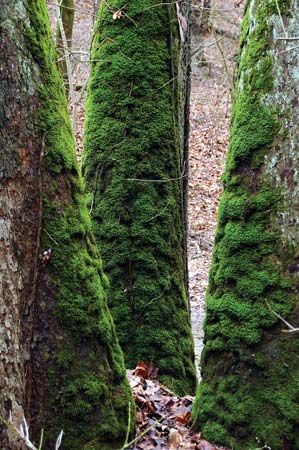
- Soil Formation and Erosion Control: Mosses are pioneer species that colonize bare rock surfaces, initiating soil formation by breaking down substrates and releasing nutrients for more complex plants. They also prevent erosion by providing a protective surface cover that stabilizes the ground.1617
- Hydrological Regulation: Many mosses, particularly those in the genus Sphagnum, act like massive sponges. They absorb and retain vast quantities of water, which helps control the water table and the hydrology of surrounding landscapes control the water table and the hydrology of surrounding landscapes.167
- Nutrient Cycling: Mosses contribute to the nutrient economy of various environments by capturing airborne minerals and precipitation that might otherwise be unavailable to seed plants. In some forests, the rapid evaporation from dense moss mats can even influence the composition of local vegetation by regulating moisture access to tree roots.1617
- Carbon Sequestration: Peatlands formed by mosses are critical for carbon sequestration, making their protection an important strategy in mitigating climate change.7
Sources
- urn moss — Encyclopædia Britannica
- urn moss — Merriam-Webster
- bryophyte - Reproduction and life cycle — Encyclopædia Britannica
- bryophyte - Form and function — Encyclopædia Britannica
- bryophyte — Encyclopædia Britannica
- Plant - Division Bryophyta — Encyclopædia Britannica
- moss — Encyclopædia Britannica
- Plant - Definition of the category — Encyclopædia Britannica
- Xylem — Encyclopædia Britannica
- Plant reproductive system - Variations in reproductive cycles — Encyclopædia Britannica
- Animal reproductive system - Sponges, coelenterates, flatworms, and aschelminthes — Encyclopædia Britannica
- Plant reproductive system - Mosses — Encyclopædia Britannica
- Alternation of generations — Encyclopædia Britannica
- Plant - Anisosporous life histories — Encyclopædia Britannica
- Gametophyte — Encyclopædia Britannica
- bryophyte - Ecology and habitats — Encyclopædia Britannica
- peat moss — Encyclopædia Britannica
Published on · 3 min read