Top Moss
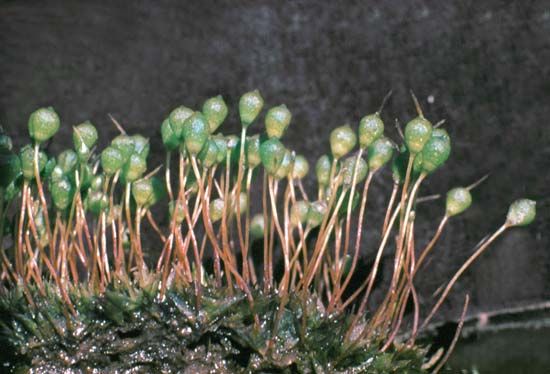
Top moss (Physcomitrium pyriforme) is a common species of urn moss belonging to the family Funariaceae within the division Bryophyta.
What is Top moss?
Top moss (Physcomitrium pyriforme) is a common species of urn moss belonging to the family Funariaceae within the division Bryophyta.1
The plant receives its common name from its distinctive top-shaped capsules. These structures open by a small lid at the tip to release the plant’s spores. While it is a member of the diverse group of mosses—which includes at least 12,000 species of small, nonvascular, spore-bearing land plants—it is distinct from other well-known types such as peat moss.123
What is the difference between bryophytes and vascular plants?
The primary distinction between bryophytes and vascular plants lies in their internal structure and life cycle.
Structural Differences
- Vascular Tissue: Vascular plants possess specialized tissues—xylem for water conduction and phloem for food transport—which allow them to grow to significant sizes and inhabit diverse environments. Bryophytes lack these complex tissues, generally limiting their height to a few centimeters.567
- Plant Organs: Vascular plants have true roots, stems, and leaves adapted for terrestrial life. Bryophytes lack these true structures, though some possess analogous parts.587
Life Cycle Differences
- Dominant Generation: In bryophytes, the gametophyte is the long-lived, dominant, and photosynthetic phase of the life cycle. In contrast, the sporophyte is the dominant and more conspicuous generation in vascular plants.875
- Reproduction: Both groups share an alternation of generations. While vascular plants have evolved sophisticated methods for survival on land, both bryophytes and lower vascular plants (such as ferns) rely on water for fertilization because they produce motile, flagellated sperm.875
How do mosses reproduce through the alternation of generations?
Mosses exhibit a distinct alternation of generations in which two morphologically different phases—the haploid gametophyte and the diploid sporophyte—alternate to complete the life cycle.910
The Gametophyte Phase
The gametophyte is the dominant, photosynthetic, and independent phase of the moss life cycle. It begins when a spore germinates into a branched, filamentous structure called a protonema. This protonema eventually produces buds that develop into leafy shoots known as gametophores. These shoots bear the sex organs: the male antheridia and female archegonia.910117
Fertilization and the Sporophyte Phase
When moisture is present, such as during rain or heavy dew, the biflagellate sperm are released from the antheridia and swim to the archegonia to fertilize the egg. The resulting diploid zygote develops into an embryo and eventually grows into a sporophyte. This sporophyte remains attached to and partially dependent on the gametophyte for nutrients. It typically consists of a foot, a stalk (seta), and a capsule (sporangium). Inside the capsule, meiosis occurs to produce haploid spores, which are eventually released to begin the cycle anew.71011
Why are some plants like Spanish moss or reindeer moss not actually mosses?
The term “moss” is frequently applied to various organisms that are not members of the division Bryophyta, which comprises true mosses. These misnomers often arise from superficial physical similarities rather than biological classification.312
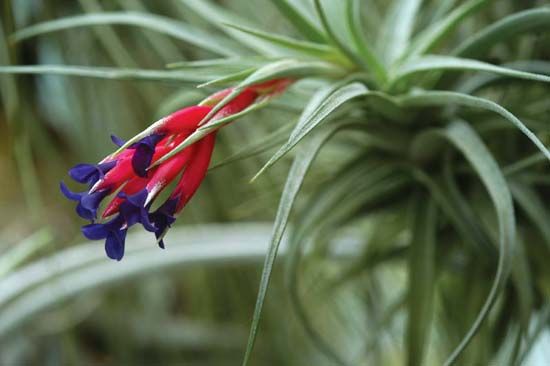
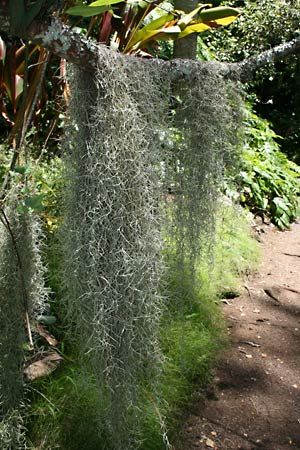
- Spanish moss (Tillandsia usneoides) is not a moss at all, but rather a flowering epiphyte (air plant) belonging to the pineapple family, Bromeliaceae. It grows on other plants but does not rely on them for nutrients, instead absorbing moisture and nutrients from the air.313
- Reindeer moss (Cladonia species) is a lichen. Lichens are complex organisms formed through a symbiosis between fungi and photosynthetic partners, such as algae or cyanobacteria. Unlike true mosses, which are nonvascular plants, reindeer lichen is a bushy, branched organism that serves as a vital food source for caribou and other arctic animals.31415
Other common misnomers include Irish moss, which is a red alga, and club mosses, which are actually fern allies.312
Sources
- peat moss — Encyclopædia Britannica
- top moss — Encyclopædia Britannica
- moss — Encyclopædia Britannica
- bryophyte - Ecology and habitats — Encyclopædia Britannica
- Plant - Definition of the category — Encyclopædia Britannica
- bryophyte — Encyclopædia Britannica
- Plant - Definition of the category — Encyclopædia Britannica
- lower vascular plant - Vascular system — Encyclopædia Britannica
- bryophyte - Form and function — Encyclopædia Britannica
- Alternation of generations — Encyclopædia Britannica
- Plant reproductive system - Mosses — Encyclopædia Britannica
- Plant - Division Bryophyta — Encyclopædia Britannica
- reindeer moss — Merriam-Webster
- reindeer lichen — Encyclopædia Britannica
- list of mosses — Encyclopædia Britannica
- Tillandsia — Encyclopædia Britannica
Published on · 3 min read