Vascular System
Xylem is a specialized vascular tissue in plants responsible for transporting water and dissolved minerals from the roots to the rest of the plant, while…
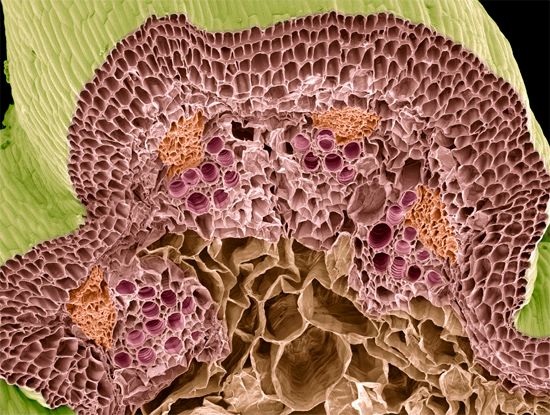
How does the xylem tissue function in transporting water and minerals?
Xylem is a specialized vascular tissue in plants responsible for transporting water and dissolved minerals from the roots to the rest of the plant, while also providing structural support.12
Mechanisms of Transport
Water movement through xylem is primarily a passive process driven by the cohesion-tension hypothesis.34
- Transpiration Pull: The evaporation of water from the leaves creates a negative pressure (tension) that pulls water upward through the plant.34
- Cohesion and Adhesion: Water molecules exhibit strong cohesion (sticking to each other) and adhesion (sticking to the walls of xylem vessels and tracheids). These forces allow water to form a continuous, stable column that can be pulled to great heights without breaking.34
- Root Pressure: In some conditions, such as when soil is wet and transpiration is low, active ion uptake by roots can create positive pressure that pushes water upward.4
Structural Components
Transport occurs through specialized, hollow cells called tracheary elements:
- Tracheids: Narrow, elongated cells found in all vascular plants.1
- Vessel members: Wider cells with perforations that allow for more rapid water flow, primarily found in angiosperms.1
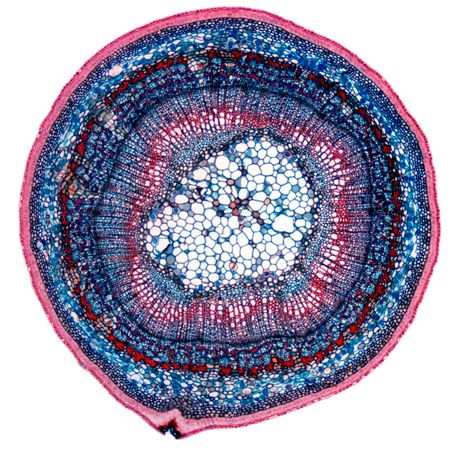
What is the importance of the vascular cambium in the growth of woody plants?
The vascular cambium is a critical lateral meristem that facilitates the transition of a plant from an herbaceous state to a woody one by enabling secondary growth, or the increase in stem and root girth.567
Its primary importance lies in its role as a source of secondary vascular tissues:
- Production of Secondary Tissues: The cambium divides tangentially to produce secondary xylem (wood) toward the interior and secondary phloem toward the exterior.85
- Structural Support and Conduction: By continuously generating new xylem, the vascular cambium provides the structural mass necessary for trees to grow tall and robust, while also ensuring a persistent system for the transport of water and nutrients.85
- Circumferential Expansion: As the plant thickens, the vascular cambium itself must increase in circumference to keep pace with the growing stem. This is achieved through the division of its two cell types: fusiform initials, which produce the vertical conducting system, and ray initials, which create the horizontal system for storage and translocation.85
Because the cambium produces more xylem than phloem, it is the primary driver of wood formation, which constitutes the bulk of the secondary plant body.85
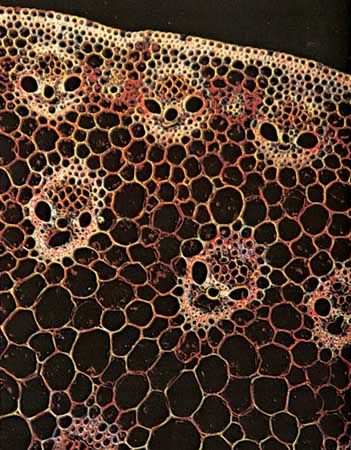
How does the vascular system contribute to the overall growth and development of plants?
The vascular system is fundamental to the growth and development of plants, acting as a complex internal transport network analogous to the circulatory system in animals. It is composed of two primary tissues, xylem and phloem, which facilitate the movement of essential resources throughout the plant body.954
Primary Functions in Development
- Resource Transport: Xylem conducts water and dissolved minerals from the roots to the leaves, while phloem translocates photosynthates (sugars) from leaves to areas of active growth, such as roots and shoot apical meristems, to fuel development.594
- Structural Support: The rigid, lignified cell walls of tracheary elements in the xylem provide the necessary support for land plants to grow upright and reach heights that would be impossible without such a skeletal structure.94
- Secondary Growth: In woody plants, the vascular cambium—a lateral meristem—produces secondary xylem and phloem, allowing the plant to increase in girth and sustain long-term growth.108
By enabling long-distance transport and providing structural integrity, the vascular system allows plants to colonize diverse terrestrial habitats and achieve significant size.94
What adaptations have vascular plants developed to optimize water and nutrient transport?
Vascular plants have evolved specialized tissues and structural adaptations to optimize the long-distance transport of water, nutrients, and photosynthetic products. These adaptations allow them to thrive in diverse terrestrial environments by overcoming the challenges of gravity and water scarcity.114
Specialized Conducting Tissues
- Xylem: This tissue is specialized for the upward transport of water and minerals from the roots. In flowering plants, xylem has evolved into highly efficient vessels formed by dead, lignified cells that act as open capillaries. This structure allows for rapid conduction while providing the rigid, self-supporting framework necessary for land plants to grow tall.114
- Phloem: This tissue transports sugars and other organic compounds from “source” areas (like leaves) to “sink” areas (like roots or fruits). It consists of sieve-tube members that facilitate the flow of solutions, often regulated by companion cells.1112
Structural and Physiological Adaptations
- Root Specializations: To maximize absorption, plants utilize root hairs to increase surface area and form symbiotic mycorrhizae with fungi to enhance phosphorus uptake. Specialized roots like buttress roots and pneumatophores provide stability and aeration in challenging environments.13
- Transpiration Regulation: While transpiration is an unavoidable consequence of gas exchange, plants regulate it via stomata. Adaptations such as waxy cuticles, sunken stomata, and alternative photosynthetic pathways like crassulacean acid metabolism (CAM) help minimize water loss in arid conditions.14
Sources
- Xylem — Encyclopædia Britannica
- Cohesion hypothesis — Encyclopædia Britannica
- Angiosperm - Process of xylem transport — Encyclopædia Britannica
- Angiosperm - Evolution of the transport process — Encyclopædia Britannica
- Angiosperm - Secondary vascular system — Encyclopædia Britannica
- Tree - General features of the tree body — Encyclopædia Britannica
- Meristem — Encyclopædia Britannica
- Angiosperm - Vegetative structures — Encyclopædia Britannica
- Angiosperm - Organization of the vascular tissue — Encyclopædia Britannica
- Plant - Definition of the category — Encyclopædia Britannica
- Angiosperm - Structural basis of transport — Encyclopædia Britannica
- Transpiration — Encyclopædia Britannica
- Tree - Tree roots — Encyclopædia Britannica
- Angiosperm - Process of phloem transport — Encyclopædia Britannica
Published on · 4 min read