Water Moss
Water moss refers to a genus of mosses known as Fontinalis, which typically inhabit flowing freshwater streams and ponds throughout temperate regions. While…
What is Water moss?
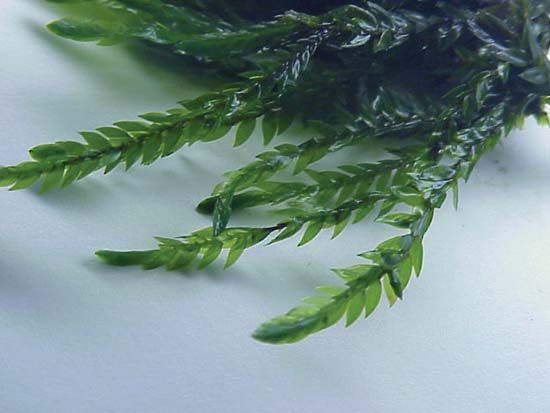
Water moss refers to a genus of mosses known as Fontinalis, which typically inhabit flowing freshwater streams and ponds throughout temperate regions. While the term can sometimes describe various aquatic plants, such as algae or liverworts that resemble moss in appearance, it most specifically identifies the Fontinalis genus.12
Of the 20 known species, 18 are native to North America. These plants are usually anchored to submerged objects like stones or tree roots. A notable species, F. antipyretica, features long, slender branches adorned with glossy, yellowish-green or dark green leaves arranged in three ranks. These shoots can grow quite long, typically reaching 30 to 100 cm, though they may occasionally grow up to 200 cm. In these plants, male and female reproductive organs are found on separate individuals.1
How do bryophytes differ from algae?
While bryophytes are believed to have evolved from ancestral green algae, they differ significantly in their biological complexity and habitat adaptations.
Key differences include:
- Reproductive Structures: Bryophytes possess multicellular reproductive structures, such as archegonia and antheridia, which protect and nourish the developing embryo. In contrast, green algae have unicellular reproductive structures.3
- Habitat and Body Complexity: Bryophytes are primarily terrestrial plants with complex, multicellular bodies adapted for life on land. Green algae are primarily aquatic and generally exhibit less-complex forms.3
- Classification: Bryophytes are classified within the kingdom Plantae, whereas algae are placed in the kingdom Protista because they lack certain features characteristic of true plants](https://www.britannica.com/science/protist) because they lack certain features characteristic of true plants.4
- Life Cycle: Bryophytes exhibit a well-defined alternation of generations where the gametophyte is the dominant, independent, and photosynthetic phase.3
Although both groups share traits like motile sperm, similar photosynthetic pigments, and a general absence of vascular tissue, these distinctions highlight the evolutionary transition of bryophytes to terrestrial environments.3
What animals rely on water moss for shelter?
The provided search results do not contain specific information regarding which animals rely on water moss (Fontinalis) for shelter. While the articles explain that water mosses grow in flowing freshwater streams and ponds and that bryophytes generally contribute to the development of wetland habitats and nutrient cycling, they do not list the specific fauna that utilize these plants for protection or habitat.
Sorry, the Britannica knowledge base does not contain this information.
How does water moss adapt to living in flowing water?
Water moss (Fontinalis) is a genus of mosses specifically adapted to thrive in flowing freshwater environments, such as streams and ponds. Its survival in these habitats relies on several key strategies:1
- Anchorage: The primary challenge for organisms in flowing water is the risk of being washed away. Water moss addresses this by attaching itself firmly to stable substrates, such as stones or tree roots. This ability to anchor is a common evolutionary mechanism for plants living in currents, ensuring they remain in a nutrient-rich environment.17
- Morphological Structure: Water mosses can grow quite long, with shoots reaching 30 to 100 cm (and occasionally up to 200 cm) in length. This slender, elongated form allows the plant to sway with the water current, reducing drag and preventing structural damage from the force of the flow.1
- Environmental Advantages: By successfully anchoring in flowing water, water moss gains access to a continuous supply of nutrients and well-oxygenated water, which are constantly replenished by the current. Furthermore, the precarious nature of these fast-moving habitats provides a degree of protection from predation, as the number of predators capable of inhabiting such environments is limited.7
Sources
- water moss — Encyclopædia Britannica
- water moss — Merriam-Webster
- Plant - Definition of the category — Encyclopædia Britannica
- Plant - Definition of the kingdom — Encyclopædia Britannica
- moss — Encyclopædia Britannica
- bryophyte - Ecology and habitats — Encyclopædia Britannica
- Biosphere - Water currents — Encyclopædia Britannica
Published on · 3 min read