Fern Moss
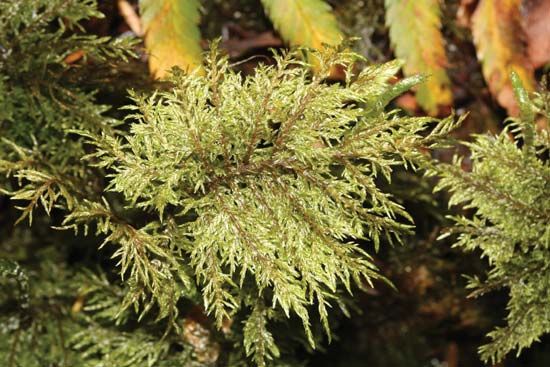
Fern moss refers to any of the approximately 73 species within the genus Thuidium (subclass Bryidae). These plants are characterized by their fernlike…
What is Fern moss?
Fern moss refers to any of the approximately 73 species within the genus Thuidium (subclass Bryidae). These plants are characterized by their fernlike branches and are commonly found forming mats in grassy areas, as well as on soil, rocks, logs, and the bases of trees throughout the Northern Hemisphere.1
While they are distinct from true ferns, which are vascular plants, fern mosses are bryophytes that reproduce via spores held in curved, cylindrical capsules that typically mature in late summer or autumn. Fewer than 10 of these species are native to North America. It is worth noting that the term “fernlike” is also used to describe other mosses, such as the stair-step moss (Hylocomium splendens), which is common on coniferous forest floors.12
How do mosses differ from ferns?
Mosses and ferns differ fundamentally in their biological structure and life cycles. The primary distinctions include:
Vascular Tissue
- Mosses: Classified as bryophytes, mosses are nonvascular plants. They lack specialized xylem and phloem for conducting water and nutrients, which limits their size and necessitates growth in moist environments.56
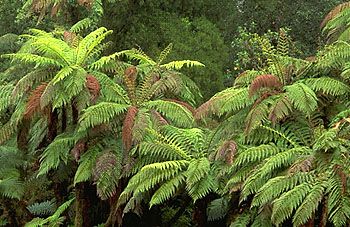
- Ferns: These are vascular plants (tracheophytes) equipped with vascular tissue. This allows them to transport water and nutrients efficiently, supporting the development of true roots, stems, and leaves, and enabling them to grow much larger than mosses.78
Dominant Life Cycle Phase
- Mosses: The dominant, long-lived, and photosynthetic phase is the gametophyte. The sporophyte is dependent on the gametophyte for nutrients and water.56
- Ferns: The dominant, conspicuous phase is the sporophyte. The gametophyte is typically small, ephemeral, and independent.79
Reproduction
While both groups rely on water for the transport of motile, flagellated sperm to achieve fertilization, they differ in their structural complexity. Ferns possess complex vascularized organs, whereas mosses rely on simpler structures like rhizoids for anchorage and water uptake.576
What role do mosses play in soil formation?
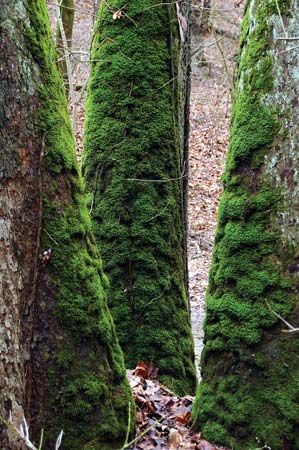
Mosses play a vital role in soil formation by acting as pioneer species that colonize bare rock surfaces. Through their growth and eventual decomposition, they break down these exposed substrata, which releases essential nutrients into the environment.211
This process is a key component of ecological succession, specifically in primary succession where life begins in essentially lifeless areas like volcanic lava flows or rocks left by retreating glaciers. As mosses establish themselves, they create the initial layers of soil, which then provide a suitable substratum for more complex seed plants to colonize. Once these larger plants take root, they often shade out the pioneer mosses, but the mosses’ contribution to nutrient cycling remains fundamental to the development of the forest vegetation that follows. Additionally, by providing surface cover and absorbing water, mosses help control soil erosion.13211
How do bryophytes reproduce without seeds?
Bryophytes—which include mosses, liverworts, and hornworts—reproduce through a process known as alternation of generations, which involves both sexual and asexual methods.
Sexual Reproduction
The life cycle alternates between two distinct phases:
- Gametophyte: This is the dominant, independent, and photosynthetic phase. It produces male sex organs called antheridia and female sex organs called archegonia.
- Fertilization: When the environment is moist, the antheridia release flagellated sperm that swim to the archegonia to fertilize the egg.
- Sporophyte: The resulting zygote develops into a sporophyte, which remains attached to and dependent on the gametophyte. The sporophyte produces spores within a sporangium. When released, these spores germinate to form a protonema, which eventually grows into a new gametophyte.514119
Asexual Reproduction
Bryophytes can also reproduce vegetatively, allowing them to spread without fertilization:
Sources
- fern moss — Encyclopædia Britannica
- bryophyte - Ecology and habitats — Encyclopædia Britannica
- houseplant - Ferns — Encyclopædia Britannica
- stair-step moss — Encyclopædia Britannica
- bryophyte — Encyclopædia Britannica
- Plant - Definition of the category — Encyclopædia Britannica
- lower vascular plant - Vascular system — Encyclopædia Britannica
- Plant reproductive system - Variations in reproductive cycles — Encyclopædia Britannica
- Plant - Definition of the category — Encyclopædia Britannica
- Fern - Ecology — Encyclopædia Britannica
- moss — Encyclopædia Britannica
- Plant reproductive system - Mosses — Encyclopædia Britannica
- ecological succession: Top Questions — Encyclopædia Britannica
- bryophyte - Reproduction and life cycle — Encyclopædia Britannica
- Gametophyte — Encyclopædia Britannica
Published on · 3 min read