Water Scarcity Facts and Statistics
Water scarcity occurs when available freshwater resources are insufficient to meet human and environmental demands. While Earth is abundant in water, only…
What is Water Scarcity Facts and Statistics?
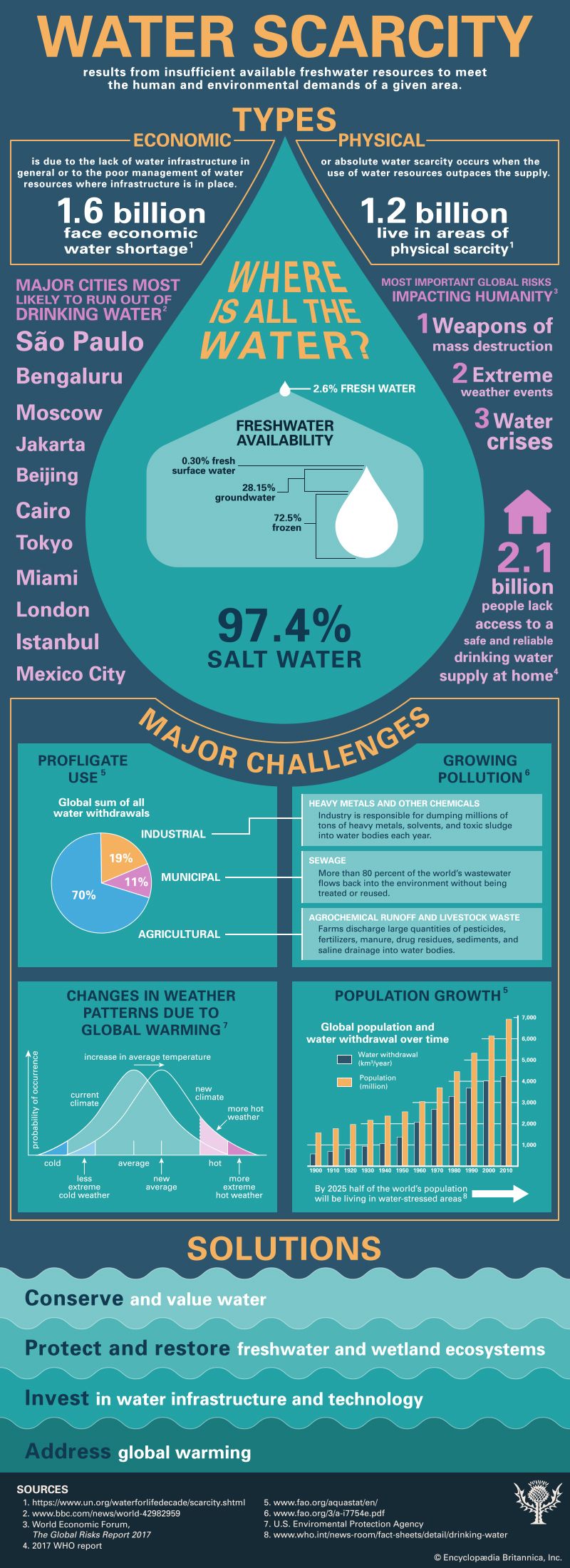
Water scarcity occurs when available freshwater resources are insufficient to meet human and environmental demands. While Earth is abundant in water, only 2.6 percent is fresh, and much of that is inaccessible as ice or deep groundwater.12
Types of Scarcity
- Physical (Absolute): Occurs when demand outpaces supply. Approximately 1.2 billion people live in these areas.23
- Economic: Results from poor management or lack of infrastructure. An estimated 1.6 billion people face this shortage, where water exists but is inaccessible or unsanitary.23
Key Statistics
- Access: 2.1 billion people lack access to safe, reliable drinking water at home.24
- Usage: Agriculture accounts for 70 percent of global water withdrawals, followed by industry (19 percent) and municipal use (11 percent).2
- Pollution: Over 80 percent of global wastewater is released into the environment untreated.2
- Future Outlook: By 2025, half of the world’s population is projected to live in water-stressed areas.2
Water crises are considered a top global risk, threatening human health and stability. Ensuring equitable access to safe water is a fundamental human rights priority.251
What are some ways to conserve water at home?
Conserving water at home is an essential practice for reducing demand on municipal systems and addressing the global challenge of water scarcity. Here are effective ways to reduce your household water footprint:
- Install Aerators: You can easily install faucet aerators and aerating showerheads to cut water usage—particularly hot water—by as much as 50%.7
- Implement Rainwater Harvesting: Using rainwater harvesting systems, such as rain barrels, allows you to collect and store water for nonpotable tasks. This captured water is ideal for irrigating landscaping, washing cars, flushing toilets, or laundering clothes, which significantly reduces the demand for treated potable water.8
- Maintain Systems: If you use a harvesting system, ensure gutters and screens are kept clean of debris like moss and leaves. Regularly inspecting your tanks and ensuring all openings are insect-proof helps maintain water quality and system efficiency.8
By adopting these technologies and habits, households can play a vital role in preserving precious freshwater resources can play a vital role in preserving precious freshwater resources.8
How does agriculture use the most water compared to other industries?
Agriculture is the largest consumer of global freshwater, accounting for approximately 70 percent of all available freshwater resources. This high level of consumption is primarily driven by the necessity of irrigation to sustain crop production, particularly in arid and semi-arid regions where natural rainfall is insufficient.9101112
The dominance of agriculture in water usage compared to other industries stems from several factors:
- Scale of Demand: To maintain productivity, crops require significant volumes of water. For instance, while cereal grains may require 305 to 760 mm of water annually, crops like rice can require two to three times that amount.11
- Inefficient Delivery Methods: Many agricultural regions still rely on surface irrigation, or simple flooding. This method often inundates fields with more water than crops actually require, leading to substantial losses through evaporation and seepage during transport from the water source.910
- Expansion Needs: Expanding irrigation is considered an absolute necessity to increase crop acreage and meet the food demands of a growing global population, further driving the total volume of water withdrawn for farming.12
While other sectors use water for municipal or industrial purposes, the sheer geographic scale and the biological requirements of farming make it the most water-intensive industry globally ](https://www.britannica.com/topic/agriculture) make it the most water-intensive industry globally.10
What is the difference between surface water and groundwater?
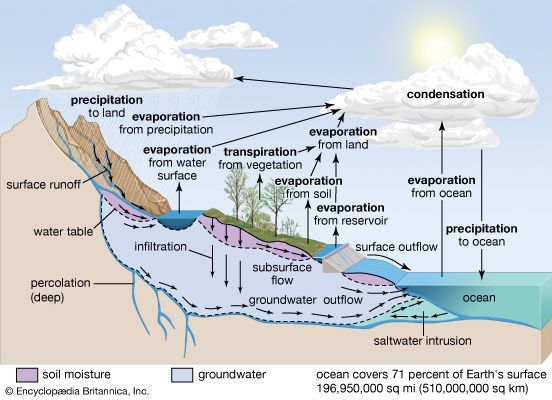
Surface water and groundwater are both essential components of the hydrologic cycle, yet they differ primarily in their location and movement.1314
Surface Water
Surface water is water found on the Earth’s exterior in bodies such as oceans, lakes, rivers, and streams. It is essentially the residue of precipitation and melted snow that does not evaporate or soak into the ground, often referred to as runoff. Because it is exposed to the atmosphere and flows over land, it frequently picks up soil particles, organic matter, and pollutants from human activities.131415
Groundwater
Groundwater, or subsurface water, is water that has infiltrated the Earth’s surface and occupies the void spaces within soils or geologic strata. It collects in underground layers known as aquifers. Unlike surface water, groundwater moves very slowly and is generally protected from surface contaminants, though it can acquire more dissolved minerals due to its prolonged contact with rock and soil.131415
While these two sources are distinct, they are interconnected; groundwater can emerge into streams and lakes, and surface water can infiltrate the ground to replenish aquifers.1416
Sources
- water scarcity — Encyclopædia Britannica
- Water Scarcity Facts and Statistics — Encyclopædia Britannica
- water scarcity - Mechanisms — Encyclopædia Britannica
- Global warming - Socioeconomic consequences of global warming — Encyclopædia Britannica
- water purification - Determining water quality — Encyclopædia Britannica
- water scarcity - Effects — Encyclopædia Britannica
- Did you know? — Merriam-Webster
- rainwater harvesting system — Encyclopædia Britannica
- Irrigation - Water supply — Encyclopædia Britannica
- Sustainable agriculture — Encyclopædia Britannica
- Origins of agriculture - Irrigation — Encyclopædia Britannica
- water scarcity - Engineering technologies — Encyclopædia Britannica
- groundwater — Encyclopædia Britannica
- surface water — Merriam-Webster
- water supply system - The hydrologic cycle — Encyclopædia Britannica
- water supply system - Drinking-water quality — Encyclopædia Britannica
- hydrosphere - Groundwaters and river runoff — Encyclopædia Britannica
Published on · 4 min read