Weka
The weka (Gallirallus australis) is a flightless, nonmigratory bird belonging to the rail family (Rallidae) that is endemic to New Zealand. Roughly the size…
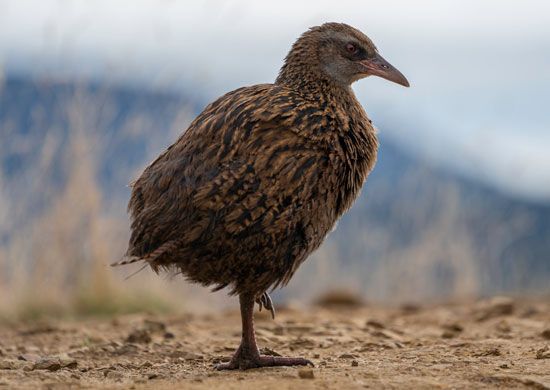
What is a weka?
The weka (Gallirallus australis) is a flightless, nonmigratory bird belonging to the rail family (Rallidae) that is endemic to New Zealand. Roughly the size of a chicken, this omnivorous species is known for its curious, feisty nature and its tendency to steal food and small objects.1
Weka inhabit diverse environments, including forests, wetlands, and suburban areas. While they cannot fly, they are strong swimmers and capable of walking long distances. The species is divided into four subspecies, all of which share characteristics such as red eyes, reduced wings, and a broad, pointed bill.1
Since 2000, the International Union for Conservation of Nature and Natural Resources (IUCN) has classified the weka as a vulnerable species due to threats like habitat loss, invasive species, and hunting. Conservation efforts, including captive breeding programs, are currently underway to help restore their populations.1
Where are weka birds found?
Weka birds are endemic to New Zealand, where they inhabit more than 70 islands. They are found in a variety of moist environments, including forests, wetlands, marine intertidal areas, shrublands, grasslands, farmlands, and suburban areas.2
The distribution of the four recognized subspecies is as follows:
- North Island weka (Gallirallus australis greyi): Inhabits the eastern side of the North Island.2
- Western weka (G. australis australis): Found in the northern and western parts of the South Island.2
- Buff weka (G. australis hectori): Located on the Chatham and Pitt islands.2
- Stewart Island weka (G. australis scotti): Inhabits Stewart Island and smaller nearby islands.2
Conservation efforts, including captive breeding programs, have also involved introducing weka to various mainland and island sites to reinforce existing populations or establish new ones.2
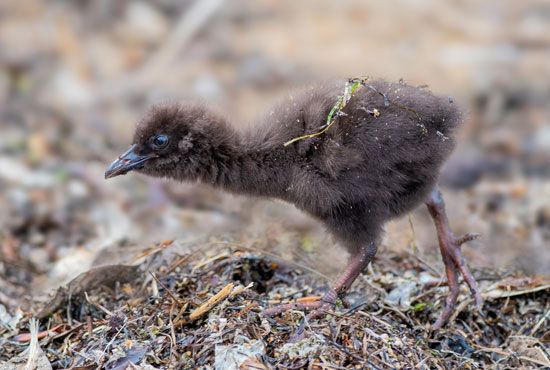
What does a weka look like?
The weka (Gallirallus australis) is a flightless bird roughly the size of a chicken. Its physical appearance is defined by several key characteristics:
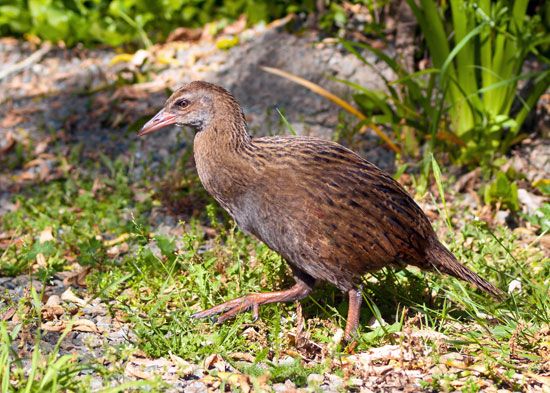
- Plumage: The bird typically features brown feathers with black streaks, though the exact coloration varies by subspecies. For instance, the western weka is known for having nearly black plumage.2
- Size: Adults generally measure between 46 and 60 cm (18.1 to 23.6 inches) in length. They typically weigh between 0.43 and 1.4 kg (0.95 to 3.1 pounds), with males averaging about 1 kg (2.2 pounds) and females about 0.7 kg (1.5 pounds).2
- Distinctive Features: Regardless of subspecies, all adult weka possess red eyes, reduced wings, and a broad, pointed bill.2
Because they are flightless, their anatomy is adapted for walking long distances and swimming, rather than aerial travel.2
What do weka birds eat?
Weka are omnivorous birds with a diverse diet that includes both plant and animal matter. Their food sources consist of:
- Plant material: They consume a variety of grasses, leaves, berries, and seeds.2
- Invertebrates: Their diet includes earthworms, beetles, and snails.2
- Vertebrates: They eat small lizards, rodents, smaller birds, and the eggs of ground-nesting birds.2
- Carrion: They also scavenge for dead animal matter.2
Known for their curious and feisty nature, weka are also notorious for stealing human food and crops. As they forage, they act as important seed dispersers, capable of spreading seeds that are too large for smaller birds to consume.2
Sources
- weka — Merriam-Webster
- Weka — Encyclopædia Britannica
- New Zealand - Plant and animal life — Encyclopædia Britannica
Published on · 3 min read