What Is a Mega Penguin?
The term "mega penguin" refers to a group of giant, extinct penguins that significantly exceeded the size of any living species. While the term is used…
What Is a Mega Penguin?
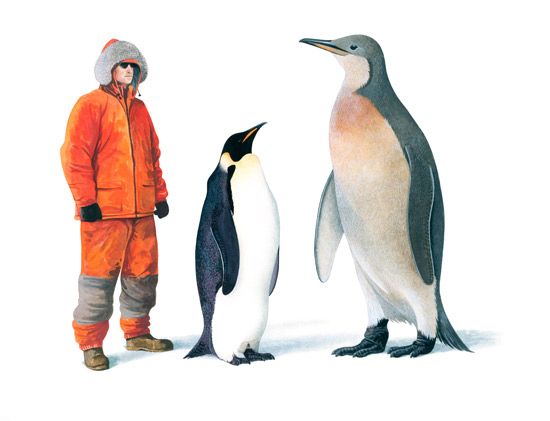
The term “mega penguin” refers to a group of giant, extinct penguins that significantly exceeded the size of any living species. While the term is used broadly to describe these prehistoric birds, it is often used as a nickname for the colossus penguin (Palaeeudyptes klekowskii), which is considered the tallest penguin ever discovered.1
These giants lived primarily during the Paleogene Period. Notable examples include:
- Palaeeudyptes klekowskii: The tallest known species, estimated to have stood about 2 meters (6.6 feet) tall.1
- Kumimanu fordycei: The heaviest identified species, weighing an estimated 148–160 kg (326–353 pounds), which is more than three times the weight of the modern emperor penguin.1
Their massive size likely provided advantages in cold environments, such as improved heat retention and the ability to dive deeper for larger prey. These birds eventually went extinct about 20 million years ago, likely due to competition and predation from toothed whales and seals.1
How do scientists estimate the size of extinct animals from only a few bones?
Scientists estimate the size of extinct animals by using the few available fossils to extrapolate dimensions based on known biological relationships. This process often relies on allometry, the study of how biological characteristics change in proportion to body size.1
Key methods include:
- Limb Bone Scaling: Paleontologists frequently use weight-bearing bones, such as the femur, to estimate total body mass. By comparing the diameter or length of these bones to those of living relatives or animals with similar body plans, researchers can calculate a probable size range.23
- Comparative Anatomy: By examining homologous structures—body parts that share an evolutionary origin—scientists can infer the proportions of an extinct animal. For instance, if a fossilized wing or foot bone is found, its size is compared to the corresponding bones in modern species to estimate the animal’s total height or weight.24
- Growth Rings: To understand the life history and maturity of a specimen, scientists count annual growth rings in long bones, similar to counting tree rings. This helps determine if a fossil represents a fully grown adult or a juvenile, which is essential for accurate size estimation.5
Estimates can vary depending on which bones are used, especially if an animal had unusual proportions, such as asymmetrical limbs.3
What are the main differences between the Paleogene Period and today’s environment?
The Paleogene Period (66 million to 23 million years ago) represents a pivotal transition in Earth’s history, marking the shift from a globally warm, reptile-dominated world to the cooler, mammalian-dominated environment we recognize today.7
Key Environmental Differences
- Climate: The Paleogene began as a warm “greenhouse” world with relatively high sea levels and an absence of major continental glaciers. Over the course of the period, the Earth transitioned toward a cooler “icehouse” phase, characterized by the development of polar glaciation and sharply differentiated climate zones.78
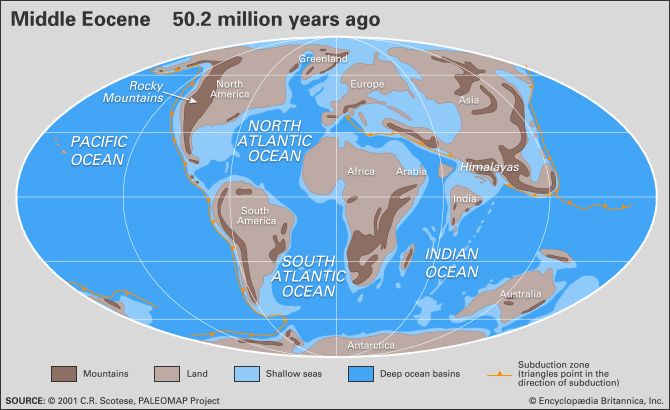
- Geography and Circulation: During the Paleogene, the fragmentation of Gondwana continued, significantly altering global ocean circulation. A critical development was the separation of Australia from Antarctica and the subsequent opening of the Drake Passage, which allowed for the formation of the Antarctic Circumpolar Current. This current thermally isolated Antarctica, contributing to the global cooling trend.9
- Biological Dominance: While the preceding era was dominated by reptiles, the Paleogene saw a dramatic evolutionary expansion of mammals, as well as flowering plants, insects, and birds, establishing the ecological foundations of the modern world.7
Why did penguins lose the ability to fly?
Penguins lost the ability to fly as they underwent evolutionary specialization for an aquatic existence. While it is widely accepted that penguins descended from flying ancestors, their wings gradually transformed into paddlelike structures optimized for swimming and rapid propulsion in water rather than flight through the air.1617
Unlike many other flightless birds that lost their flight muscles and the sternum keel, penguins retained these features. However, the keel evolved to support the powerful pectoral muscles required to move their rigid, flattened flippers. This adaptation allowed them to become highly efficient divers and swimmers, perfectly suited to the cold, nutrient-rich waters of the Southern Hemisphere.171618
The transition to flightlessness likely occurred as these birds occupied environments where flight was not necessary for survival or where other evolutionary pressures favored aquatic efficiency. By specializing in this marine niche, penguins gained the ability to exploit food sources like krill and fish while utilizing their unique body morphology to thrive in extreme temperatures.17191618
Sources
- What Is a Mega Penguin? — Encyclopædia Britannica
- tyrannosaur - Other skeletal features — Encyclopædia Britannica
- Phoberomys — Encyclopædia Britannica
- Comparative anatomy — Encyclopædia Britannica
- allometry — Encyclopædia Britannica
- evolution - Convergent and parallel evolution — Encyclopædia Britannica
- A Journey Through Time Since the Precambrian - Paleogene Period: 66 million to 23 million years ago, and Neogene Period: 23 million to 2.6 million years ago — Encyclopædia Britannica
- Cretaceous Period - Paleoclimate — Encyclopædia Britannica
- Tertiary Period - Paleogeography — Encyclopædia Britannica
- Pleistocene Epoch - Pleistocene fauna and flora — Encyclopædia Britannica
- Holocene Epoch - Faunal change — Encyclopædia Britannica
- Climate change - Phanerozoic climates — Encyclopædia Britannica
- Quaternary - Paleoclimate — Encyclopædia Britannica
- evolution of the atmosphere - Early composition — Encyclopædia Britannica
- Climate - The evolution of life and the atmosphere — Encyclopædia Britannica
- penguin - Form and function — Encyclopædia Britannica
- Flightless bird — Encyclopædia Britannica
- Why are there no penguins at the North Pole? — Encyclopædia Britannica
- penguin - Fossil record — Encyclopædia Britannica
- Bird - Flightlessness — Encyclopædia Britannica
Published on · 3 min read