Why Is the Platypus a Mammal?
The platypus is classified as a mammal because it possesses the defining characteristics of the class Mammalia, most notably the production of milk to…
Why Is the Platypus a Mammal?
The platypus is classified as a mammal because it possesses the defining characteristics of the class Mammalia, most notably the production of milk to nourish its young. While female platypuses lack teats and instead secrete milk through specialized mammary hairs, this method of lactation remains a fundamental mammalian trait.123
As a member of the order Monotremata, the platypus represents an ancient evolutionary branch that diverged from other mammals approximately 166 million years ago. Because of this early separation, it retains primitive features—such as laying eggs and having a lower body temperature—that reflect the common evolutionary origin of mammals in reptiles reflect the common evolutionary origin of mammals in reptiles.32
Despite these differences from placental mammals and marsupials, the platypus is definitively a mammal, sharing the class’s core biological requirements and evolutionary history. Its unique physiology provides scientists with valuable insights into the early development of mammalian traits.2
What are the main differences between monotremes, marsupials, and placental mammals?
The primary differences between monotremes, marsupials, and placental mammals lie in their reproductive strategies and the development of their young.2
Reproductive Differences
- Monotremes: These are the only mammals that lay shelled, yolk-rich eggs rather than giving birth to live young. Upon hatching, the young are in an early, altricial state of development and rely on milk secreted from mammary hairs, as these mammals lack teats.245
- Marsupials: These mammals are viviparous but give birth to incompletely developed young after a short gestation period. The newborns must migrate to the mother’s body to attach to teats for further development, often within a pouch called the marsupium.24
- Placental Mammals: These mammals utilize a placenta to facilitate the exchange of nutrients and waste between the mother and the developing fetus. This allows the young to reach a more advanced stage of development within the womb before birth.25
While these groups differ in how they bring forth their young, they all share fundamental mammalian characteristics, including the nourishment of offspring with milk, the presence of hair, and specific skeletal features like the structure of the middle ear and jaw.25
How do echidnas compare to platypuses as the only other living monotremes?
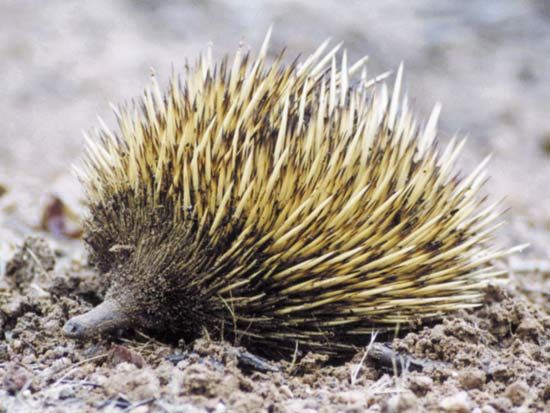
The platypus and echidnas are the only living members of the order Monotremata, an ancient group of mammals that lay eggs. While they share common traits—such as electroreception and a single opening for reproduction and excretion—they have evolved to occupy distinct ecological niches.6
Key Differences
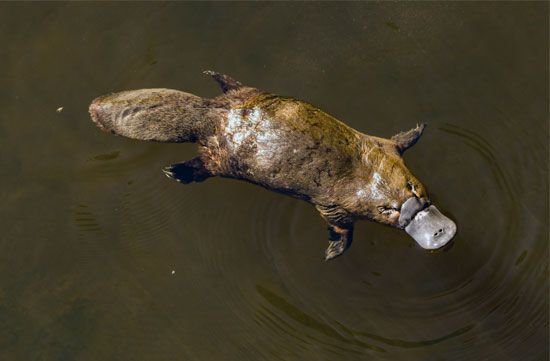
- Habitat and Lifestyle: The platypus is a semiaquatic carnivore found in Australian and Tasmanian waterways. In contrast, echidnas are land-dwelling insectivores found across Australia, Tasmania, and New Guinea, where they utilize burrows or caves for shelter.67
- Physical Features: The platypus possesses a duck-like bill for foraging on riverbeds. Echidnas have tubular beaks—ranging from short to long depending on the species—adapted for probing soil or leaf litter for insects. Additionally, echidnas are covered in spines, a defense mechanism absent in the platypus.67
- Feeding: While both are insectivores, the platypus uses its bill to find invertebrates in water. Echidnas use long, sticky tongues to capture prey like ants and termites, sometimes breaking larger victims with their beaks.67
Both animals maintain an unusually low body temperature and are highly sensitive to extreme heat.7
What is convergent evolution and how does it explain the platypus’s venom?
Convergent evolution is an evolutionary process in which unrelated species, living in similar environments or facing similar selective pressures, independently develop comparable morphological, physiological, or behavioral traits. Because these species do not share a recent common ancestor that possessed the trait, the similarity is a result of natural selection favoring the same functional solution to an ecological challenge.3
This concept explains the platypus’s venom, which is often mistakenly compared to that of venomous reptiles due to their shared ancestral roots. While the platypus and reptiles both descend from a common reptilian ancestor, the platypus’s ability to produce venom is an instance of convergent evolution. The platypus developed this trait independently as an adaptive mechanism for defense, utilizing a fanglike spur on its ankle to deliver toxins.89
Although the platypus’s venom serves a similar defensive function to the venom found in other animals, it evolved separately from the venomous systems seen in snakes, spiders, or scorpions.810
Sources
- platypus — Encyclopædia Britannica
- mammal — Encyclopædia Britannica
- Why Is the Platypus a Mammal? — Encyclopædia Britannica
- mammal - Estrus and other cycles — Encyclopædia Britannica
- mammal - Implantation, gestation, and birth — Encyclopædia Britannica
- What is a platypus’s closest living relative? — Encyclopædia Britannica
- echidna — Encyclopædia Britannica
- What’s the Difference Between Venomous and Poisonous? — Encyclopædia Britannica
- community ecology - Convergence — Encyclopædia Britannica
- scorpion - Venoms — Encyclopædia Britannica
- Venom — Encyclopædia Britannica
Published on · 3 min read