Worm Snake
The term worm snake refers to various harmless, burrowing snakes that possess a wormlike appearance. While the name is frequently applied to blind snakes…
What is worm snake?
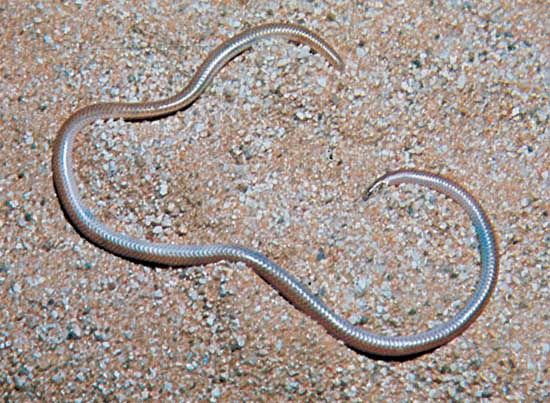
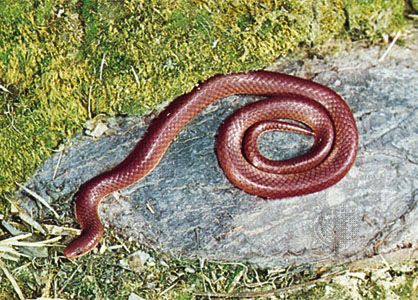
The term worm snake refers to various harmless, burrowing snakes that possess a wormlike appearance. While the name is frequently applied to blind snakes within the family Typhlopidae, it most specifically identifies the American worm snake (Carphophis amoena), a small member of the family Colubridae found in the eastern United States.12
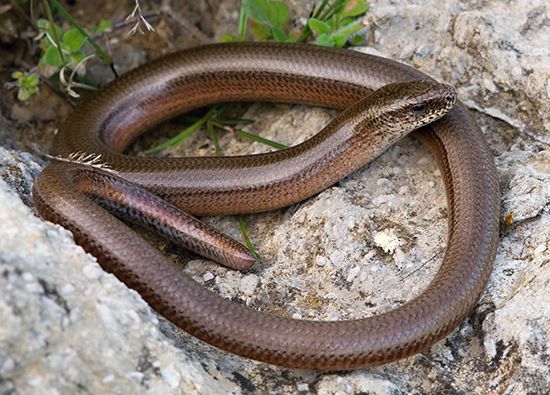
These snakes are typically dark brown or blackish on their dorsal side with a distinct pink or pinkish-red belly. Adults of the American species are generally small, measuring less than 25 cm (10 inches) in length. Additionally, the genus Trachischium, known as the Oriental worm snakes, shares a similar physical resemblance to the American species. It is important to distinguish these true snakes from the slowworm, which is actually a legless lizard rather than a snake.123
What are the main differences between snakes and legless lizards?
While snakes are technically a specialized group of limbless lizards within the order Squamata, they are distinct from other legless lizards due to several key anatomical features.43
The primary differences include:
- Eyelids: Most lizards, including legless varieties like the slowworm, possess movable eyelids. In contrast, snakes lack movable eyelids, which gives them their characteristic, fixed stare.453
- Ear Openings: Snakes do not have external ear openings. Many legless lizards, such as the slowworm, retain these openings.453
- Internal Anatomy: Snakes have undergone significant structural simplification. They lack a urinary bladder, and their internal organs are elongated, often with a reduced or absent left lung.3
- Evolutionary Specializations: Snakes have developed unique traits not found in other lizards, such as a tracheal lung and, in many species, a venom-conducting system for subduing prey.3
While both groups may use similar methods of movement—such as serpentine locomotion—it is important to remember that not all limbless reptiles are snakes; some lizards have simply experienced limb degeneration over time.463
What do worm snakes typically eat in their natural habitat?
The provided search results do not contain specific information regarding the diet of the American worm snake (Carphophis amoena) or the Oriental worm snakes (Trachischium). While the information provided details the diet of the slowworm—which consists of snails, slugs, and earthworms—this is a distinct species of legless lizard and should not be confused with the worm snakes mentioned in your query.13
Because the Britannica knowledge base does not currently provide the dietary habits for the specific snakes you inquired about, I cannot answer this part of your request.
How do burrowing snakes adapt to living underground?
Burrowing (fossorial) snakes have evolved a suite of specialized physical and behavioral adaptations that allow them to thrive in subterranean environments, often living their entire lives underground like earthworms.8
Physical Adaptations
- Body Shape: Burrowing snakes are typically small and slender with cylindrical bodies, which facilitates movement through soil. They possess smooth, shiny scales that reduce friction as they navigate through tight spaces.8910
- Reduced Appendages and Features: True burrowers often have almost no tail, though some retain a spiny tail tip that acts as an anchor point when moving through soil. Their eyes are significantly reduced, often appearing only as small, dark spots covered by scales or flesh, as vision is of limited use underground.811910
- Skull Structure: To navigate dense substrates, these snakes often have a flattened head with a snout that extends beyond the mouth. Some species utilize specialized skull movements, such as “snout-shifting,” to maneuver through their environment.1211
Locomotion and Behavior
Burrowing is generally achieved through axial movement, where the snake uses its head to compact soil against the tunnel walls. Common patterns include driving the snout forward and raising the head to compress soil, or using side-to-side motions to shave and shape the tunnel. Because movement is restricted in narrow tunnels, some species, such as the burrowing asp, have adapted to strike sideways or backwards with elongated fangs while their mouths remain essentially closed.129
Sources
- worm snake — Encyclopædia Britannica
- worm snake — Merriam-Webster
- slowworm — Encyclopædia Britannica
- lizard — Encyclopædia Britannica
- 7 Questions About Lizards, Snakes, and Other Reptiles Answered — Encyclopædia Britannica
- Locomotion - Crawling — Encyclopædia Britannica
- snake — Encyclopædia Britannica
- snake - Form and function — Encyclopædia Britannica
- snake - Skull and sense organs — Encyclopædia Britannica
- burrowing asp — Encyclopædia Britannica
- Burrowing — Encyclopædia Britannica
- Locomotion - Fossorial vertebrates — Encyclopædia Britannica
- reptile - Chemoreception — Encyclopædia Britannica
Published on · 3 min read