Yucatán Current
The Yucatán Current is an oceanic surface current that serves as the western limb of a clockwise gyre in the eastern Gulf of Mexico. It originates near…
What is Yucatán Current?
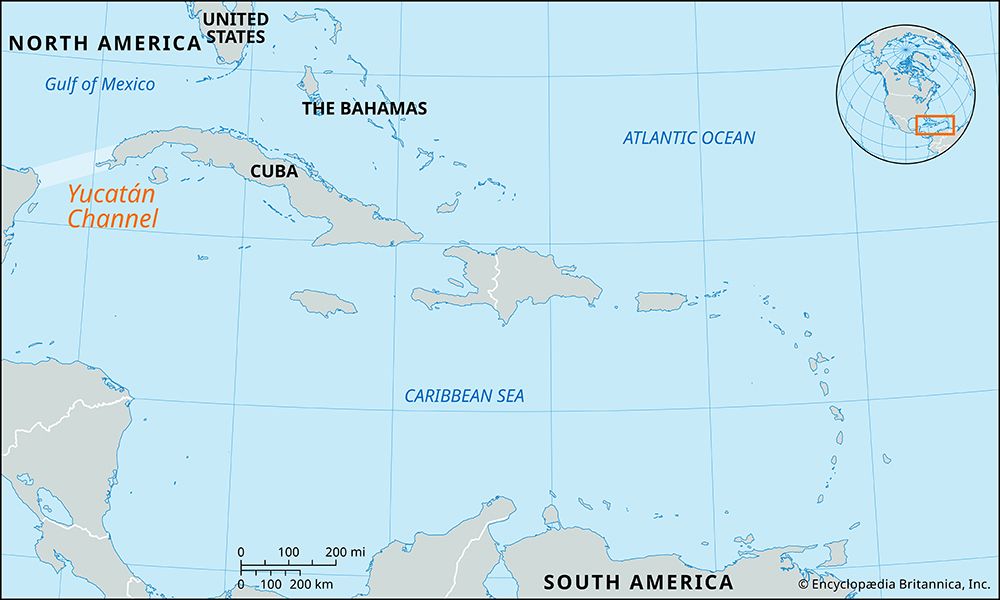
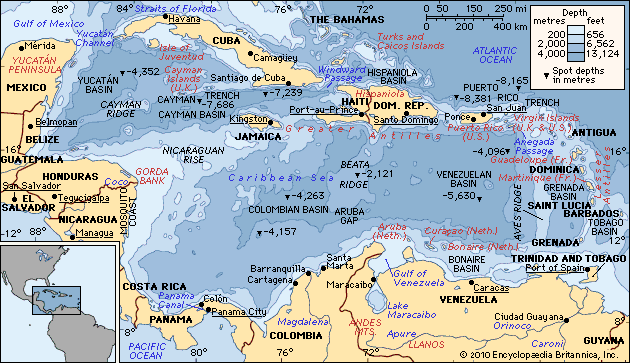
The Yucatán Current is an oceanic surface current that serves as the western limb of a clockwise gyre in the eastern Gulf of Mexico. It originates near northern Honduras and flows through the Yucatán Channel, reaching the central eastern portion of the Gulf. This current is most intense during the summer months.1
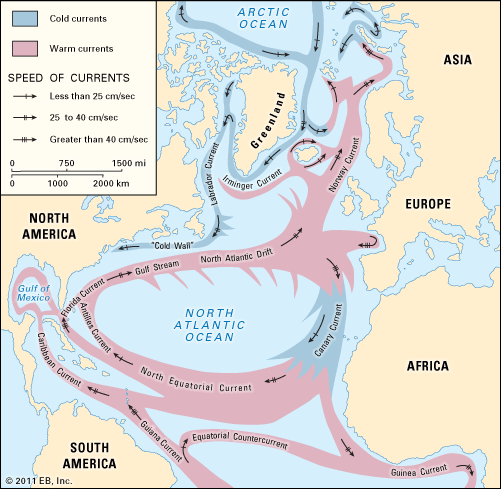
As a primary component of the region’s hydrology, the Yucatán Current acts as the main source for the Gulf Stream, facilitating the movement of water from the Caribbean Sea into the Gulf of Mexico. The water eventually exits the Gulf in a clockwise direction through the Straits of Florida. While the current is a dominant feature, the Gulf also experiences complex “loop currents” that break off from the main stream and fluctuate based on seasonal and annual conditions.23
What is the Gulf Stream and why is it important?
The Gulf Stream is a powerful, warm ocean current that flows northeastward along the eastern coast of North America before extending into the North Atlantic Ocean. It is a vital component of the Atlantic Meridional Overturning Circulation (AMOC), a system of surface and deep currents that regulates global heat distribution.456
Why the Gulf Stream is Important
- Climate Regulation: The Gulf Stream plays a critical role in moderating the climate of northwestern Europe. By transporting warm, saline tropical waters toward higher latitudes, it significantly raises winter temperatures in regions like Norway and the British Isles, making them much milder than other areas at similar latitudes.57
- Marine Productivity: The current’s interaction with colder waters creates turbulence and brings nutrient-rich salts to the surface. These conditions have historically supported some of the most productive commercial fishing grounds in the world, such as the Grand Banks of Newfoundland.5
- Global Circulation: As part of the AMOC, the Gulf Stream helps drive the global thermohaline circulation. This process is essential for moving heat around the planet and sequestering carbon dioxide from the atmosphere.6
How do loop currents affect the Gulf of Mexico?
Loop currents are meandering masses of water that break off from the main current system in the Gulf of Mexico. These currents move in a clockwise direction into the northeastern part of the gulf.2
Their influence on the region includes:
- Hydrological Variation: Loop currents are not static; they exhibit both seasonal and annual variations in their intensity and path.2
- Circulation Patterns: They represent a significant component of the gulf’s complex circulation, distinct from the relatively weaker and less defined current patterns found in the western portion of the gulf.2
- Interaction with Main Currents: These meanders originate from the principal current that enters through the Yucatán Channel and eventually exits via the Straits of Florida, serving as a primary source for the Gulf Stream primary source for the Gulf Stream.2
What is an oceanic gyre?
An oceanic gyre is a vast, circular system of ocean currents that spirals around a central point. These systems are primarily driven by wind patterns and the Coriolis force, which deflects moving water due to the Earth’s rotation.4910
There are two main types of gyres:
- Subtropical Gyres: These large, circular systems ring subtropical high-pressure areas. In the Northern Hemisphere, they rotate clockwise, while in the Southern Hemisphere, they rotate counterclockwise. Because they draw in and trap floating debris, these gyres are known for accumulating significant amounts of plastic pollution, such as the well-known Great Pacific Garbage Patch.410111213
- Subpolar Gyres: These systems enclose areas of low atmospheric pressure. They are characterized by cyclonic circulation, which causes surface water to diverge and leads to the upwelling of deeper waters.414
Gyres are fundamental to the Earth’s climate, as they help regulate the distribution of heat across the planet’s oceans.914
Sources
- Yucatán Current — Encyclopædia Britannica
- Gulf of Mexico / Gulf of America - Hydrology — Encyclopædia Britannica
- Yucatán Channel — Encyclopædia Britannica
- Climate - The Gulf Stream — Encyclopædia Britannica
- Gulf Stream — Encyclopædia Britannica
- Atlantic Meridional Overturning Circulation — Encyclopædia Britannica
- Europe - Air pressure belts — Encyclopædia Britannica
- electricity - Behaviour of an AC circuit — Encyclopædia Britannica
- gyre — Encyclopædia Britannica
- subpolar gyre — Encyclopædia Britannica
- ocean current - Coriolis effect — Encyclopædia Britannica
- plastic pollution - Plastic pollution in oceans and on land — Encyclopædia Britannica
- ocean current - Geostrophic currents — Encyclopædia Britannica
- Great Pacific Garbage Patch — Encyclopædia Britannica
Published on · 3 min read