Zorapteran
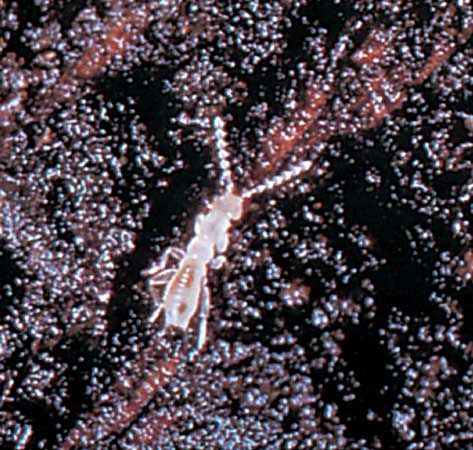
A zorapteran is a member of the insect order Zoraptera, a small group consisting of approximately 30 species found on every continent except Europe.
What is zorapteran?
A zorapteran is a member of the insect order Zoraptera, a small group consisting of approximately 30 species found on every continent except Europe.1
These insects are minute, typically measuring less than 3 mm (1/8 inch) in length. They possess chewing mouthparts and nine-segmented antennae. While most species are blind and wingless, some individuals feature eyes and two pairs of sparsely veined, membranous wings.1
Zorapterans are primarily terrestrial and inhabit colonies beneath the bark of rotting trees or within humus. Despite living in these groups, they do not exhibit social organization. Their diet consists of fungal spores and other arthropods, and they are considered to be of little economic importance. The order is characterized by its inclusion in a single genus, Zorotypus.12
What are some other types of tiny insects?
Many insects are remarkably small, with the majority measuring less than 6 mm (0.2 inch) in length. Beyond the zorapterans, several other groups are notable for their minute size:3
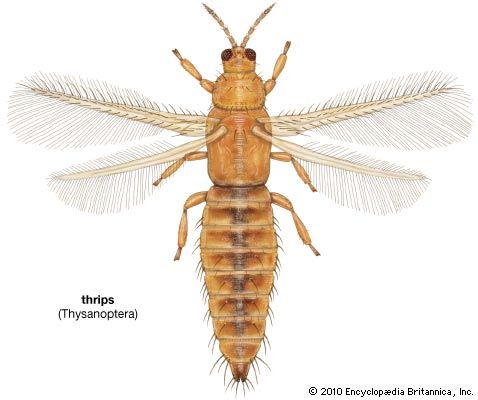
- Thrips (order Thysanoptera): These are among the smallest winged insects, typically ranging from 1.5 to 3 mm (0.06 to 0.12 inch) in length, though some can be as small as 0.6 mm (0.02 inch). Their name refers to their narrow, fringed wings.4
- Feather-winged beetles (family Ptiliidae): These beetles are among the smallest known arthropods, with some species measuring less than 0.25 mm (0.01 inch) in length.53
- Parasitic wasps: Certain species of parasitic wasps are nearly microscopic, rivaling the smallest beetles in their diminutive scale.53
- Psocids (order Psocoptera): Often referred to as booklice, these are small or minute insects that may be winged or wingless.6
While these insects are tiny, they often possess complex structures and specialized survival strategies, such as the use of debris for camouflage or unique feeding habits.47
How do insects adapt to living under tree bark?
Insects have evolved a variety of specialized adaptations to thrive in the confined, protected, and resource-rich environment beneath tree bark. These adaptations include physical modifications, behavioral strategies, and symbiotic relationships:
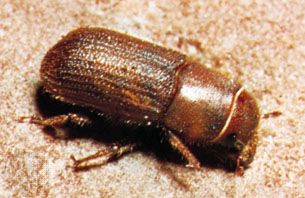
- Physical Morphology: Many insects that live under bark, such as bark beetles, possess cylindrical bodies that allow them to navigate narrow tunnels and crevices efficiently. Some species have evolved wing reduction or loss, which is often an adaptation to living in confined spaces like tunnels. Additionally, certain insects have developed specialized body colors and textures that mimic the appearance of bark, providing effective camouflage against predators.1011
- Feeding and Tunneling: Insects often exhibit specialized feeding habits, such as boring into the cambium layer or wood to access nutrients. Bark beetles, for instance, construct intricate gallery patterns for egg-laying, which serve as both a nursery and a protected habitat for their larvae.1210
- Symbiotic Relationships: Some insects have developed sophisticated partnerships with fungi. For example, certain beetles possess specialized indentations on their outer shells designed to carry fungal spores, which they inoculate into the wood as they burrow, facilitating the growth of fungi that they or their larvae then consume. Other insects, such as scale insects, form protective associations where fungi grow over their colonies, providing defense against enemies in exchange for nutrients.1314
What is the difference between social and solitary insects?
The primary distinction between social and solitary insects lies in their level of cooperation, colony structure, and reproductive organization.
Social Insects
Social insects, such as termites, ants, and certain bees and wasps, live in colonies characterized by three key traits: group integration, an overlap of generations, and a division of labour.15
- Castes: They are organized into specialized groups, such as reproductives (e.g., the queen) and steriles (workers and soldiers), each performing specific tasks like nest maintenance, foraging, or defense.15
- Communication: These societies function as “gigantic families” where individuals coordinate their actions, often using pheromones to communicate colony needs or the health of the queen.16
Solitary Insects
In contrast, solitary insects operate independently. Each female is responsible for her own survival and reproduction without the support of a colony or specialized castes.17
- Nesting: Solitary females typically build their own nests—often in soil, wood, or mud—and provision them with food, such as paralyzed prey or pollen, to sustain their developing larvae.17
- Independence: Because there is no division of labor, a solitary female must perform all tasks herself, including nest construction, egg-laying, and food gathering.17
While solitary insects lack the complex social structure of colonies, they are often the behavioral and learning equals of their social counterparts.16
Sources
- zorapteran — Encyclopædia Britannica
- Zoraptera — Merriam-Webster
- thrips — Encyclopædia Britannica
- arthropod - Size range — Encyclopædia Britannica
- Insects That Wear Things — Encyclopædia Britannica
- insect - Annotated classification — Encyclopædia Britannica
- homopteran - Habitats — Encyclopædia Britannica
- insect - Appearance and habits — Encyclopædia Britannica
- arthropod - Muscles , appendages , and locomotion — Encyclopædia Britannica
- Coleoptera - Feeding habits and habitats — Encyclopædia Britannica
- fungus - Parasitism in plants and insects — Encyclopædia Britannica
- heteropteran - Wings — Encyclopædia Britannica
- bark beetle — Encyclopædia Britannica
- Taiga - Insects — Encyclopædia Britannica
- social insect — Encyclopædia Britannica
- Animal - Social levels of organization — Encyclopædia Britannica
- insect - Insect societies — Encyclopædia Britannica
- Hymenoptera - Solitary forms — Encyclopædia Britannica
Published on · 3 min read