Biotic Potential
Biotic potential is the maximum reproductive capacity of an organism when provided with optimum environmental conditions. It represents the theoretical…
What is biotic potential?
Biotic potential is the maximum reproductive capacity of an organism when provided with optimum environmental conditions. It represents the theoretical growth rate of a population in the absence of limiting factors.1
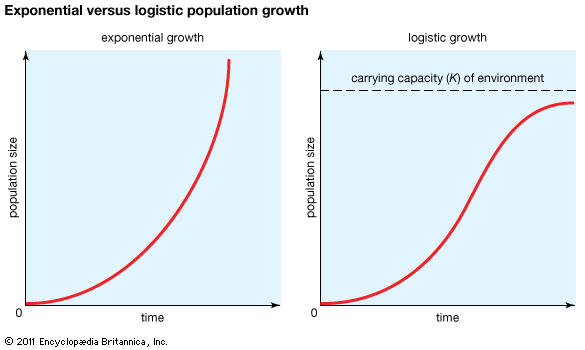
This potential is often quantified as a percentage increase per year or by the time required for a population to double in size. In mathematical models, such as the logistic growth equation, it is represented by the variable r. While r-selected species are characterized by populations governed primarily by their biotic potential, the actual growth of any population is typically restricted by environmental resistance.12
Environmental resistance includes factors that inhibit population increases, such as:
- Unfavorable climate or lack of space and light1
- Deficiencies in essential minerals or chemical compounds1
- Predation, parasitism, disease, or unfavorable genetic changes1
Essentially, while biotic potential defines the upper limit of reproductive success, environmental resistance ensures that most populations remain balanced within their ecosystem’s carrying capacity1.2
What is environmental resistance?
Environmental resistance refers to the sum of all environmental factors that restrict the biotic potential of an organism, effectively imposing a limit on its numerical increase. While organisms have the theoretical capacity to grow exponentially under ideal conditions, environmental resistance ensures that real-world populations remain within the bounds of their ecosystem.314
These limiting factors can be categorized into two primary types:
- Density-independent factors: These forces affect population size regardless of how many individuals are present in a given area. They often stem from physical or chemical phenomena, such as weather, climate, flooding, or wildfires.5
- Density-dependent factors: These forces influence population size in response to the density of the population. Examples include the spread of diseases and competition for food, water, or nesting sites, which intensify as individuals become more crowded.6
Common specific examples of environmental resistance include unfavorable climatic conditions, lack of space or light, deficiencies in essential minerals, and the pressure of predation or parasitism.1
How do r-selected and K-selected species differ?
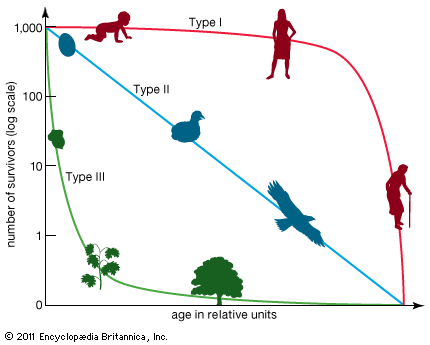
The concepts of r-selected and K-selected species represent two generalized life-history strategies proposed by ecologists Robert MacArthur and Edward O. Wilson to describe how different organisms manage reproduction and survival.27
Key Differences
Feature
r
-selected Species
K
-selected Species
Primary Driver
Biotic potential
(
r
)
Carrying capacity
(
K
)
Offspring
Numerous, small
Few, large
Maturation
Rapid
Slow
Parental Care
Little or none
Extended
Life Span
Short
Long
Habitat
Disturbed or temporary
Stable or climax communities
Strategy Overview
- r-selected species are opportunistic organisms that thrive in disturbed environments. They prioritize rapid, exponential population growth, allowing them to colonize unused resources quickly. However, their populations are often unstable and prone to rapid declines when competition increases or resources become scarce.7
- K-selected species maintain populations at or near the carrying capacity of their environment. They invest more energy into the survival of individual offspring through extended parental care and slower maturation, which allows them to compete effectively in stable, long-term biological communities.2
What is carrying capacity in an ecosystem?
Carrying capacity is defined as the average population density or size of a species that a specific habitat can sustain over the long term. It represents the threshold below which a population tends to increase and above which it tends to decrease due to limited resources, such as food, shelter, and social requirements.8
Because each species has unique biological needs, the carrying capacity is specific to that species within its environment. When a population exceeds this limit, the environment may suffer from deterioration, leading to a decline in the quality of life and potentially resulting in a population crash—a sudden, sharp reduction in numbers caused by high mortality and reproductive failure. Essentially, carrying capacity acts as a natural ceiling that prevents a population from growing indefinitely, ensuring the environment remains capable of supporting the species without undergoing degradation.891
Sources
- biotic potential — Encyclopædia Britannica
- K-selected species — Encyclopædia Britannica
- environmental resistance — Merriam-Webster
- density-independent factor — Encyclopædia Britannica
- density-dependent factor — Encyclopædia Britannica
- population ecology - Exponential and geometric population growth — Encyclopædia Britannica
- r-selected species — Encyclopædia Britannica
- carrying capacity — Encyclopædia Britannica
- Overpopulation — Encyclopædia Britannica
- carrying capacity — Merriam-Webster
Published on · 3 min read