Bolson
A bolson (from the Spanish bolsón, meaning "large purse") is a semiarid, flat-floored desert valley or depression. These landforms are typically centered on…
What is bolson?
A bolson (from the Spanish bolsón, meaning “large purse”) is a semiarid, flat-floored desert valley or depression. These landforms are typically centered on a playa or salt pan and are entirely enclosed by surrounding hills or mountains.12
As a specific type of basin, the term is primarily used to describe geographic features found in the southwestern United States and northern Mexico, where they are characteristic of basin-and-range terrain.1
What is a playa lake?
A playa lake is a temporary body of water that forms in an arid or semiarid region when a playa—a flat-bottomed depression in an interior desert basin—is inundated by water.34
These lakes are characterized by the following features:
- Formation: They occur when surface runoff collects in the lowest point of a closed basin where evaporation rates significantly exceed inflow.4
- Ephemeral Nature: Because they are located in arid environments, these lakes are temporary. The water eventually evaporates into the atmosphere or slowly infiltrates the groundwater system.4
- Sedimentation: As the water evaporates, it leaves behind deposits of salt, sand, and mud. Over time, this process helps maintain the near-perfect flatness characteristic of playa surfaces.4
- Terminology: Due to their global presence, these features are known by many local names, including salt pans, alkali flats, dry lake beds, or, in some regions, pans or clay pans.45
How does basin-and-range topography form?
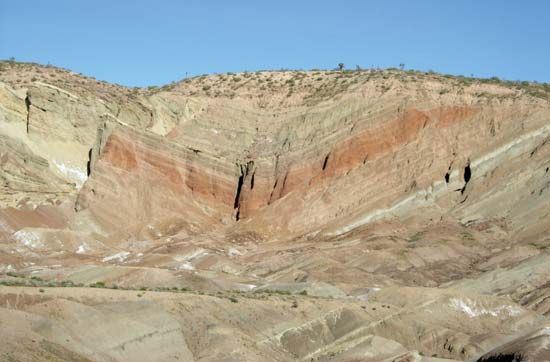
Basin-and-range topography is a distinctive landscape characterized by a series of roughly parallel mountain ranges separated by flat, sediment-filled basins. This topography is primarily the result of crustal extension, a tectonic process where the Earth’s crust is pulled apart, causing it to thin and fracture.91011
The Geological Mechanism
The formation of this landscape involves several key processes:
- Faulting: As the crust undergoes lateral tension, it breaks along steeply dipping normal faults. These faults allow blocks of the crust to shift vertically relative to one another.1211
- Horst and Graben Formation: The landscape develops as a series of horsts and grabens. The raised blocks, or horsts, form the mountain ranges, while the lowered blocks, or grabens, create the basins.1211
- Tilting and Erosion: Over time, these crustal blocks may tilt. The mountains are subjected to erosion, and the resulting debris (alluvial material) washes down into the adjacent basins, partially burying them and creating their characteristic flat floors.13149
The Basin and Range Province in the western United States is the most prominent example of this morphology, featuring an extensive network of these tectonic depressions.1311
What types of plants survive in a bolson?
A bolson is a flat-floored, semiarid desert basin surrounded by mountains, typically featuring a central playa or salt pan. Because these environments are characterized by moisture scarcity, the plants that survive there are highly specialized to endure long periods of drought.117218
Plant Survival Strategies
Vegetation in a bolson generally falls into several adaptive categories:
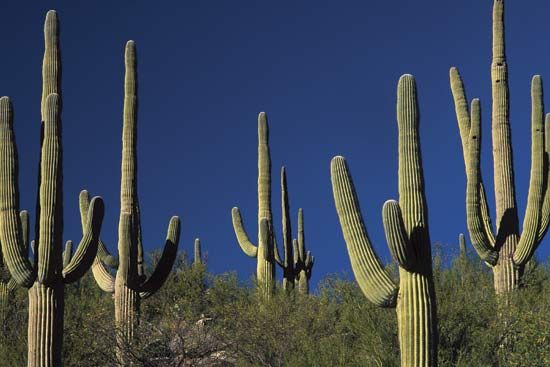
- Xerophytes: These plants are adapted to dry conditions through mechanisms such as waxy leaf coatings, hairy or reflective leaves to reduce water loss, and the ability to store water in fleshy stems or leaves (e.g., cacti and agaves).1918
- Phreatophytes: These deep-rooted plants survive by tapping into permanent groundwater supplies.18
- Ephemeral Plants: These plants survive dry periods as dormant seeds. Following infrequent rains, they germinate, grow, and reproduce rapidly before the soil moisture is depleted.2
- Perennials: Many desert perennials survive by becoming physiologically inactive during dry spells, requiring little water until triggered by rain.2
Common Vegetation
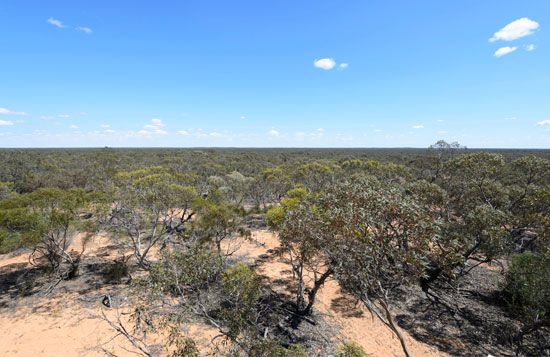
Typical plant life found in these basins includes sagebrush and saltbush, as well as various shrubs like the creosote bush and yucca. In some areas, woody plants such as mesquite may also be present.18
Sources
- bolson — Encyclopædia Britannica
- bolson — Merriam-Webster
- playa - Saline minerals — Encyclopædia Britannica
- playa lake — Merriam-Webster
- playa — Encyclopædia Britannica
- playa - Physical characteristics — Encyclopædia Britannica
- arroyo — Encyclopædia Britannica
- Inland water ecosystem - Temporary bodies of standing fresh water — Encyclopædia Britannica
- horst and graben — Encyclopædia Britannica
- tectonic landform — Encyclopædia Britannica
- tectonic basins and rift valleys - Basins and ranges — Encyclopædia Britannica
- Basin and Range Province — Encyclopædia Britannica
- basin range — Merriam-Webster
- normal fault — Encyclopædia Britannica
- mountain - Tectonic processes that produce high elevations — Encyclopædia Britannica
- Cordilleran Geosyncline — Encyclopædia Britannica
- Xerophyte — Encyclopædia Britannica
- Desert - Population and community development and structure — Encyclopædia Britannica
- Desert - Flora — Encyclopædia Britannica
- North American Desert - Plant life — Encyclopædia Britannica
- Rocky Mountains - Plant life — Encyclopædia Britannica
Published on · 3 min read