Chukchi Sea
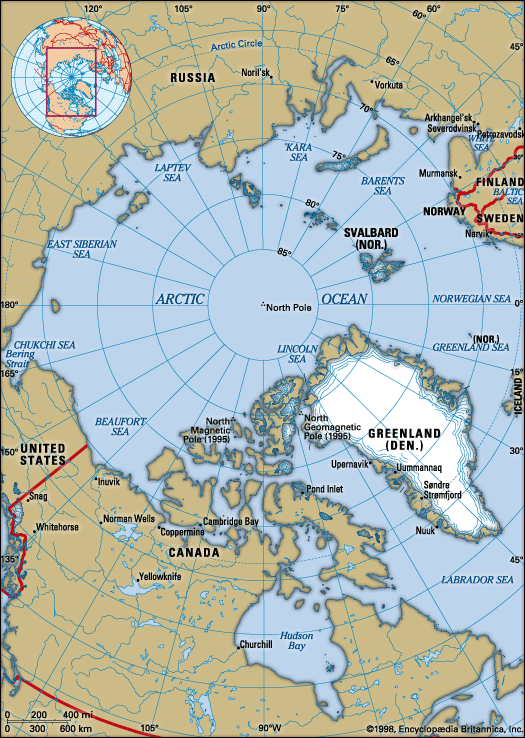
The Chukchi Sea is a marginal sea of the Arctic Ocean covering approximately 225,000 square miles (582,000 square km). It is bounded by Wrangel Island to the…
What is Chukchi Sea?
The Chukchi Sea is a marginal sea of the Arctic Ocean covering approximately 225,000 square miles (582,000 square km). It is bounded by Wrangel Island to the west, northeastern Siberia and northwestern Alaska to the south, the Beaufort Sea to the east, and the Arctic continental slope to the north.1
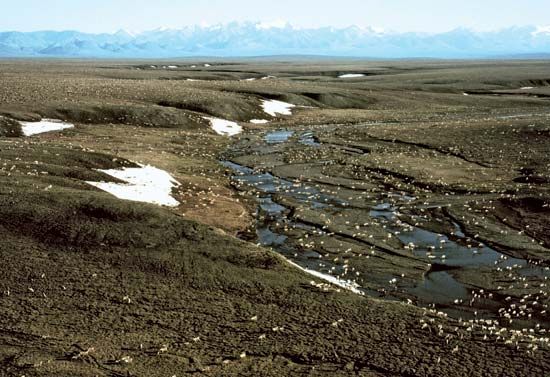
The sea has an average depth of 253 feet (77 m) and is navigable between July and October via the Bering Strait. Its waters are characterized by ice-bearing currents that flow southeastward along the Siberian coast. The region supports diverse wildlife, including various species of seals and walrus, while whales and numerous seabirds are common summer visitors.1
What unique animals live in the Arctic Ocean?
The Arctic Ocean is home to a variety of specialized wildlife that has adapted to its extreme, cold-dominated environment. Because the region is characterized by seasonal light and ice cover, many species have developed unique survival strategies, such as the ability to thrive in or near sea ice.4
Marine Mammals
Mammals dominate the Arctic macrofauna, benefiting from their warm-blooded (homoiothermic) nature.4
- Whales: The beluga and narwhal are species native to Arctic waters. The bowhead whale is also found in the region, particularly in the Beaufort Sea.4
- Seals: The ringed and bearded seals are typical Arctic species. Migrant populations of harp seals and hooded seals also frequent the area.4
- Polar Bears: Occupying a unique ecological niche, the polar bear is essentially an aquatic animal that relies on sea ice to hunt seals.45
Fish and Birds
While fish are less abundant in the Arctic zone than in temperate regions, species such as the arctic char and the polar and arctic cod are well-adapted to the cold. Marine birds are abundant during the summer, including members of the auk family, various sea ducks, gulls, and the arctic tern, which performs a remarkable migration to subantarctic waters.4
Ecosystem Foundations
A critical component of the Arctic marine ecosystem is the algae (mainly diatoms) that grow within the sea ice. This plant life supports a complex food web that includes invertebrates, fish, birds, and seals.4
How does the Bering Strait connect the Pacific and Arctic oceans?
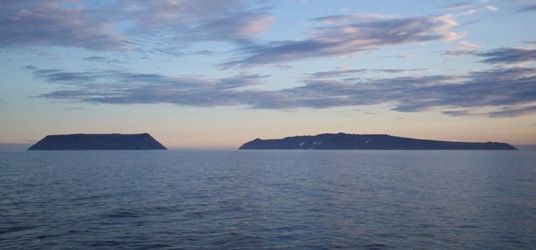
The Bering Strait serves as a vital, relatively shallow passage—averaging 98 to 165 feet in depth—that links the Pacific Ocean to the Arctic Ocean.1213
The connection functions primarily through the northward flow of low-salinity water from the Pacific into the Arctic Basin. This inflow is driven largely by a slight difference in sea level between the two oceans, though it is also significantly influenced by wind fields and large-scale atmospheric circulation over the North Pacific. While some water passes through the strait into the Arctic, most of the water in the region eventually returns to the Pacific. Once this Pacific water enters the Chukchi Sea, it mixes with colder, more saline waters, eventually flowing as a distinct layer between the Arctic and Atlantic water masses within the Amerasia Basin.813
What are the main differences between the Chukchi and Beaufort seas?
The Chukchi Sea and the Beaufort Sea are distinct regions of the Arctic Ocean with significant differences in geography, depth, and ice conditions.
Key Differences
Feature
Chukchi Sea
Beaufort Sea
Area
225,000 sq mi (582,000 sq km)
184,000 sq mi (476,000 sq km)
Average Depth
253 ft (77 m)
3,239 ft (1,004 m)
Ice Conditions
Navigable July–October
Under ice almost year-round; breaks up only in Aug–Sept
Geography
Bounded by Siberia, Alaska, and Wrangel Island
Bounded by Canada and Alaska; features Mackenzie River delta
Environmental and Economic Context
The Chukchi Sea is characterized by its relative shallowness and serves as a gateway for currents flowing from the Bering Strait, supporting indigenous populations of seals, walrus, and seasonal whales.1
In contrast, the Beaufort Sea is significantly deeper, with a complex structure including a narrow continental shelf and a steep continental slope. It is heavily influenced by the Mackenzie River, which deposits massive amounts of sediment annually. Economically, the Beaufort Sea is notable for petroleum production centered at Prudhoe Bay, which is linked to southern markets via the Trans-Alaska Pipeline.3
Sources
- Chukchi Sea — Encyclopædia Britannica
- Bering Sea and Strait - Climate — Encyclopædia Britannica
- Beaufort Sea — Encyclopædia Britannica
- Arctic - Marine fauna — Encyclopædia Britannica
- Baffin Bay — Encyclopædia Britannica
- Inuit: Top Questions — Encyclopædia Britannica
- Polar ecosystem - Biota of the Arctic — Encyclopædia Britannica
- Arctic Ocean - Oceanography — Encyclopædia Britannica
- Ectotherm — Encyclopædia Britannica
- sea ice - The emerging impacts of recent changes to sea ice — Encyclopædia Britannica
- Arctic - Climate of the Arctic — Encyclopædia Britannica
- Bering Sea and Strait — Encyclopædia Britannica
- Bering Strait — Encyclopædia Britannica
Published on · 3 min read