Crucifixion Thorn
The term "crucifixion thorn" refers to several distinct species of spiny shrubs found in North American deserts, rather than a single plant. Consequently…
What is the scientific name of the crucifixion thorn plant and which plant family does it belong to?
The term “crucifixion thorn” refers to several distinct species of spiny shrubs found in North American deserts, rather than a single plant. Consequently, there is no single scientific name for the plant.
The primary species identified as crucifixion thorn include:
- Koeberlinia spinosa, which is the sole member of the family Koeberliniaceae.1
- Canotia holacantha, which belongs to the family Celastraceae.1
- Castela emoryi, which is a member of the family Simaroubaceae.1
- Dalea spinosa, which belongs to the family Fabaceae.1
Additionally, plants in the Middle East such as Paliurus spina-christi (Christ’s-thorn) and Ziziphus jujuba (jujube) are also associated with the name and belong to the Rhamnaceae family.1
What is the crucifixion thorn plant and where is it typically found?
The term “crucifixion thorn” is a common name applied to several distinct, highly adapted, and spiny shrubs or small trees found primarily in the arid regions of North America, particularly in the southwestern United States and Mexico.13
The primary plants referred to by this name include:
- Koeberlinia spinosa: A woody, thorny shrub that is the sole member of the family Koeberliniaceae. It is found in the drier areas of central and southwestern North America and parts of South America, such as Bolivia.13
- Canotia holacantha: A member of the family Celastraceae, often called the Mojave thorn, characterized by its rushlike green branches and flammable resins.1
- Castela emoryi: A shrub belonging to the family Simaroubaceae.1
- Dalea spinosa: A blue-flowered shrub belonging to the family Fabaceae.1
Additionally, in the Middle East, the name is sometimes associated with Paliurus spina-christi and Ziziphus jujuba, both of which belong to the Rhamnaceae family. These plants are generally characterized by their reduced, scalelike leaves and specialized, thorn-bearing structures that allow them to survive in harsh desert environments.13
How does the crucifixion thorn plant compare to other thorny plants in its ecosystem?
The crucifixion thorn plants, such as Koeberlinia spinosa and Canotia holacantha, are distinguished from other thorny vegetation in their ecosystem by their extreme reduction of leaves and reliance on specialized, spiny branches for survival in arid environments. While many desert plants in the North American Desert—such as mesquite, ironwood, and various cacti—utilize thorns or spines as a defense mechanism, the crucifixion thorn is notable for being nearly leafless, with its green, photosynthetic branches and thorns serving as the primary structures for growth and moisture preservation.14
In contrast, other common desert shrubs like the creosote bush or sagebrush rely on different physiological adaptations, such as waxy leaves or deep root systems, to manage water scarcity. Furthermore, while the bean family (which includes Dalea spinosa) is a prominent component of desert flora, the crucifixion thorn represents a unique evolutionary strategy where the plant body itself is modified into a highly resilient, thorny framework.415
What are the unique physical characteristics of the crucifixion thorn plant?
The term “crucifixion thorn” refers to several distinct, spiny, and nearly leafless shrubs adapted to arid environments. Their physical characteristics vary by species:
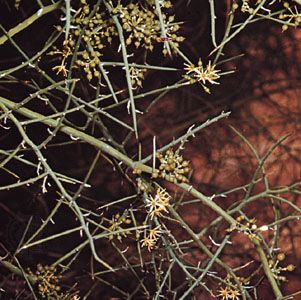
- Koeberlinia spinosa: This woody shrub is defined by its green thorns that grow at right angles to its branches. It features highly reduced, scalelike leaves, produces small, four-petaled greenish flowers, and bears clusters of black berries.13
- Canotia holacantha: Also known as the Mojave thorn, this plant has rushlike green branches and ascending green thorns. It contains highly flammable resins in its stems, bears five-petaled flowers, and produces oval, brown, one- or two-seeded capsules.1
- Other species: Plants such as Castela emoryi and Dalea spinosa (a blue-flowered shrub) are also commonly referred to by this name due to their similar thorny, desert-adapted appearances.1
These plants are characterized by their ability to thrive in harsh, dry conditions through the reduction of foliage, shifting the primary photosynthetic function to their specialized, spiny stems.13
Sources
- crucifixion thorn — Encyclopædia Britannica
- Jerusalem thorn — Merriam-Webster
- Brassicales - Bataceae , Salvadoraceae , and Koeberliniaceae — Encyclopædia Britannica
- North American Desert - Plant life — Encyclopædia Britannica
- Desert - Flora — Encyclopædia Britannica
- crown of thorns — Encyclopædia Britannica
Published on · 3 min read