Irminger Current
The Irminger Current is a branch of the warm North Atlantic Current that flows westward along the southern coast of Iceland. Named after the Danish admiral…
What is Irminger Current?
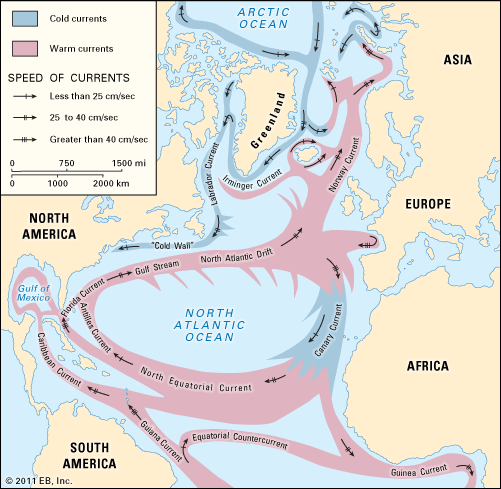
The Irminger Current is a branch of the warm North Atlantic Current that flows westward along the southern coast of Iceland. Named after the Danish admiral Carl L. Irminger, this saline flow is a mixture of waters from the North Atlantic and Arctic oceans.12
West of Iceland, the current splits into two paths: one moves northward and eastward around the island, while the other flows westward and southwestward to merge with the East Greenland Current and eventually the West Greenland Current. The thermal mixing of these waters creates highly productive fishing grounds near the Icelandic coast.13
How does the North Atlantic Current influence European weather?
The North Atlantic Current plays a vital role in maintaining the mild climate of northwestern Europe by transporting heat from the tropics to higher latitudes. This influence occurs through two primary mechanisms:345
- Thermohaline Circulation: This large-scale overturning of the ocean, often referred to as the Atlantic Meridional Overturning Circulation, moves warm, saline water northward. As this water reaches the Labrador, Greenland, and Norwegian seas, it releases heat into the atmosphere, significantly warming the region during winter.46
- Atmospheric Transport: Prevailing westerly winds blow over these warmed surface waters, carrying heat and moisture deep into the European continent.356
This process creates one of the world’s most significant temperature anomalies, allowing areas like Norway and the British Isles to experience much milder winters than other regions at similar latitudes. Without this heat transfer, northwestern Europe would likely be significantly cooler and drier, fundamentally altering its ecosystems and agricultural capacity.7465
Why are areas where warm and cold currents mix good for fishing?
Areas where warm and cold ocean currents meet are highly productive for fishing because they facilitate the movement of nutrient-rich water to the surface, which is essential for supporting marine life.89
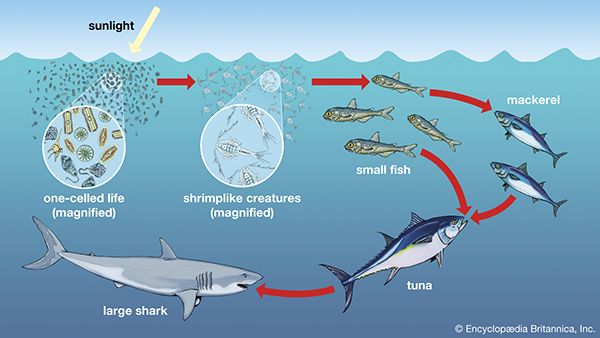
The productivity of the ocean is primarily driven by phytoplankton, which require both sunlight and nutrients to thrive. In many parts of the ocean, nutrients are depleted at the surface as dead organic matter sinks to the bottom. However, when different currents interact—or when winds and currents induce upwelling—these nutrient-rich deeper waters are brought back to the surface.8910
This process creates a “new water” environment that triggers rapid reproduction of phytoplankton. Because phytoplankton form the base of the marine food chain, their abundance supports a large population of zooplankton, which in turn provides a rich food source for fish. Consequently, these mixing zones become some of the world’s most significant and reliable fisheries, attracting large numbers of both pelagic and predatory species.81011
What is the difference between the Gulf Stream and the North Atlantic Current?
The Gulf Stream and the North Atlantic Current are interconnected parts of the same oceanic system, but they differ significantly in their characteristics and flow patterns.316
- Nature and Flow: The Gulf Stream is a powerful, concentrated western boundary current that originates in the Gulf of Mexico and flows northward along the North American coast to Cape Hatteras. It is characterized by high speeds, typically ranging from 1 to 6 knots.316
- Transition: As the Gulf Stream moves northeastward toward the Grand Banks of Newfoundland, it loses its identity as a single, well-defined current. It gradually emerges as the North Atlantic Current, which acts as its northeastward extension.163
- Characteristics: Unlike the intense, concentrated flow of the Gulf Stream, the North Atlantic Current is composed of several broad, slower currents moving at approximately 0.2 knots. It carries warm, saline water toward northwestern Europe, where it plays a critical role in moderating the regional climate alongside prevailing westerly winds.316
Sources
- Irminger Current — Encyclopædia Britannica
- Greenland Current — Encyclopædia Britannica
- North Atlantic Current — Encyclopædia Britannica
- Gulf Stream — Encyclopædia Britannica
- Climate - Thermohaline circulation — Encyclopædia Britannica
- How Do Ocean Currents Affect the Biosphere? — Encyclopædia Britannica
- Atlantic Meridional Overturning Circulation: Top Questions — Encyclopædia Britannica
- commercial fishing - The oceans — Encyclopædia Britannica
- Marine ecosystem - Upwelling — Encyclopædia Britannica
- Marine ecosystem - Ocean currents — Encyclopædia Britannica
- Marine ecosystem - Seasonal cycles of production — Encyclopædia Britannica
- Marine ecosystem - Migrations of marine organisms — Encyclopædia Britannica
- ocean warming — Encyclopædia Britannica
- plankton - Plankton and biological productivity — Encyclopædia Britannica
- Migration - Fish — Encyclopædia Britannica
- Climate - The Gulf Stream — Encyclopædia Britannica
- Atlantic Ocean - The North Atlantic — Encyclopædia Britannica
- thermohaline circulation — Encyclopædia Britannica
Published on · 3 min read