Greenland Current
The Greenland Current is a surface oceanic current formed by a combination of polar sea surface drift, the return flow of the North Atlantic Current, and…
What is Greenland Current?
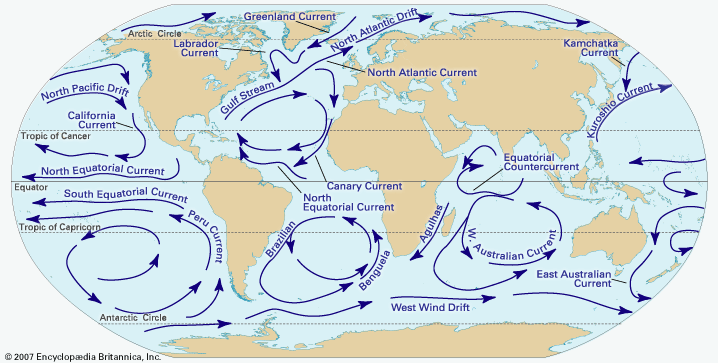
The Greenland Current is a surface oceanic current formed by a combination of polar sea surface drift, the return flow of the North Atlantic Current, and waters from the Irminger Current.1
It is primarily composed of two distinct flows:
- East Greenland Current: A cold flow originating in the Arctic Ocean that moves southward along Greenland’s east coast, transporting large fields of ice before turning toward the Labrador Sea.12
- West Greenland Current: A branch that forms at Cape Farewell and flows northward along Greenland’s west coast into the Davis Strait, where it eventually joins the Labrador Current.13
The mixing of these waters with warmer currents creates productive fishing grounds near Iceland and in the Norwegian Sea. While the east coast is often ice-laden, the west coast remains relatively free of ice due to the influence of warmer North Atlantic waters.1
How does the Labrador Current affect the climate of North America?
The Labrador Current significantly influences the climate of eastern North America, particularly in Newfoundland and Labrador, by acting as a source of cold, low-salinity water. Its impact is primarily observed through the following mechanisms:57
- Cooling Coastal Temperatures: Prevailing northeasterly and easterly winds blowing across the cold waters of the current keep coastal summers cool and delay the arrival of spring.8
- Temperature Regulation: By transporting cold Arctic air and maintaining low water temperatures (often below 32° F/0° C), the current contributes to lower regional temperatures than would otherwise be expected for these latitudes.58
- Fog Formation: When the cold, humid air moving over the Labrador Current encounters the warmer surface waters of the Gulf Stream, it causes widespread condensation8. This interaction produces frequent, dense fogs, particularly over the Grand Banks and along the southern and southeastern coasts of Newfoundland.8910
While the Gulf Stream provides a warming effect to many regions, the Labrador Current serves as a cooling influence along the western margins of the North Atlantic.9
What is the thermohaline circulation and why is it important?
The thermohaline circulation (THC) is a global system of slow-moving ocean currents driven by horizontal differences in temperature and salinity rather than wind. While wind-driven currents dominate the surface, the THC extends to the seafloor, acting as a massive conveyor belt that continually replaces deep seawater with surface water and vice versa.11
Why It Is Important
The thermohaline circulation is vital for regulating Earth’s environment through several key functions:
- Climate Moderation: By driving warmer surface waters from the subtropics toward the poles, the THC helps moderate the climate of coastal regions, such as Iceland and parts of Europe.1112
- Global Transport: It moves tremendous volumes of heat, nutrients, and other materials across vast distances, which is essential for maintaining marine ecosystems.11
- Deep Ocean Ventilation: The sinking of cold, dense water in polar regions—such as the Atlantic Meridional Overturning Circulation (AMOC)—transports oxygen and surface properties into the deep ocean, facilitating global heat exchange.1112
Scientists monitor the THC closely, as global warming could potentially weaken this system by introducing freshwater from melting ice, which reduces water density and inhibits the sinking motion that powers the circulation.11
How do ocean currents influence global fishing industries?
Ocean currents are fundamental to the productivity of global fisheries by regulating the distribution of nutrients and the movement of marine life. Their influence is primarily exerted through the following mechanisms:
Upwelling and Nutrient Supply
The most productive fishing grounds are found in regions of upwelling, where currents bring nutrient-rich deep waters to the surface. This process fuels the rapid growth of phytoplankton, which forms the base of the marine food web. Notable examples include:
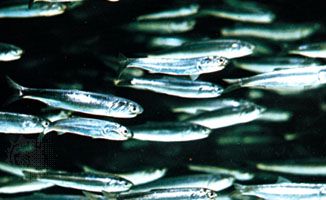
- The Peru Current: Supports one of the world’s most significant anchovy fisheries off the coast of South America.1415
- The California Current: Combines with nutrient-rich coastal currents to create a highly productive environment for diverse marine life.15
- The Benguela Current: Drives high biological productivity along the west coast of southern Africa.15
Habitat and Migration
Currents act as “conveyor belts” that transport larvae and influence the geographic range of various species. For instance, the Gulf Stream is essential for the recruitment of eels to Europe and helps maintain the biodiversity of coral reefs by transporting tropical larvae to higher latitudes. Conversely, the meeting of the cold Labrador Current and the warm Gulf Stream at the Grand Banks creates turbulent, nutrient-rich waters that historically supported massive commercial fish stocks.16817
Environmental Sensitivity
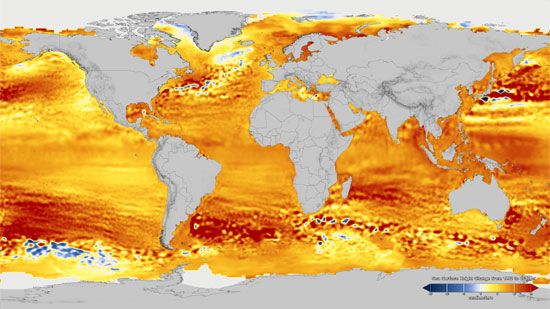
The stability of these currents is critical. Changes in atmospheric circulation, such as El Niño events, can disrupt upwelling, leading to the collapse of local fisheries. Furthermore, ocean warming is currently altering current speeds and shifting the distribution of fish populations toward the poles, which threatens global food security.1418
Sources
- Greenland Current — Encyclopædia Britannica
- East Greenland Current — Encyclopædia Britannica
- West Greenland Current — Encyclopædia Britannica
- Climate - Thermohaline circulation — Encyclopædia Britannica
- Labrador Current — Encyclopædia Britannica
- Greenland Sea — Encyclopædia Britannica
- Newfoundland and Labrador - Climate of Newfoundland and Labrador — Encyclopædia Britannica
- Gulf Stream — Encyclopædia Britannica
- Labrador Sea — Encyclopædia Britannica
- Labrador Current — Merriam-Webster
- thermohaline circulation — Encyclopædia Britannica
- density current - Mediterranean overflow current — Encyclopædia Britannica
- convection: Top Questions — Encyclopædia Britannica
- Marine ecosystem - Upwelling — Encyclopædia Britannica
- plankton - Plankton and biological productivity — Encyclopædia Britannica
- ocean warming — Encyclopædia Britannica
- Grand Banks — Encyclopædia Britannica
- Marine ecosystem - Ocean currents — Encyclopædia Britannica
- Pacific Ocean - Fisheries — Encyclopædia Britannica
- fish - Distribution and abundance — Encyclopædia Britannica
Published on · 4 min read