Japurá River
The Japurá River is a major waterway that originates in the Colombian Cordillera Central as the Caquetá River, east of Pasto, Colombia. It flows…
What is Japurá River?
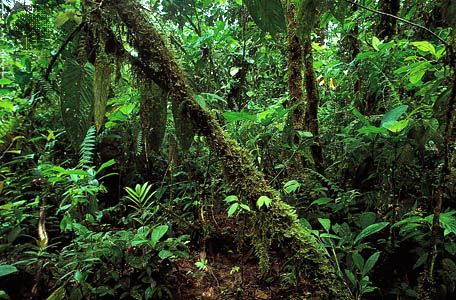
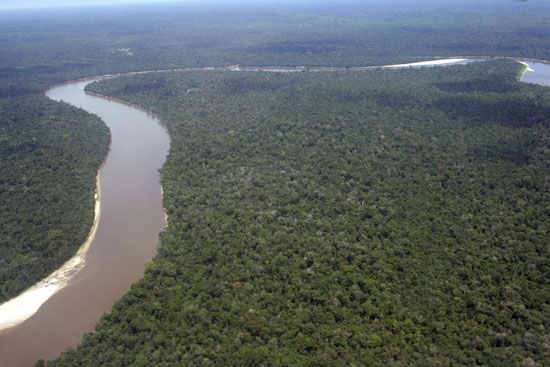
The Japurá River is a major waterway that originates in the Colombian Cordillera Central as the Caquetá River, east of Pasto, Colombia. It flows east-southeast through the tropical rain forest of southeastern Colombia before crossing into Brazil, where it takes the name Japurá after receiving the Apaporis River.1
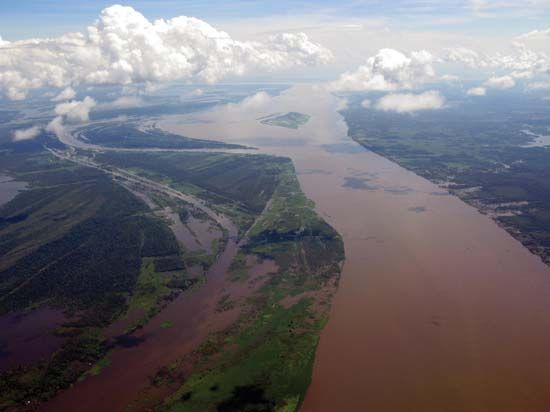
The river eventually joins the Solimões River—the stretch of the Amazon River in Brazil—above the city of Tefé. Including the Caquetá, the river spans approximately 1,750 miles (2,820 km) in total length. Because it originates in the geologically youthful and tectonically active Andes, the Japurá carries heavy sediment loads, classifying it as a “whitewater” river. At its mouth, the river forms a complex network of channels, large islands, and seasonal lakes, and it remains navigable for small boats within Brazil.12
What is the difference between whitewater and blackwater rivers in the Amazon?
In the Amazon basin, rivers are categorized based on their geological origins, sediment content, and chemical composition. The primary differences between whitewater and blackwater rivers are as follows:
Whitewater Rivers
- Origin: These rivers, such as the Madeira, Purus, and Japurá, originate in the geologically youthful and tectonically active Andes.2
- Characteristics: They carry heavy loads of suspended silt and sediment, which gives the water a murky, opaque appearance. This high sediment content is a defining feature of the main Amazon River (known as the Solimões in Brazil).2
Blackwater Rivers
- Origin: These rivers, such as the Negro, originate in ancient, crystalline highlands and flow through nutrient-poor, sandy uplands.2
- Characteristics: They contain high levels of humic acids, which stain the water a dark, tea-like color. Because they drain sandy soils, they carry little to no silt or dissolved solids, making them relatively clear despite their dark tint.2
When these two types of water meet—most famously at the confluence of the Amazon and the Negro at Manaus—they do not mix immediately, creating a striking color boundary due to differences in temperature, sediment, and density.2
How does the Amazon River’s floodplain support local ecosystems?
The Amazon River’s floodplain is a vital component of the basin’s ecology, functioning as a dynamic system that supports immense biodiversity through seasonal inundation. These floodplains, which can expand to over 35 miles (55 km) in width during peak floods, are categorized primarily into two types of forests: várzea and igapó.356
Nutrient Cycling and Fertility
The várzea forests are located along whitewater rivers and are particularly significant for their fertility. As these rivers flood, they deposit nutrient-rich silt onto the floodplain, rejuvenating the soil annually. This process makes these areas highly productive, though they are subject to periodic destruction by the rising waters.576
Ecological Adaptations
The annual flooding cycle, which can last up to seven months, has driven unique evolutionary adaptations in both flora and fauna:
- Seed Dispersal: Many trees have evolved to fruit during the high-water season. They produce floating fruits that attract over 200 species of fish, such as the tambaqui, which consume the fruit and disperse the seeds intact throughout the flooded forest.8
- Fish Migration: During the flood, fish migrate into the inundated forest to feed and spawn, utilizing the forest as a critical habitat.8
- Vegetation: The igapó forests, found along blackwater rivers, are adapted to acidic, nutrient-poor conditions and can remain submerged for up to half the year.56
What are some of the other major tributaries of the Amazon River?
The Amazon River system is fed by more than 1,000 tributaries originating from the Andes, the Guiana Highlands, and the Brazilian Highlands. Several of these are major rivers exceeding 1,000 miles in length.2
Key tributaries include:
- Madeira River: The largest tributary, exceeding 2,000 miles in length. It is a whitewater river formed by the junction of the Mamoré and Beni rivers.29
- Negro River: The largest blackwater tributary, accounting for about one-fifth of the Amazon’s total discharge. It includes the Branco River as a major affluent.210
- Japurá River: Known as the Caquetá in Colombia, this is a significant whitewater tributary.2
- Purus and Juruá Rivers: Important meandering whitewater tributaries that flank the Madeira River.2
- Xingu River: A major clearwater tributary.2
- Ucayali and Huallaga Rivers: Major right-bank affluents that contribute to the headwaters of the Amazon system.2
- Putumayo River: Also known as the Içá in Brazil, this is a significant whitewater tributary.2
Sources
- Japurá River — Encyclopædia Britannica
- Amazon River - Physiography of the river course — Encyclopædia Britannica
- Amazon River - Hydrology of the Amazon River — Encyclopædia Britannica
- Why are Amazon River dolphins pink? — Encyclopædia Britannica
- Amazon River - Plant life — Encyclopædia Britannica
- Vegetarian piranhas — Encyclopædia Britannica
- Amazon River - Soils of the Amazon River — Encyclopædia Britannica
- Amazon basin — Encyclopædia Britannica
- Madeira River — Encyclopædia Britannica
- Negro River — Encyclopædia Britannica
- Negro River — Encyclopædia Britannica
Published on · 3 min read