Lantern Fish
A lantern fish is any of the numerous species of small, deep-sea fish belonging to the family Myctophidae. These fish are typically elongated, ranging from…
What is lantern fish?
A lantern fish is any of the numerous species of small, deep-sea fish belonging to the family Myctophidae. These fish are typically elongated, ranging from 2.5 to 15 cm (1 to 6 inches) in length, and possess large mouths and eyes.1
A defining characteristic of these fish is the presence of numerous light organs, known as photophores, located on their heads, undersides, and tail bases. These organs produce bioluminescence, which serves several vital functions:12
- Species and sex recognition: The distinct arrangement of lights helps individuals identify members of their own species or sex.12
- Camouflage: By matching the intensity of sunlight filtering down from the surface, the light emitted downward can conceal the fish’s shadow from predators lurking below.2
While some lantern fish remain in deep water, many migrate toward the surface at night.1
What is counter-illumination and how does it help lanternfish hide?
Counter-illumination is a specialized form of camouflage used by many deep-sea organisms, including lantern fishes, to avoid detection by predators.
In the ocean’s “twilight zone,” predators often hunt by looking upward to spot the silhouettes of prey against the faint light filtering down from the surface. To counter this, lantern fish utilize light-producing organs called photophores, which are arranged along their ventral (lower) surfaces and directed downward.25
By emitting light that matches the intensity and color of the ambient sunlight penetrating from above, the fish effectively “obliterate” their own shadow. This process provides a unique form of countershading, as it removes the depth relief and silhouette that would otherwise reveal the fish’s presence to a predator lurking below. This biological strategy allows the fish to blend into the background illumination of the water column, making them nearly invisible to observers beneath them.25
How do photophores function to create light in deep-sea creatures?
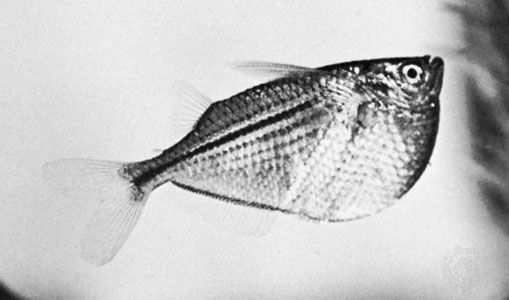
Photophores are specialized light-emitting organs found in many deep-sea creatures, including lantern fishes and hatchetfishes. These organs function through a biochemical process known as bioluminescence, which generates “heatless” light.25
The Biochemical Mechanism
The production of light relies on an enzyme-substrate reaction involving two primary components:5
- Luciferin: An organic molecule that acts as the substrate.5
- Luciferase: An enzyme that catalyzes the oxidation of luciferin.25
When luciferin is oxidized in the presence of luciferase, oxygen, and often the energy molecule ATP, the reaction releases energy in the form of a photon of visible light. This light is typically blue or blue-green, as these wavelengths are most effectively transmitted through seawater.52
Structure of Photophores
In complex organisms, photophores are highly organized structures that often include:58
- Photocytes: Specialized cells that produce the light.8
- Reflectors: Layers that direct the light outward.8
- Lenses: Structures that focus or disperse the light.8
- Color filters: Components that may adjust the light’s appearance.8
Some creatures produce this light internally, while others harbor symbiotic luminous bacteria within their photophores, controlling the light output by adjusting blood flow or using mechanical shutters like pigment-filled membranes.8
What other animals in the deep ocean use bioluminescence to survive?
Beyond lanternfish, a wide array of deep-ocean organisms utilize bioluminescence for survival, including hunting, defense, and communication.29
Predators and Lures
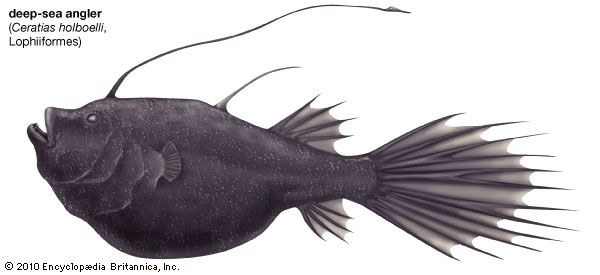
- Anglerfishes: These fish use a modified dorsal spine that acts as a fishing rod, dangling a luminous lure to attract unsuspecting prey directly to their jaws.29
- Deep-sea fishes: Many species use light organs to illuminate their surroundings or to identify potential mates and school members.29
- Sharks: Certain deep-sea species, such as the kitefin shark and various lanternsharks, possess photophores that generate light through hormonal control rather than bacterial symbiosis.5
Defense and Confusion
- Squids: Many deep-sea squids, such as Lycoteuthis and Histioteuthis, are self-luminous. When threatened, they can secrete a luminous cloud to confuse predators and facilitate an escape.259
- Crustaceans: Small organisms like the ostracod Vargula hilgendorfii eject a blue luminous secretion into the water when disturbed to deter attackers.59
Colonial and Planktonic Organisms
- Jellyfish and Ctenophores: These gelatinous animals often exhibit bioluminescence, sometimes generating waves of light across their bodies when stimulated.5
- Pyrosoma: Known as “fire bodies,” these floating, colonial tunicates are responsible for brilliant displays of light in the open ocean.5
- Sea pens: These bottom-dwelling colonies can generate a traveling wave of light across their structure upon physical stimulation.5
Sources
- lantern fish — Encyclopædia Britannica
- Bioluminescence - The role of bioluminescence in behavior — Encyclopædia Britannica
- caddisfly - Annotated classification — Encyclopædia Britannica
- caddisfly - Distinguishing taxonomic features — Encyclopædia Britannica
- Marine bioluminescence — Encyclopædia Britannica
- flashlight fish — Encyclopædia Britannica
- coloration - Countershading — Encyclopædia Britannica
- luciferase — Encyclopædia Britannica
- Bioluminescence - The range and variety of bioluminescent organisms — Encyclopædia Britannica
- human eye - Rhodopsin — Encyclopædia Britannica
- Photoreception - Photopigments — Encyclopædia Britannica
Published on · 3 min read