Lindeman Island
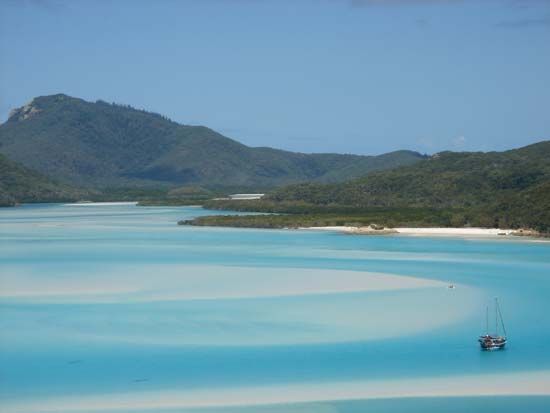
Lindeman Island is a rocky, coral-fringed continental island located in the Cumberland Islands off the coast of northeastern Queensland, Australia.
What is Lindeman Island?
Lindeman Island is a rocky, coral-fringed continental island located in the Cumberland Islands off the coast of northeastern Queensland, Australia.1
Part of the Great Barrier Reef, the island covers an area of 6 square miles (16 square km) and reaches an elevation of 800 feet (240 m) at Mount Oldfield. Historically significant as the first island in the Cumberland group to be developed as a resort in 1923, it is now designated as a national park.1
What are the Cumberland Islands?
The Cumberland Islands are an archipelago located within the Great Barrier Reef off the eastern coast of Queensland, Australia.2
It is important to clarify that these islands are distinct from the Cumberland Island National Seashore, which is a barrier island located in the United States off the coast of Georgia.3
The Australian archipelago consists of more than 70 inner continental islands—meaning they are composed of land rather than coral—including Whitsunday, Lindeman, Brampton, Molle, Long, Hook, Dent, and Hayman. Key details about this group include:2
- Discovery and Naming: The islands were discovered in 1770 by Captain James Cook and later surveyed by Captain Phillip King in 1820. They were named in honor of the Duke of Cumberland, Henry Frederick, who was a brother of George III.2
- Character: The chain is defined by high cliffs and wooded terrain. While they were once inhabited by timber cutters and squatters, they are now protected as a reserve area.2
How was the Great Barrier Reef formed?
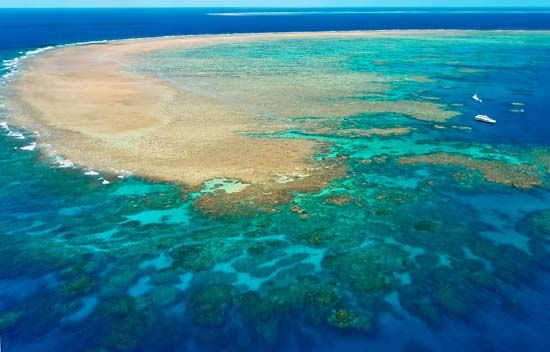
The Great Barrier Reef is a massive, complex structure formed over millions of years through the accumulation of the skeletons and skeletal waste of living marine organisms.4
The Building Process
The reef’s framework is constructed by the following biological and physical processes:
- Primary Builders: Tiny creatures known as coral polyps and hydrocorals create the “bricks” of the reef through their calcareous remains.4
- Binding Agents: Coralline algae and bryozoans act as the “cement,” binding these skeletal remains together.4
- Infilling: The gaps within this framework are filled by vast quantities of skeletal waste, produced by the constant pounding of waves and the actions of boring organisms.4
Geological Context
The reef has developed on the shallow continental shelf fringing the Australian continent. Borings have confirmed that reef growth in this region began as early as the Miocene Epoch (23.0 million to 5.3 million years ago), with the shelf undergoing subsidence throughout this period.4
What makes a national park different from other protected areas?
A national park is an area designated by a national government specifically to preserve the natural environment in its natural state, often for public recreation, enjoyment, or its scientific and historical significance.78
While the term is sometimes used interchangeably with other protected areas, national parks are distinct in their primary mandate: to maintain landscapes, plants, and animals in an undisturbed condition while balancing the inherent paradox of encouraging tourism without molesting the wildlife. This is typically managed by restricting visitors to specific, limited areas within the park.7
In contrast, other protected areas—such as nature reserves or national forests—may have different primary objectives, such as resource extraction, scientific research, or the protection of specific hunting grounds, which have historically been maintained for the use of elites. Furthermore, the focus of national parks varies globally; for example, some emphasize wildlife conservation, while others prioritize the preservation of scenic land or historical sites.7
Sources
- Lindeman Island — Encyclopædia Britannica
- Cumberland Islands — Encyclopædia Britannica
- Cumberland Island National Seashore — Encyclopædia Britannica
- coral reef - Tropical water conditions — Encyclopædia Britannica
- Great Barrier Reef — Encyclopædia Britannica
- Pleistocene Epoch - Coastal environments and sea-level changes — Encyclopædia Britannica
- national park — Encyclopædia Britannica
- National Park Service - Origins of the U.S. national park system — Encyclopædia Britannica
- national park: Top Questions — Encyclopædia Britannica
Published on · 3 min read