Pirarucu
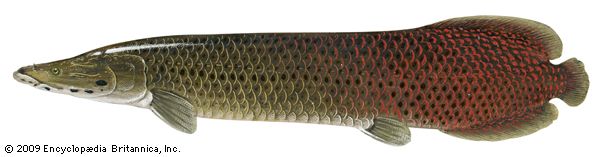
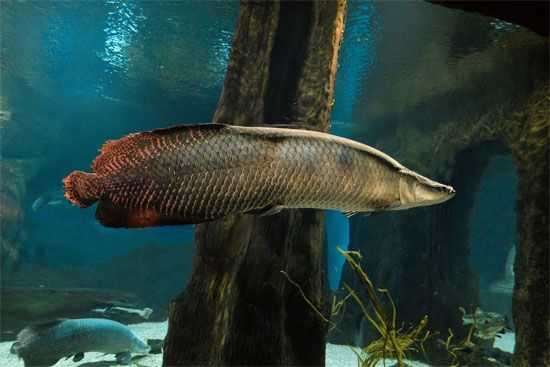
The pirarucu (Arapaima gigas) serves as a significant predator within the Amazonian ecosystem. As a member of the Osteoglossidae family, this carnivorous…
What is the pirarucu’s role in the Amazon ecosystem?
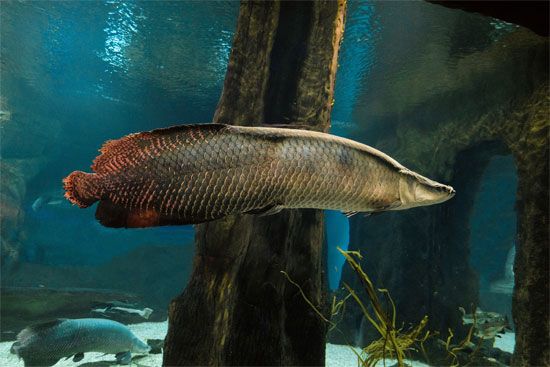
The pirarucu (Arapaima gigas) serves as a significant predator within the Amazonian ecosystem. As a member of the Osteoglossidae family, this carnivorous fish utilizes a specialized, tooth-studded tongue to crush its prey. By inhabiting oxygen-poor waters, the pirarucu gains a competitive advantage, as it can breathe air using its air bladder while its prey remains sluggish and vulnerable in the low-oxygen environment.1
Beyond its role as a predator, the pirarucu is a vital component of the Amazonian food web and a key commercial species in the region. However, the species faces significant pressure from overfishing, which has led to a decline in the number of large individuals in certain areas.21
While the provided information highlights the pirarucu’s predatory habits and its status as a major fish species in the Amazon River, the current knowledge base does not detail broader ecological functions, such as nutrient cycling or specific interactions with other non-prey species.
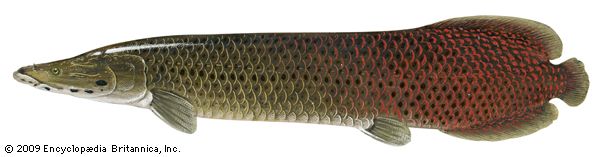
How does the pirarucu’s scales contribute to its survival and potential uses?
Sorry, the Britannica knowledge base does not contain information regarding the specific contribution of the pirarucu’s scales to its survival or their potential uses. The available information focuses on the fish’s physical profile, its air-breathing capabilities, and its reproductive behaviors.1
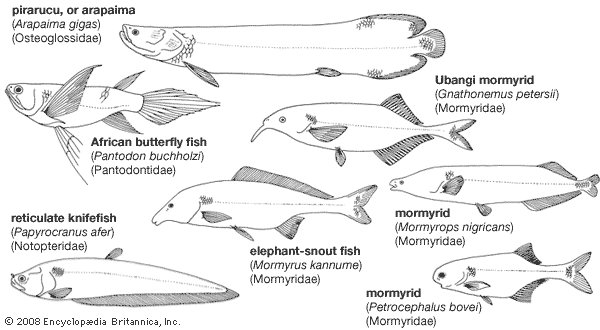
What is the scientific name of the pirarucu and what does it mean?
The scientific name of the pirarucu is Arapaima gigas.14
The name is derived from two distinct linguistic roots:
- Arapaima: This is the name used by Indigenous peoples of the Amazon region to refer to the fish.4
- gigas: This is a Latin noun meaning “giant,” which itself originates from the Greek word for giant.56
Together, the name reflects the fish’s status as one of the largest freshwater species in the world, capable of reaching lengths of nearly 3 metres.1
What are the breeding habits and parental care behaviors of pirarucu?
The breeding and parental care behaviors of the pirarucu (Arapaima gigas) are highly specialized and involve both sexes to ensure the survival of their offspring.
Breeding Habits
As the rainy season approaches, both the male and female pirarucu work together to prepare for spawning. They excavate a nesting pit in the mud of shallow waters, typically measuring about 50 cm (20 inches) wide and 20 cm (8 inches) deep, using their mouths, fins, and lower jaws to clear the area. A large female may deposit as many as 50,000 eggs into this pit, which are then fertilized by the male.17
Parental Care
Following fertilization, the parents engage in protective behaviors:
- Guarding: The male remains to guard the nest, while the female stays nearby to ward off potential predators.1
- Hatching and Association: The embryos typically hatch and leave the pit after about seven days. Once hatched, the young congregate around the father’s head.71
- Camouflage and Signaling: During this period, the male’s head turns a grayish-black color, which provides camouflage for the dark-colored young. It is believed that the male also secretes a substance from glands on his head that provides a gustatory or olfactory stimulus, helping to keep the young together in a shoal.17
- Duration: This parent-young association typically persists for two to three months. If the male dies during this time, the young will join other shoals.7
Sources
- pirarucu — Encyclopædia Britannica
- pacu — Encyclopædia Britannica
- Amazon River: Top Questions — Encyclopædia Britannica
- bony tongue — Encyclopædia Britannica
- gigas — Merriam-Webster
- giga- — Merriam-Webster
- osteoglossomorph - Life cycle and reproduction — Encyclopædia Britannica
- Animal social behavior - Social interactions involving the costs and benefits of parental care — Encyclopædia Britannica
Published on · 3 min read