Pauropod
A pauropod is any member of the class Pauropoda, a group of small, terrestrial arthropods that superficially resemble tiny centipedes or millipedes.
What is pauropod?
A pauropod is any member of the class Pauropoda, a group of small, terrestrial arthropods that superficially resemble tiny centipedes or millipedes.12
These invertebrates are found worldwide, typically living under stones, dead leaves, and rotten wood, where they feed primarily on fungi and decaying organic matter. They are very small, ranging in length from 0.5 to 2 mm (0.02 to 0.08 inch).1
Key physical characteristics include:
- Head: Features large, branched antennae, deep-set mandibles, and two pairs of maxillae. Instead of eyes, they possess vibration-sensitive organs called pseudoculi.1
- Body: Composed of 11 partially fused segments with nine pairs of legs. The first pair of legs is reduced.1
- Respiration: Occurs directly at the body surface.1
- Reproduction: Reproductive organs open at the bases of the second pair of legs; males are equipped with a pair of penes.1
How do pauropods differ from centipedes and millipedes?
While pauropods are often compared to centipedes and millipedes due to their appearance, they are distinct members of the subphylum Myriapoda with unique anatomical features.14
The primary differences include:
- Antennae: Pauropods are distinguished by their branched antennae, whereas centipedes and millipedes possess unbranched antennae.14
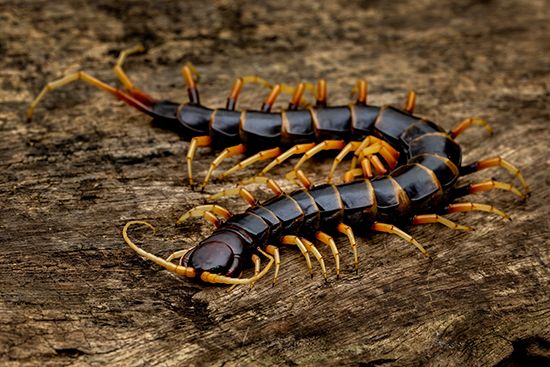
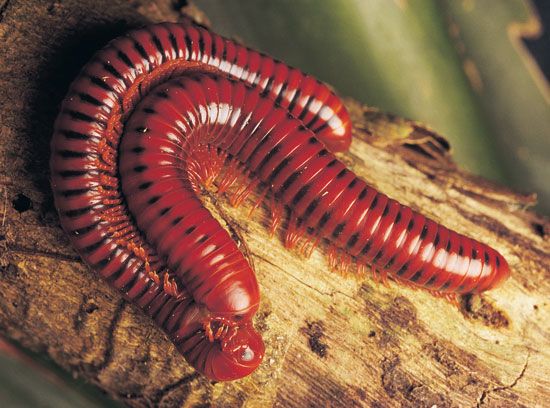
- Body Structure and Size: Pauropods are significantly smaller (0.5 to 2 mm) and have a body consisting of 11 partially fused segments with only nine pairs of legs. In contrast, centipedes have many segments with one pair of legs each, and millipedes feature “diplosegments,” where most segments bear two pairs of legs.14
- Respiration: Unlike centipedes and millipedes, which use tracheae for gas exchange, pauropods lack a specialized respiratory system and breathe directly through their body surface.14
- Sensory Organs: Pauropods lack eyes, relying instead on vibration-sensitive organs called pseudoculi, while many centipedes and millipedes possess simple eyes (ocelli).14
What are pseudoculi and how do they help pauropods?
Pseudoculi are specialized sensory organs found on the heads of pauropods. Because these small, soil-dwelling arthropods lack eyes, they rely on these organs to navigate their environment.1
The primary function of the pseudoculi is to act as vibration-sensitive receptors. By detecting subtle movements and vibrations in their surroundings, pauropods can effectively sense their environment, which is essential for survival in the dark, terrestrial habitats—such as under stones, dead leaves, and rotten wood—where they typically reside.1
What role do pauropods play in their ecosystem?
Pauropods play a vital role in their ecosystem as members of the soil mesofauna. As terrestrial invertebrates that primarily feed on fungi and decaying organic matter, they contribute to the essential processes of life, death, and decay that rejuvenate the environment.19
By consuming and fragmenting organic material, pauropods and other soil organisms help break down complex plant and animal tissues. This activity is a critical step in the decomposition process, which releases stored nutrients and converts them into forms that can be utilized by living plants. Through their feeding habits, they act as catalysts in natural nutrient cycles, including the carbon cycle, nitrogen cycle, and sulfur cycle, thereby supporting soil fertility and the overall health of their habitat.91
Sources
- pauropod — Encyclopædia Britannica
- pauropod — Merriam-Webster
- mollusk - Habitats, feeding habits, and associations — Encyclopædia Britannica
- arthropod - Annotated classification — Encyclopædia Britannica
- Pauropoda — Merriam-Webster
- malacostracan - The nervous system and sensory organs — Encyclopædia Britannica
- acarid - External features — Encyclopædia Britannica
- arachnid - Body and appendages — Encyclopædia Britannica
- soil organism — Encyclopædia Britannica
Published on · 2 min read