Pukapuka Atoll
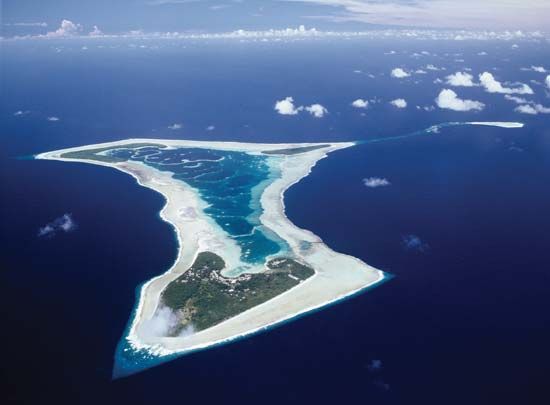
Pukapuka Atoll is a coral formation located in the northern Cook Islands, a self-governing state in free association with New Zealand in the South Pacific…
What is Pukapuka Atoll?
Pukapuka Atoll is a coral formation located in the northern Cook Islands, a self-governing state in free association with New Zealand in the South Pacific Ocean. It consists of three islets: the main islet of Pukapuka (Wale) and the uninhabited Motu Kavata and Motu Koe.1
While some sources suggest Ferdinand Magellan sighted Pukapuka in 1521, historical records indicate it was first sighted by the Spanish explorer Álvaro de Mendaña in 1595 and later “rediscovered” in 1765 by the English navigator John Byron, who named it the “Isle of Danger” due to its treacherous surf. The atoll has a unique elevation for its type, reaching 100 feet (30 metres) at one point. Historically, the island suffered from the impact of 19th-century Peruvian slavers and was later annexed by Great Britain in 1892. Today, it maintains a small population supported by local resources and features basic infrastructure like a school and hospital.21
How are coral atolls formed in the ocean?
Coral atolls are primarily formed through a process of gradual subsidence, a theory first proposed by Charles Darwin in 1842. This development typically follows a sequence of stages:
- Fringing Reef: Coral reefs initially grow in shallow waters surrounding a volcanic island.
- Barrier Reef: As the volcanic island slowly sinks—often due to the cooling and densification of the ocean floor as it spreads from oceanic ridges—the reef continues to grow upward to remain near the surface. This creates a lagoon between the reef and the receding shoreline.
- Atoll: Eventually, the volcanic island subsides completely below sea level, leaving behind an annular reef that encloses a central lagoon.
While Darwin’s subsidence model remains fundamental, modern science also incorporates the impact of sea-level fluctuations caused by Pleistocene Epoch ice sheet melting. Additionally, some atolls may form through subaerial erosion of uplifted limestone platforms, which, upon subsequent submergence, allow coral growth to resume along the rim.
What makes the Polynesian culture unique?
Polynesian culture is defined by a remarkable mastery of the Pacific Ocean environment and a profound connection to the past, which has persisted despite centuries of colonial disruption. Several key characteristics distinguish this culture:78
- Maritime Mastery: Polynesians were exceptional mariners who navigated vast distances using traditional, non-instrumental methods. This expertise permeated their social organization, religion, and daily life, equipping them to survive in a challenging environment.78
- Animism and Mana: Belief systems centered on animism, where all things possess a sacred supernatural power known as mana. This power was protected by complex tapu (taboos), which governed social hierarchies, gender roles, and interactions with the environment.9
- Cultural Conservatism: Despite being spread across thousands of miles, Polynesian groups maintained remarkable similarities in material goods, kinship terms, and artistic motifs, reflecting a deep reverence for ancestral traditions and oral history.7
- Practical Worldview: Their languages and social structures were highly specialized, reflecting systematic observations of nature, including stars, winds, and currents.7
- Artistic Expression: Traditional arts, such as monumental stone sculpture, intricate tattoos, and performance art, were highly developed. While many traditional practices were suppressed by missionaries, there has been a significant resurgence in these arts and indigenous languages since the late 20th century.81011
What are the main differences between an atoll and a volcanic island?
The primary difference between an atoll and a volcanic island lies in their geological composition and stage of development.
Volcanic Islands
Volcanic islands are formed by volcanism, where magma erupts from the ocean floor to build a landmass above sea level. These islands are often characterized by:43
- High Elevation: They are typically “high islands” with significant relief, sometimes featuring active volcanoes or hard, cone-shaped lava surfaces.4
- Geological Activity: They are often associated with plate-tectonic activity, such as convergent plate boundaries that create island arcs plate boundaries that create island arcs.3
- Erosion: While some shield volcanoes are resistant to erosion, others composed of ash and pumice can erode rapidly.4
Atolls
An atoll is a ring-shaped coral reef that encloses a central [lagoon]. According to the subsidence theory, an atoll represents the final stage of a volcanic island’s life cycle:145
- Formation: As a volcanic island sinks—due to the cooling and densification of the ocean floor—coral reefs continue to grow upward to remain near the surface.145
- Structure: Once the original volcanic peak subsides completely below sea level, only the annular reef remains, surrounding a lagoon that may be 50 meters or more in depth.145
- Composition: Unlike volcanic islands, the surface of an atoll is typically composed of low, flat strips of coral rock and limestone.144
Sources
- Pukapuka Atoll — Encyclopædia Britannica
- Tuamotu Archipelago — Encyclopædia Britannica
- coral reef - Origin and development of reefs — Encyclopædia Britannica
- atoll — Encyclopædia Britannica
- volcano - Submarine volcanoes — Encyclopædia Britannica
- mountain - Volcanic structures along subduction zones — Encyclopædia Britannica
- Polynesian culture - Traditional Polynesia — Encyclopædia Britannica
- Polynesian culture - Religion of Polynesian culture — Encyclopædia Britannica
- Polynesian culture - Contemporary Polynesia — Encyclopædia Britannica
- Oceanic literature - Polynesia and Micronesia — Encyclopædia Britannica
- Polynesian culture - Art — Encyclopædia Britannica
- Polynesian languages — Encyclopædia Britannica
- French Polynesia - Cultural life — Encyclopædia Britannica
- Tonga - Relief — Encyclopædia Britannica
- island arc — Encyclopædia Britannica
Published on · 3 min read