Screech Owl
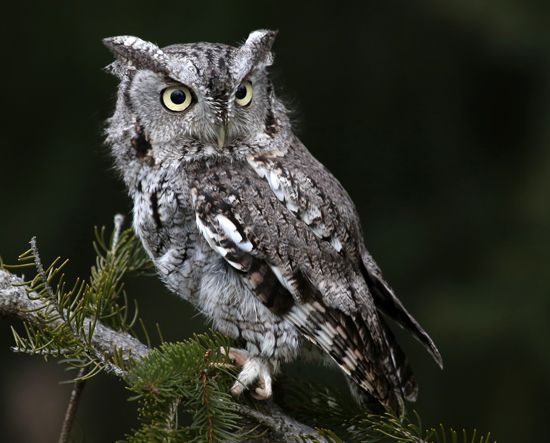
A screech owl refers to any of approximately 25 species of New World owls belonging to the genus Megascops. While older classifications once grouped them…
What is Screech owl?
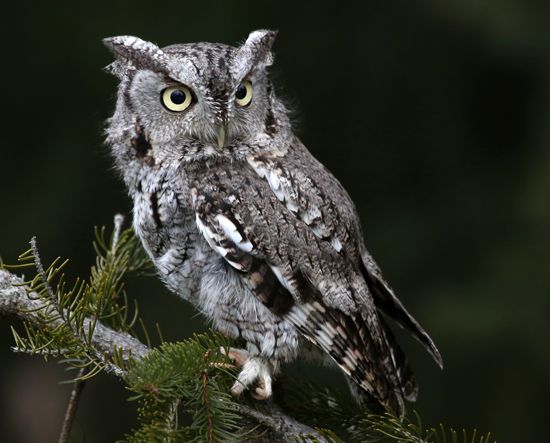
A screech owl refers to any of approximately 25 species of New World owls belonging to the genus Megascops. While older classifications once grouped them with Old World scops owls in the genus Otus, taxonomic revisions in the early 21st century separated them based on DNA and behavioral studies.1
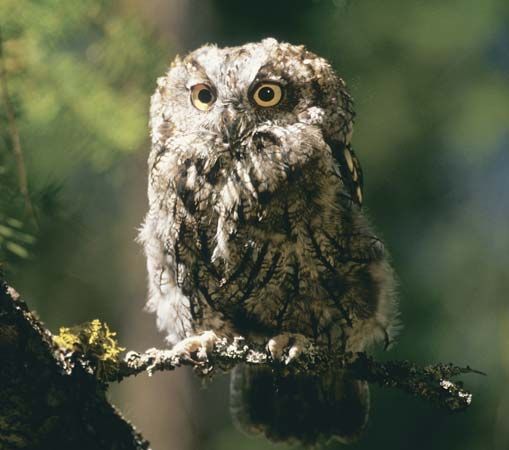
These birds are relatively small, measuring about 20–30 cm (8–12 inches) in length, and are characterized by a facial disk, ear tufts, and plumage featuring a concealing, bark-like pattern. They primarily feed on small mammals, birds, and insects.12
Screech owls are well known for their vocalizations, which include shrill calls used for territorial defense and mating. In some species, pairs engage in complex duets to reinforce their pair bond. While most populations remain stable, the Santa Marta screech owl is currently listed as a vulnerable species.13
How do screech owls use camouflage to hide from predators?
Screech owls utilize a combination of physical appearance and behavioral adaptations to remain hidden from predators and other threats.
Physical Camouflage
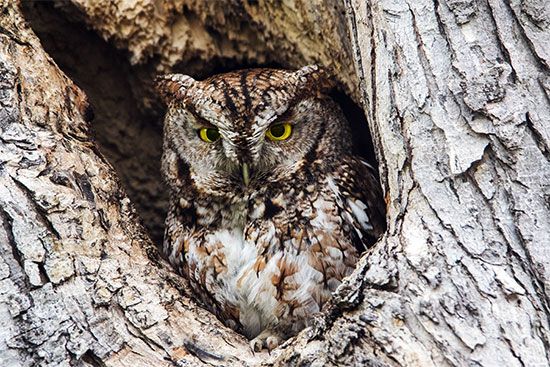
The plumage of screech owls is cryptically patterned with bars, streaks, or spots, allowing them to blend almost invisibly against tree bark. This concealing pattern is highly effective, and the birds exhibit geographic variation in color—ranging from gray to rufous—to match their specific environments. For instance, the red phase of the North American screech owl provides survival value in deciduous forests by mimicking the colors of summer and autumn foliage. Additionally, many owls possess erectile feather tufts that help break up the round outline of the head, further enhancing their concealment.4
Behavioral Adaptations
When attempting to avoid attention at a daytime roost, a screech owl will compress its plumage, elevate its ear tufts, and half-close its eyes. By combining this posture with its bark-like coloration, the owl effectively mimics the appearance of a broken branch, making it difficult for predators or mobbing birds to detect them.3
What are the main differences between New World and Old World owls?
The distinction between New World and Old World owls is primarily taxonomic, rooted in genetic and behavioral differences rather than a single physical trait.
Taxonomic Classification
For over a century, many small owls from both regions were grouped together in the genus Otus. However, scientific consensus shifted in the early 21st century following DNA and behavioral studies. These findings led to the separation of New World species into the genus Megascops (commonly known as screech owls), while Old World species, such as the common scops owl, remained in the genus Otus.1
Shared Characteristics
Despite these genetic differences, both groups share the general body plan of the order Strigiformes. Both types of owls typically feature:
- A flat facial disk with forward-facing eyes.5
- A small, hooked beak and sharp talons for hunting.56
- Cryptic plumage patterns (streaks, bars, or spots) that provide camouflage against tree bark.6
- Erectile feather tufts, often called “ears” or “horns,” which help break up the outline of the head.6
While they share a similar appearance and ecological niche, the evolutionary divergence between the two groups is significant enough to warrant their distinct classification.1
How do owls use their specialized hearing to hunt at night?
Owls possess highly specialized hearing that allows them to hunt effectively in low-light conditions, often enabling them to capture prey in total darkness. This capability is rooted in several unique anatomical adaptations:8
- Asymmetrical Ear Openings: In many owl species, the ear openings are positioned asymmetrically on the head—often higher on one side than the other. This arrangement causes sounds to reach each ear at slightly different times, sometimes with a delay of only 30 millionths of a second. By processing these time differences, the owl can precisely localize the origin of a sound in two planes simultaneously.48
- Sound Concentration: The ears are surrounded by a ruff of lacy, sound-permeable feathers that act as a funnel to concentrate incoming noises. Additionally, a movable flap of skin known as an operculum sits in front of the ear opening, functioning as a baffle to further focus sound.8
- Silent Flight: To ensure their own movement does not interfere with their ability to hear prey, most owls have flight feathers with a specialized nap on the upper surface, which renders their flight perfectly noiseless.8
Sources
- Screech owl — Encyclopædia Britannica
- screech owl — Merriam-Webster
- Owl - Behaviour — Encyclopædia Britannica
- Owl - Form and function — Encyclopædia Britannica
- Owl - Annotated classification — Encyclopædia Britannica
- Owl - General features — Encyclopædia Britannica
- Owl - Reproduction and development — Encyclopædia Britannica
- How Do Birds Hear? — Encyclopædia Britannica
Published on · 3 min read