Whippoorwill
The whippoorwill (Caprimulgus vociferus) is a nocturnal bird native to North America and a member of the Caprimulgidae family.
What is Whippoorwill?
The whippoorwill (Caprimulgus vociferus) is a nocturnal bird native to North America and a member of the Caprimulgidae family.1
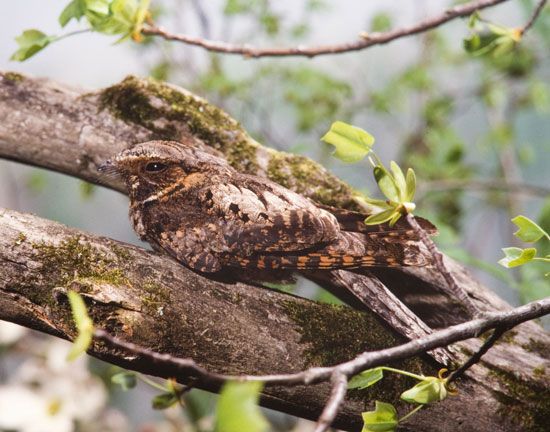
It is best known for its distinctive, repetitive call, which features accented first and third syllables and can be repeated hundreds of times without pause. Measuring approximately 24 cm (9 1/2 inches) in length, the bird possesses mottled brownish plumage; males are distinguished by a white collar and white tail corners, while females have a buffy collar and a plain tail.1
These birds inhabit woodlands near open areas, where they hunt for insects during dusk and dawn. During the day, they remain camouflaged, sleeping on the forest floor or perching lengthwise along tree branches. Their range spans from southeastern Canada and the eastern United States down through Mexico, with some populations wintering as far south as Costa Rica.1
What are other examples of nocturnal birds?
Beyond the whippoorwill, many other birds are adapted for nocturnal or crepuscular (twilight) activity. These species often possess specialized physical traits or behaviors that allow them to navigate and hunt in low-light conditions.
Caprimulgiforms
The order Caprimulgiformes includes several groups of soft-plumaged birds that are primarily active at night or during dawn and dusk:
- Nightjars and Nighthawks: Known for their cryptic plumage and aerial insect-hunting habits.
- Potoos: Arboreal birds noted for their unique, stiff posture when camouflaged against tree stumps.
- Frogmouths and Owlet-frogmouths: Tree-dwelling birds that often resemble small owls.
- Oilbirds: Unique among birds for using echolocation to navigate in total darkness within caves.
Owls
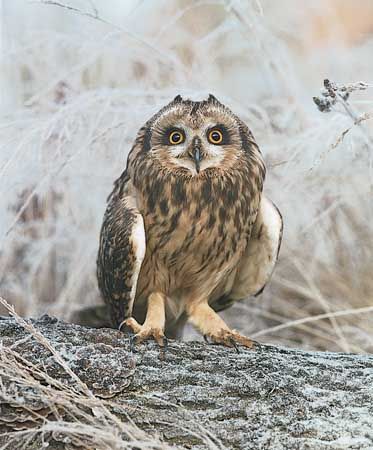
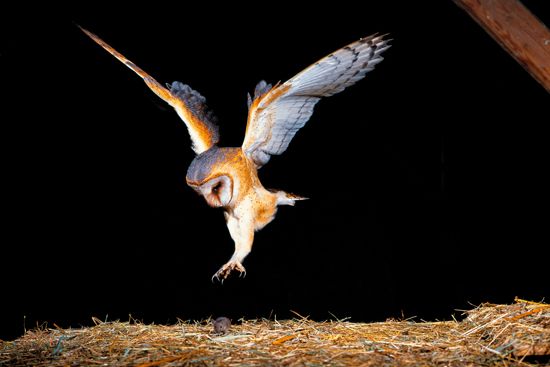
Owls are perhaps the most well-known nocturnal birds. They are characterized by forward-facing eyes, flat faces, and acute hearing, which they use to hunt prey such as rodents and insects. Common examples include:
While most birds of prey are diurnal, these nocturnal groups have evolved distinct strategies to thrive in the dark.
How do birds like the whippoorwill catch insects in the dark?
Birds like the whippoorwill are primarily crepuscular, meaning they are most active during the twilight periods of dawn and dusk, though they also hunt at night when there is sufficient illumination, such as moonlight. Unlike oilbirds, which use echolocation to navigate in total darkness, whippoorwills and other nightjars rely on their large, sensitive eyes to hunt visually.19
These birds employ several strategies to capture insects:
- Continuous Hawking: Many species pursue prey through erratic, sustained flight.10
- Short Sallies: They often wait on terrestrial or arboreal perches, making quick flights to snatch passing insects, similar to the behavior of flycatchers.10
- Ground Foraging: Some nightjars are surprisingly agile on their feet and will run along the ground or swoop from perches to capture crawling insects.10
Their physical adaptations, including enormous gapes (mouths), allow them to efficiently consume a variety of insects, such as beetles, moths, and mosquitoes.102
What is the difference between a whippoorwill and a chuck-will’s-widow?
The whippoorwill and the chuck-will’s-widow are both members of the Caprimulgidae family and are frequently confused due to their similar appearance and nocturnal habits. However, they can be distinguished by several key characteristics:
Feature
Whippoorwill
Chuck-will’s-widow
Size
Smaller (approx. 24 cm / 9.5 inches)
Larger (up to 30 cm / 12 inches)
Call
First and third syllables accented
Second and third syllables accented
Plumage
Mottled brown; males have a white collar and white tail corners
Reddish brown; little or no white in the tail
Range
Breeds from SE Canada through the eastern and southwestern U.S.
Primarily found in the southeastern U.S.
The whippoorwill’s call is noted for being vigorous and deliberate, while the chuck-will’s-widow is known for its persistence, sometimes repeating its call up to 800 times without stopping.121
Sources
- Whippoorwill — Encyclopædia Britannica
- Caprimulgiform - Natural history — Encyclopædia Britannica
- Caprimulgiform — Encyclopædia Britannica
- Owl - General features — Encyclopædia Britannica
- Why do birds chirp at night? — Encyclopædia Britannica
- Owl - Behaviour — Encyclopædia Britannica
- night bird — Merriam-Webster
- Falconiform - Behaviour — Encyclopædia Britannica
- Caprimulgiform - Food habits — Encyclopædia Britannica
- Caprimulgiform - Vocalizations — Encyclopædia Britannica
- sound reception - Uses of hearing in birds — Encyclopædia Britannica
- Chuck-will’s-widow — Encyclopædia Britannica
Published on · 3 min read