Sidewinder
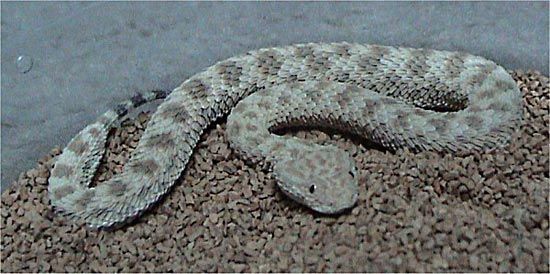
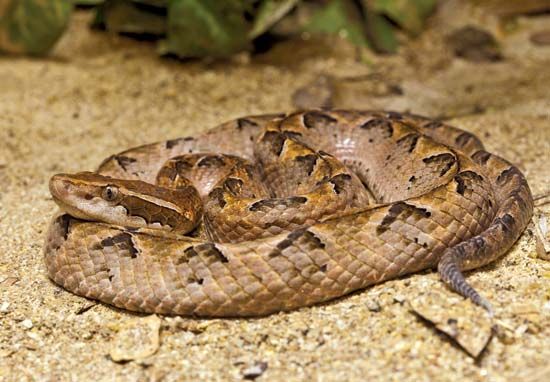
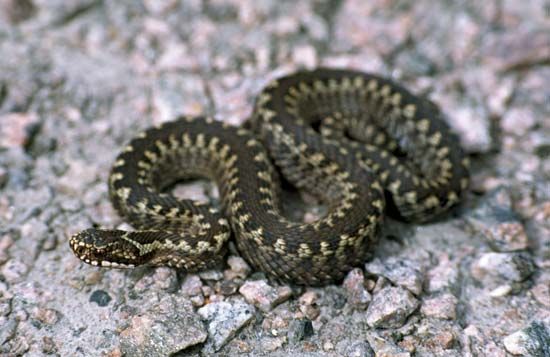
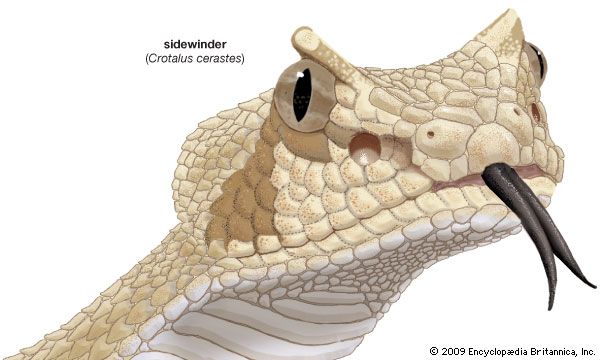
Sidewinder snakes are primarily found in desert habitats across North America, Africa, and the Middle East Africa, and the Middle East.
In which habitats are sidewinder snakes typically found?
Sidewinder snakes are primarily found in desert habitats across North America, Africa, and the Middle East Africa, and the Middle East.1
These snakes are well-adapted to their sandy environments:
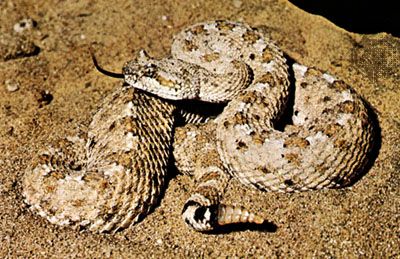
- North American Sidewinders: The North American sidewinder (Crotalus cerastes) inhabits the deserts of the southwestern United States and northwestern Mexico, such as the Sonoran Desert1.
- Old World Sidewinders: Species of the genus Cerastes are found in the Sahara and across the Middle East and Arabia. Their coloration, ranging from tan to gray, allows them to blend into the desert sands.1
To survive in these arid regions, these snakes often hide beneath sand or rocks during the day to avoid the heat and emerge at night to hunt. Their unique “sidewinding” locomotion helps them move efficiently across loose sand while minimizing contact with the hot surface.1
What are some common predators of sidewinder snakes?
Sorry, the Britannica knowledge base does not contain information regarding the specific predators of sidewinder snakes.
How did sidewinder snakes get their name, and what is their unique method of movement?
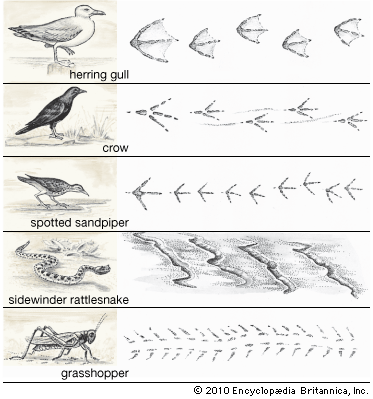
Sidewinder snakes derive their name from their unique, specialized method of locomotion known as sidewinding, which is essential for survival in their desert habitats where loose sand provides little traction for traditional movement.41
In this method, the snake does not move forward in a straight line but instead progresses sideways. The snake lifts the anterior portion of its body and moves it laterally, resting that section on the sand while keeping the remainder of its body as a lifted loop. This loop is then shifted progressively along the body toward the tail. As one loop reaches the end of the tail, a new one is formed at the head, creating a motion that resembles a coiled spring rolling across the sand.4
This technique is highly advantageous in extreme environments because it ensures that only two points of the body are in contact with the ground at any given time. By minimizing contact with the hot desert surface, the snake avoids overheating, allowing it to remain active during times that would otherwise be lethal.14
What role do sidewinder snakes play in their ecosystem?
Sidewinder snakes play a vital role in their desert ecosystems primarily as predators that help regulate populations of small animals. By hunting at night, these pit vipers and vipers serve as a natural control for various prey species, including rodents, birds, and lizards.1
In the Sonoran Desert and other arid regions across North America, the Middle East, and Africa, these snakes are well-adapted to their environment. Their nocturnal habits and specialized sidewinding locomotion allow them to thrive in harsh, sandy conditions where they remain active while avoiding the intense heat of the day. By occupying this niche, they contribute to the complex food webs of their respective desert habitats.1
Sources
- sidewinder — Encyclopædia Britannica
- rattlesnake — Encyclopædia Britannica
- Mexican west coast rattlesnake — Encyclopædia Britannica
- snake - Locomotion — Encyclopædia Britannica
Published on · 2 min read