Sphenophyllum
Sphenophyllum is a genus of extinct plants that existed from the late Devonian Period through the early Triassic Period, spanning approximately 360 to 251…
What is Sphenophyllum?
Sphenophyllum is a genus of extinct plants that existed from the late Devonian Period through the early Triassic Period, spanning approximately 360 to 251 million years ago. Often reconstructed as a shrub or creeping vine, these plants are typically associated with modern horsetails due to their distinct node-internode architecture.12
Key characteristics of Sphenophyllum include:
- Structure: They featured jointed stems with triangular leaves arranged in whorls at each node.12
- Reproduction: Like modern horsetails and the related Calamites, they produced spore-bearing cones.12
- Anatomy: Unlike their horsetail relatives, Sphenophyllum lacked a hollow central stem. Instead, their tracheids—water-conducting cells—were organized in a central triangle surrounded by wood.1
- Habitat: These plants thrived in floodplain swamps.1
The genus is classified within its own order, the Sphenophyllales.23
How are modern horsetails related to ancient plants?
Modern horsetails, which belong to the genus Equisetum, are the only surviving members of the class Equisetopsida. This group was once a diverse and dominant part of Earth’s flora, with a fossil history extending back to the Devonian Period.4
Modern horsetails share several key structural and reproductive traits with their ancient relatives:
- Architecture: Like their extinct ancestors, modern horsetails possess conspicuously jointed stems and leaves arranged in whorls at regular intervals along the stem.4
- Reproduction: They are homosporous plants that produce spores within terminal cones (strobili), a feature shared with extinct groups like the treelike Calamites and the scrambling Sphenophyllales.41
- Evolutionary Lineage: While Equisetum is a small, herbaceous remnant today, its ancestors included massive trees that contributed to the formation of coal beds during the Carboniferous Period.4
Although modern horsetails are closely related to these ancient plants, they differ in specific ways, such as the presence of a hollow central stem in Equisetum, a feature not found in all extinct sphenophytes like Sphenophyllum.41
What were the environmental conditions like during the Devonian Period?
The Devonian Period (approximately 419.2 to 359 million years ago) was characterized by a generally warm and equitable climate, with Earth likely being warmer than it is today. While the existence of polar ice caps remains debated, any that did exist were significantly smaller than modern ones.56
Geography and Climate
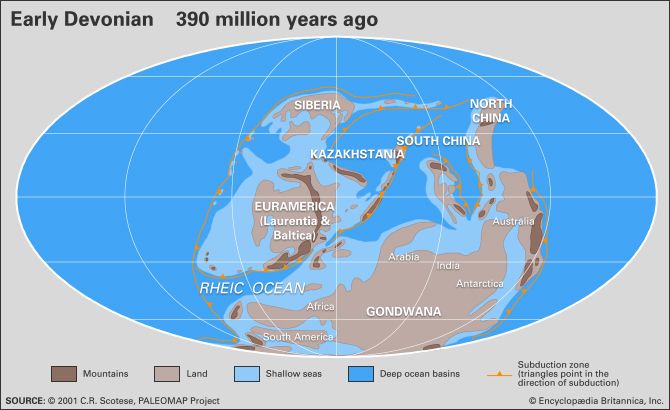
During this time, the Northern Hemisphere landmasses of North America, Greenland, and Europe were united as the supercontinent Laurussia (or Euramerica). Approximately 85 percent of the globe was covered by oceans. The climate supported widespread desert conditions, evaporite basins, and carbonate reefs. Evidence of seasonal growth patterns, such as annual tree rings in Archaeopteris, suggests cooler average temperatures in higher latitudes. Geologically, the period featured significant mountain-building events, such as the Caledonian orogeny, and frequent sea-level fluctuations.576
Environmental Shifts
The period saw major biological and environmental transitions:
- Marine Conditions: Oceans experienced episodes of reduced dissolved oxygen, leading to significant extinction events.57
- Terrestrial Colonization: Early in the period, plants were small, herbaceous colonizers of moist habitats. By the late Devonian, the evolution of heterospory and eventually seeds allowed plants to colonize a wider range of habitats, leading to the development of complex forest communities.89
- Timekeeping: The Devonian year was longer, consisting of approximately 400 days, and the lunar cycle was slightly longer than it is today.6
How do scientists reconstruct what extinct plants looked like?
Scientists reconstruct the appearance and history of extinct plants primarily through the study of fossils, which provide the essential data for paleobotany. Because soft plant tissues rarely survive, researchers rely on several specialized techniques to interpret these ancient remains:
- Physical Preservation: Larger plant structures, such as leaves and stems, are often preserved through carbonization, where they are flattened between rock layers, leaving behind a carbon film and a detailed impression. In rare instances, soft tissues may be preserved in amber or ice.1011
- Palynology: This field focuses on pollen and spores. Because these are produced in massive quantities and are highly resistant to decay, they are frequently recovered from sedimentary rocks. Analyzing these microfossils allows scientists to map the distribution of plant groups and infer regional forest composition.1213
- Microscopic Analysis: Scientists also study phytoliths—microscopic silica bodies that retain the shape of the plant cells in which they formed—and starch grains. These can be recovered from artifacts or sediments to identify specific plant types even when larger fossils are absent.14
- Excavation and Context: Paleontologists use rigorous excavation and documentation processes to catalog the location of specimens within rock strata. By comparing these sequences across different geographic sites, researchers can build a continuous record of how plant life evolved over millions of years.10
Sources
- Sphenophyllum — Encyclopædia Britannica
- Sphenophyllum — Merriam-Webster
- Sphenophyllales — Merriam-Webster
- Equisetopsida — Encyclopædia Britannica
- A Journey Through Time Since the Precambrian - Devonian Period: 419.2 million to about 359 million years ago — Encyclopædia Britannica
- Devonian Period - Paleoclimate — Encyclopædia Britannica
- Devonian Period - Significant geologic events — Encyclopædia Britannica
- Plant - Evolution of land plants from the Ordovician Period through the middle Devonian — Encyclopædia Britannica
- Plant - Evolution of seed plants and plant communities — Encyclopædia Britannica
- palynology — Encyclopædia Britannica
- fossil — Encyclopædia Britannica
- geology - Paleobotany — Encyclopædia Britannica
- geology - Palynology — Encyclopædia Britannica
- Did you know? — Merriam-Webster
- Origins of agriculture - Research techniques — Encyclopædia Britannica
Published on · 3 min read