Syrian Desert
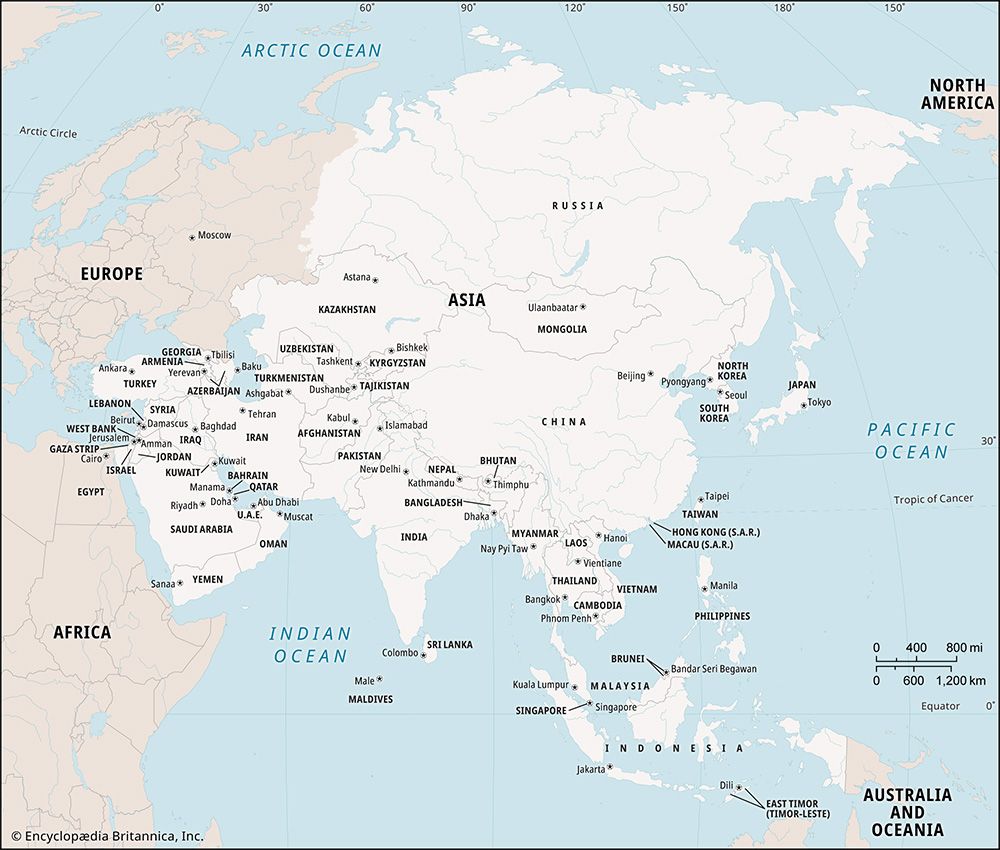
The Syrian Desert is an arid wasteland located in southwestern Asia, stretching across northern Saudi Arabia, eastern Jordan, southern Syria, and western…
What is Syrian Desert?
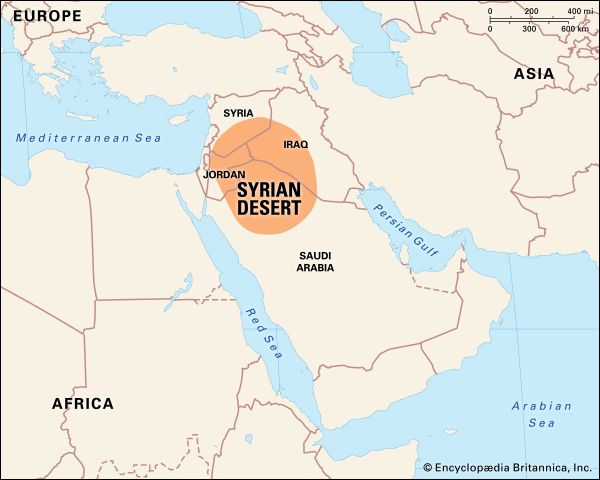
The Syrian Desert is an arid wasteland located in southwestern Asia, stretching across northern Saudi Arabia, eastern Jordan, southern Syria, and western Iraq.12
Contrary to the common perception of a sand-covered landscape, this region is primarily a rock and gravel steppe. It features undulating plains with elevations typically ranging between 980 and 1,640 feet (300 to 500 meters) above sea level, and it is largely covered by lava flows. The climate is harsh and arid, receiving on average less than 5 inches (125 mm) of rainfall annually.314
Historically, the desert served as a formidable barrier between the Levant and Mesopotamia, though it is now crossed by modern motor routes and pipelines. The southern portion of the desert is known as Al-Ḥammād, an area inhabited by nomadic tribes and breeders of Arabian horses.13
What is the difference between a sand desert and a rocky steppe?
The primary difference between a sand desert and a rocky steppe lies in their surface composition, vegetation, and moisture availability.
Sand Deserts
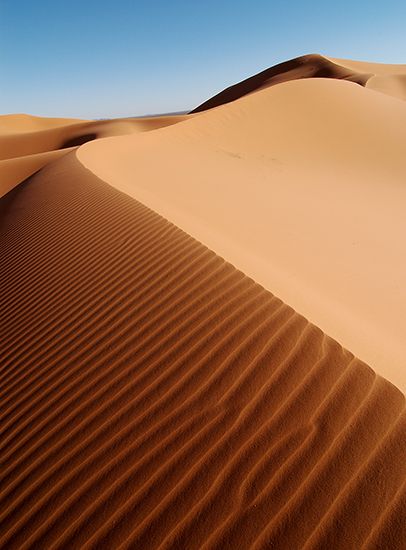
Sand deserts, often characterized by vast sand seas or ergs, are defined by large accumulations of loose, mobile sand grains shaped by the wind into sand dunes. These environments are considered the harshest and poorest of desert habitats due to the lack of stable ground and minimal vegetation. The sand is typically composed of quartz particles, which accumulate over millions of years as other minerals weather away.789
Rocky Steppes
In contrast, rocky steppes—often referred to as regs or gibber plains—are characterized by surfaces covered in coarse gravel, stones, and boulder-strewn plateaus. These areas are frequently coated with a dark, glossy patina known as desert varnish.8
While both environments are arid, the steppe is generally a transitional, semiarid region located on the periphery of true deserts. Steppes receive slightly more precipitation than true deserts, which allows for more stable soil and the growth of grasses or scrub vegetation. Unlike the mobile sand of an erg, the rocky surface of a steppe provides a more stable substrate that can support limited grazing for livestock.1011128
How have nomadic tribes historically survived in this arid environment?
Nomadic tribes, such as the Bedouin, have historically survived in arid environments like the Syrian Desert through a lifestyle of pastoral nomadism. This survival strategy relies on several key practices:
- Cyclical Migration: Tribes move their herds in established, seasonal patterns—often called transhumance orbits—to locate necessary pasturage and water sources, which are scarce and unevenly distributed.1516
- Livestock Specialization: Survival is tied to domesticated animals, primarily camels, sheep, and goats. Camels are particularly vital in the Syrian and Arabian deserts due to their endurance, allowing tribes to occupy vast, otherwise uninhabitable territories.1718
- Symbiotic Trade: Nomads often maintain economic relationships with settled societies, trading animal products for grain, manufactured goods, or services they cannot produce themselves.1516
- Social Structure: Tribal organization, led by a sheikh and councils of elders, provides the social cohesion necessary for managing resources, defending territory, and organizing collective movements.1716
While historically characterized by raiding and fierce independence, these groups have increasingly adapted to modern state boundaries, technology, and settlement programs.1718
What is the significance of the Levant and Mesopotamia regions?
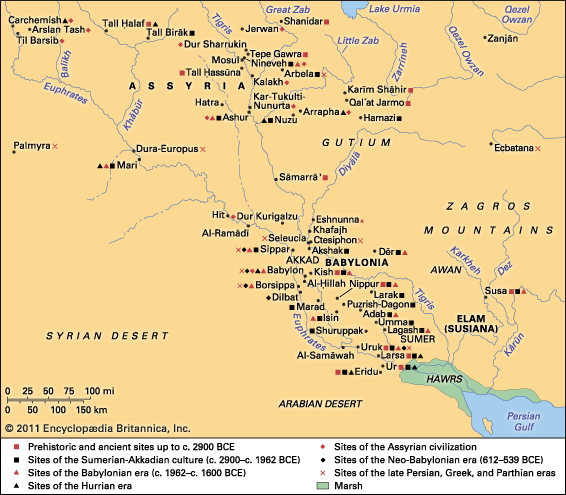
The regions of Mesopotamia and the Levant are historically significant as foundational pillars of human civilization, often linked together within the Fertile Crescent.
Mesopotamia: The Cradle of Civilization
Mesopotamia, located between the Tigris and Euphrates rivers, is widely recognized as a “cradle of civilization”. Its significance stems from:20
- Agricultural Innovation: The development of irrigation allowed early societies to thrive in an otherwise arid environment, supporting large populations and the rise of the world’s first complex urban centers.2120
- Intellectual Achievements: It was the birthplace of cuneiform, one of the earliest systems of writing, which facilitated record-keeping, law, and literature.2120
- Imperial History: The region saw the rise of influential civilizations, including the Sumerians, Akkadians, Babylonians, and Assyrians, which established early models for governance and monumental architecture.2022
The Levant: A Vital Corridor
The Levant, situated along the eastern Mediterranean coast, served as a critical sociocultural and geographic bridge.23
- Trade and Connectivity: Its coastal plains acted as a common corridor for trade networks, such as the Via Maris, connecting Egypt with the Fertile Crescent.23
- Cultural Crossroads: The region was a nexus for human movement and interaction, facilitating the exchange of goods, ideas, and religious traditions between major empires in Mesopotamia, Egypt, and later, the Mediterranean world.2322
- Strategic Importance: Throughout history, the Levant’s location made it a focal point for imperial rivalries, including those between the Byzantine and Sasanian empires, as well as a center for diverse religious and linguistic communities.2322
Sources
- Syrian Desert — Encyclopædia Britannica
- Syria - Relief — Encyclopædia Britannica
- Syrian Desert — Merriam-Webster
- Syria - History — Encyclopædia Britannica
- Syria - Temperature and precipitation — Encyclopædia Britannica
- Syria - Land — Encyclopædia Britannica
- Desert - Environment — Encyclopædia Britannica
- sand mountain — Encyclopædia Britannica
- sand dune — Encyclopædia Britannica
- Namib - Physiography — Encyclopædia Britannica
- sand dune - Sands — Encyclopædia Britannica
- Mid-latitude steppe and desert climate — Encyclopædia Britannica
- Tropical and subtropical steppe climate — Encyclopædia Britannica
- the Steppe - Geography of adjacent regions — Encyclopædia Britannica
- pastoral nomadism — Encyclopædia Britannica
- Bedouin — Encyclopædia Britannica
- Sahara - People of the Sahara — Encyclopædia Britannica
- Primitive culture - Herding societies — Encyclopædia Britannica
- Arabian Desert - People of the Arabian Desert — Encyclopædia Britannica
- history of Mesopotamia - The background — Encyclopædia Britannica
- Levant — Encyclopædia Britannica
- Fertile Crescent — Encyclopædia Britannica
- Tigris-Euphrates river system: Top Questions — Encyclopædia Britannica
- ancient Middle East - Evolution of Middle Eastern civilizations — Encyclopædia Britannica
- Fertile Crescent — Merriam-Webster
- Palmyra: Top Questions — Encyclopædia Britannica
- Middle East - Ancient history — Encyclopædia Britannica
Published on · 4 min read