Trümmelbach Falls
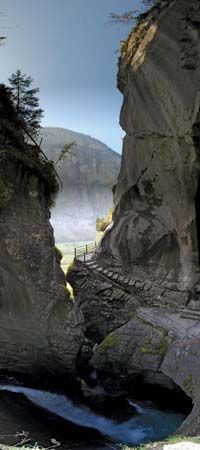
Trümmelbach Falls are a series of ten glacier-fed waterfalls located on the Trümmelbach River in the Bernese Alps of south-central Switzerland.
What is Trümmelbach Falls?
Trümmelbach Falls are a series of ten glacier-fed waterfalls located on the Trümmelbach River in the Bernese Alps of south-central Switzerland.1
These falls are a tributary of the Lütschine and are unique because they are situated inside a mountain, carved through the rock by the force of the water. The system consists of cascades fed by melting snow and ice from the surrounding glaciers. Visitors can access the falls via a combination of paths, steps, and a specialized electric elevator. The total drop of the falls is 1,300 feet (400 metres), with the highest individual cascade reaching 950 feet (290 metres).1
How do glaciers contribute to the formation of waterfalls?
Glaciers contribute to the formation of waterfalls through several distinct erosional and constructional processes that reshape the landscape.
Erosional Processes
- Hanging Valleys: As glaciers move, they carve deep, U-shaped trunk valleys. Because smaller tributary glaciers have less erosive power, they do not deepen their beds as quickly as the main glacier. When the ice retreats, these tributary valleys are left “hanging” high above the main valley floor, forcing streams to drop over the edge as waterfalls.234
- Glacial Stairways: The movement of ice over bedrock with varying resistance creates a series of “treads and risers.” After the ice melts, runoff follows these steps, resulting in a series of cascades or waterfalls at each riser.2
- Glacial Potholes: Plastic flow at the base of a glacier can gouge semicylindrical holes into the bedrock. These depressions are later deepened by meltwater runoff carrying gravel, often becoming the sites of modern cascades.2
Constructional Processes
- Ice Damming: Glaciers can block and divert rivers, creating temporary lakes. When these ice dams breach, the resulting torrents can erode deep canyons and create massive, sometimes ephemeral, waterfalls.5
- Moraines: Ridgelike deposits of sediment left by retreating glaciers can act as dams, temporarily obstructing drainage and creating waterfalls until the stream eventually cuts through the unconsolidated material.5
What other natural landmarks are found in the Bernese Alps?
The Bernese Alps are home to a variety of spectacular natural landmarks, shaped largely by their complex geological history and extensive glaciation. Beyond the famous Trümmelbach Falls, the region features:
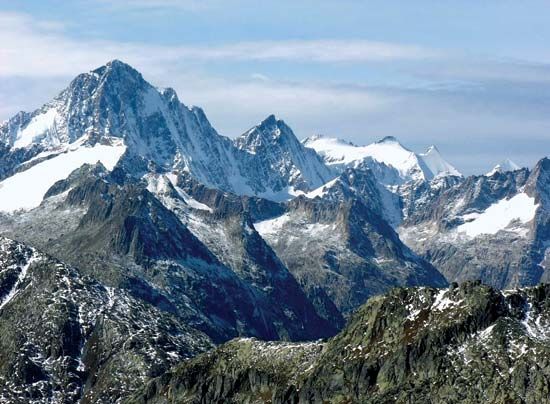
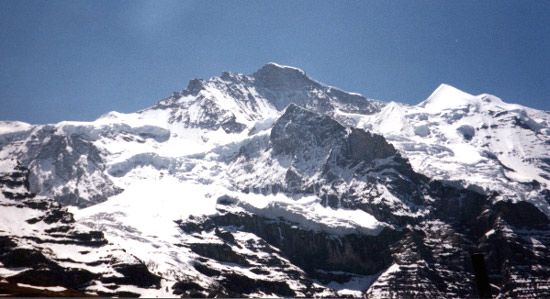
- Majestic Peaks: The range includes several of the highest mountains in the Alps, most notably the Finsteraarhorn (14,022 feet), the Jungfrau (13,642 feet), and the Aletschhorn (13,763 feet).789
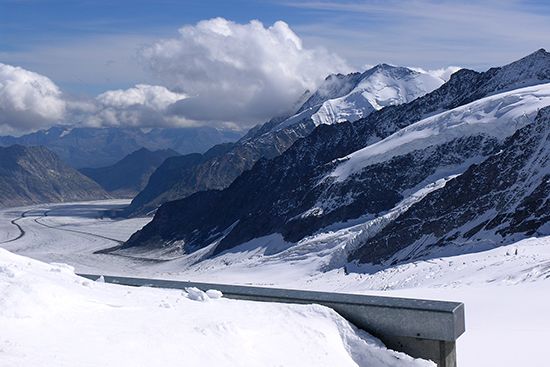
- Aletsch Glacier: As the largest and longest glacier in the Alps, the Aletsch Glacier covers approximately 66 square miles and serves as a primary feature of the high-altitude landscape.710
- Mountain Passes: The region is traversed by significant historical and transit routes, including the Lötschen, Gemmi, and Pillon passes, as well as the Lötschberg railway tunnel.7
- Scenic Valleys and Waterfalls: The Lauterbrunnen Valley is particularly renowned for its dramatic topography, featuring hanging valleys that produce iconic waterfalls like the Staubbach Falls.11
These landmarks have contributed to the development of world-famous mountain resorts, such as Interlaken, Grindelwald, Mürren, and Wengen, which serve as gateways to the region’s rugged terrain.78
How does the Lauterbrunnen Valley get its name?
The name “Lauterbrunnen” is derived from the German words lauter, meaning “clear” or “pure,” and brunnen, which translates to “springs” or “fountains.” Collectively, the name refers to the “many springs” or “clear fountains” that characterize the valley, which is famous for its numerous waterfalls cascading down the steep cliff walls.
While the provided search results confirm the linguistic roots of lauter as “clear” or “pure,” they do not explicitly detail the etymological history of the full compound name “Lauterbrunnen.” However, the valley’s geography—noted for its abundance of water features like Staubbach Falls and Trümmelbach Falls—is widely recognized as the source of this descriptive name.15116
Sources
- Trümmelbach Falls — Encyclopædia Britannica
- river - Falls attributable to discordance of river profile — Encyclopædia Britannica
- glacial landform - Hanging valleys — Encyclopædia Britannica
- river - Falls attributable to constructional processes — Encyclopædia Britannica
- glacial valley — Encyclopædia Britannica
- glacier - Glacier hydrology — Encyclopædia Britannica
- Bernese Alps — Encyclopædia Britannica
- Alps - Geology — Encyclopædia Britannica
- Aletsch Glacier — Encyclopædia Britannica
- Bern — Encyclopædia Britannica
- Jungfrau — Encyclopædia Britannica
- Lake Lucerne — Encyclopædia Britannica
- Lake Biel — Encyclopædia Britannica
- Bernina Alps — Encyclopædia Britannica
- Staubbach Falls — Encyclopædia Britannica
- lauter — Merriam-Webster
- lauter — Merriam-Webster
Published on · 3 min read