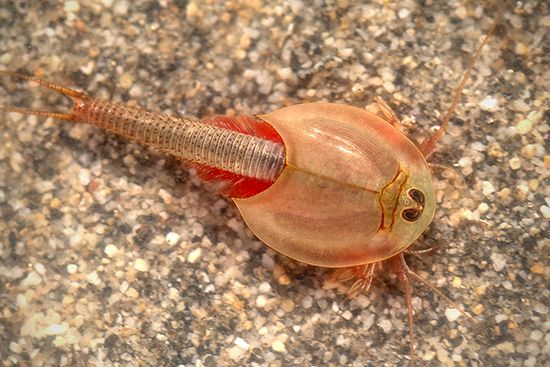
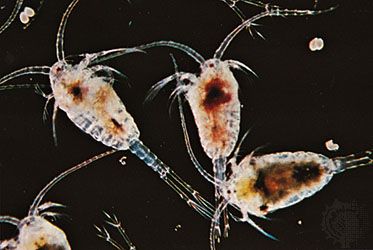
Water Flea
Most water fleas, which belong to the crustacean order Anomopoda, are filter feeders that consume microscopic particles of organic matter.
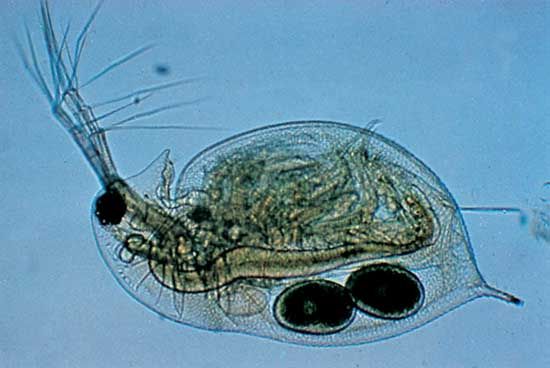
How do water fleas feed, and what types of food do they consume?
Most water fleas, which belong to the crustacean order Anomopoda, are filter feeders that consume microscopic particles of organic matter.1
Feeding Mechanism
Water fleas utilize specialized thoracic limbs to gather food from the water. These limbs are equipped with fine, hairlike structures called setae that form filters. As the animal moves, these filters strain suspended material from the water, and an elaborate mechanism then shifts the trapped particles toward the mouth.123
Diet
Their diet primarily consists of tiny organic particles, including bacteria, which makes them important for cleansing water in environments like reservoirs. While most species rely on this filtering process, there are exceptions:2
- Predatory behavior: Some species, such as the giant Leptodora, are predators rather than filter feeders.1
- Age-related changes: Certain branchiopods may shift their feeding habits as they mature, transitioning from consuming small particles to acting as predators.2
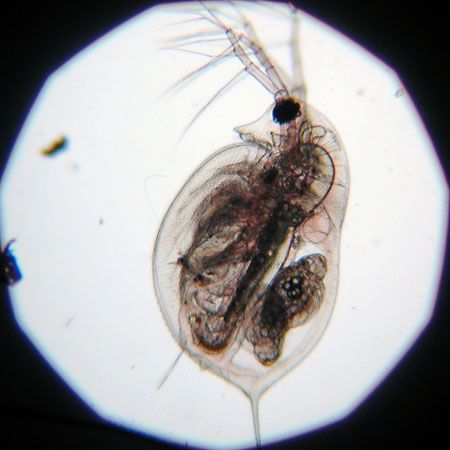
What is the typical size range of water fleas, and how does this affect their behavior?
Water fleas are typically microscopic, generally measuring between 0.2 and 3.0 millimeters (0.01 to 0.12 inch) in length. An notable exception is the predatory genus Leptodora, which can grow up to 18 millimeters long and possesses a reduced carapace.1
This size range significantly influences their behavior and ecological role:
- Locomotion: Most species use their antennae to swim, often producing a characteristic “hopping and sinking” motion through the water.1
- Feeding: Their small size necessitates a filter-feeding strategy for most species, as they rely on specialized thoracic limbs to strain microscopic organic particles from the water.1
- Ecological Impact: Because of their small size and abundance, they serve as a vital food source for many organisms, including nearly all commercial fish species in the Great Lakes of North America.1
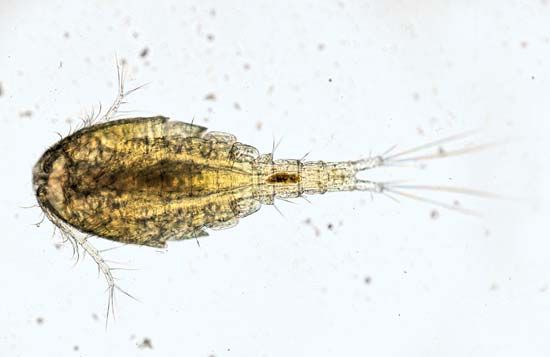
How have water fleas evolved over time, and what are their closest relatives in the crustacean family?
Water fleas belong to the order Anomopoda, which is part of the class Branchiopoda within the subphylum Crustacea.14
Evolution and Fossil History
The evolutionary history of Branchiopoda dates back to pre-Devonian times. While some Cambrian fossils have been suggested as potential branchiopod ancestors, these classifications remain uncertain. The fossil record for Anomopoda specifically is relatively sparse, as their bodies are small and delicate; however, their durable resting eggs, known as ephippia, have been identified in deposits dating back to the Oligocene and possibly the Cretaceous. Scientists often use the presence of these fossils, alongside other biological indicators, to reconstruct the environmental and climatic histories of ancient lakes.5
Closest Relatives
Within the class Branchiopoda, water fleas are classified under the suborder Cladocera, which includes several other infraorders that share similar morphological traits, such as a reduced or bivalved carapace and specialized swimming antennae. Their closest relatives within this group include:4
- Ctenopoda: Short-bodied filter feeders with six pairs of trunk limbs.4
- Onychopoda: Predatory forms with a carapace reduced to a dorsal brood pouch and four pairs of grasping limbs.4
- Haplopoda: Represented by the genus Leptodora, these are specialized plankton feeders with a highly reduced carapace and elongated head.4
What are the key characteristics that define water fleas as crustaceans?
Water fleas are classified as members of the subphylum Crustacea because they share the fundamental biological traits characteristic of this arthropod group.1
Key characteristics that define them as crustaceans include:
- Body Structure: Like other crustaceans, water fleas possess a discrete head bearing antennae and a protective outer covering known as a carapace, which typically encloses the trunk and abdomen.71
- Appendages: They feature specialized thoracic limbs that are often broad, lobed, and fringed, which are used for locomotion or filter feeding.7101
- Sensory Organs: They possess compound eyes, a common feature among the various classes of crustaceans.1
- Habitat and Physiology: As part of the class Branchiopoda, they are primarily free-living aquatic organisms, reflecting the broader crustacean tendency to occupy diverse niches in freshwater and marine environments.7111
While they are among the smallest members of the subphylum, their internal organization and developmental patterns align with the broader classification of crustaceans.112
Sources
- water flea — Encyclopædia Britannica
- branchiopod - Ecology — Encyclopædia Britannica
- Filter feeding — Encyclopædia Britannica
- branchiopod - Annotated classification — Encyclopædia Britannica
- crustacean - Evolution and paleontology — Encyclopædia Britannica
- branchiopod - Evolution and paleontology — Encyclopædia Britannica
- crustacean - Distribution and abundance — Encyclopædia Britannica
- flea - Evolution, paleontology, and classification — Encyclopædia Britannica
- arthropod - Critical appraisal — Encyclopædia Britannica
- branchiopod - Size range and diversity of structure — Encyclopædia Britannica
- branchiopod - Distinguishing taxonomic features — Encyclopædia Britannica
- crustacean - Size range and diversity of structure — Encyclopædia Britannica
- water flea — Merriam-Webster
Published on · 4 min read