Great Lake
The Great Lakes were formed through the movement of massive glaciers during the Pleistocene Epoch, a process beginning about one million years ago. These…
How was Great Lake formed, and what are its unique geological features?
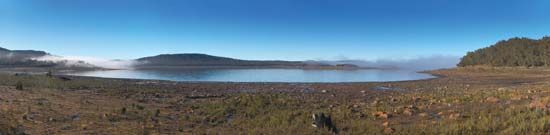
The Great Lakes were formed through the movement of massive glaciers during the Pleistocene Epoch, a process beginning about one million years ago. These glaciers scoured and widened pre-existing river valleys, creating deep basins that began filling with water as the ice sheets receded approximately 14,000 years ago.1
The region’s geology is defined by several unique features:
- Glacial Legacy: The weight of the ice depressed the Earth’s crust; as the ice retreated, the land began to rise—a process of uplift that continues today at about 1 foot per century.1
- Diverse Bedrock: The basins contain a mix of ancient Canadian Shield rocks and Paleozoic sedimentary rocks, including limestone outcrops.1
- Distinct Formations: Areas like Pictured Rocks National Lakeshore feature sandstone cliffs carved into caves and arches by waves and ice, with mineral-stained faces.2
- Sedimentation: Deep areas contain glacial clays and organic sediments, while shorelines are often characterized by large deposits of sand and gravel.1
What impact has the creation of dams and power stations had on the natural environment of Great Lake?
The creation of dams and power-related infrastructure has significantly altered the natural environment of the Great Lakes, primarily through water diversion, habitat disruption, and changes to water quality.
Hydrological and Environmental Impacts
- Water Diversion: Humans have engineered direct diversions, such as the Chicago Sanitary and Ship Canal, which moves water out of the Great Lakes basin into the Illinois River watershed3. Conversely, water is diverted into Lake Superior from the Hudson Bay watershed. These diversions, alongside consumptive use—largely as steam from power plant cooling towers—affect lake levels, which in turn influences shoreline erosion and hydroelectric potential at Niagara Falls.34
- Habitat and Species Disruption: Historically, the damming of tributaries led to the elimination of Atlantic salmon and restricted whitefish populations by blocking spawning routes.5
- Infrastructure Challenges: Engineering projects like jetties and breakwaters can interfere with natural circulation, leading to sediment buildup in harbors or increased erosion along previously stable shorelines.6
While these structures serve essential energy and water management needs, they often conflict with ecological health and property interests. We could dive deeper into the specific pollution control efforts currently underway to mitigate these human impacts.4
How does the climate of the Great Lake region affect its ecosystem and water levels?
The climate of the Great Lakes region is profoundly shaped by the lakes themselves, which act as massive heat reservoirs. By absorbing heat during warmer months and releasing it during colder ones, the lakes moderate the regional climate, resulting in cooler summers and warmer winters than would otherwise occur.3910
Impact on Ecosystems
This climate modification directly influences local ecosystems:
- Snowbelts: During winter, cold air passing over the relatively warmer lake water becomes moisture-laden and unstable. This creates significant “lake-effect” snowfall along the eastern and downwind shores, supporting unique microclimates and vegetation patterns in areas like Buffalo and Traverse City.310
- Thermal Regulation: The lakes’ ability to store heat influences the timing of ice formation and melting. This thermal cycle dictates the seasonal behavior of aquatic life and the duration of ice cover, which serves as a critical barrier for energy exchange between the atmosphere and the water.1112
Impact on Water Levels
Water levels are sensitive to the balance between precipitation and evaporation, both of which are influenced by regional climate patterns:
- Precipitation and Evaporation: The lakes receive their primary supply from precipitation, yet 65 to 85 percent of this is lost to evaporation.3
- Seasonal Fluctuations: Levels typically vary by one to two feet annually, peaking in mid-summer and reaching their lowest points in late winter.3
- Atmospheric Disturbances: Winds and changes in barometric pressure can trigger seiches—harmonic oscillations that cause temporary, dramatic shifts in water levels across different parts of a lake.3
What is the history of human settlement around Great Lake?
The Great Lakes region has a rich history of human settlement, beginning centuries ago with numerous American Indian peoples who inhabited the area long before European arrival.13
European Exploration and Conflict
European interest began in the 16th and 17th centuries as explorers sought routes to the Orient. Samuel de Champlain is credited as the first European to see the Great Lakes, reaching Lake Huron in 1615. Early French activity included missionary work and the establishment of settlements, such as the mission at Sault Ste. Marie and St. Ignace. The region was later shaped by three major conflicts: the French and Indian War, the American Revolution, and the War of 1812, which ultimately defined the international boundary between the United States and Canada.1314
Economic Development and Urbanization
The lakes served as a vital transportation route, fueling the growth of industries based on the region’s abundant timber, fertile land, and mineral deposits like iron, copper, and limestone. This resource wealth, combined with a reliable water supply, led to the development of major metropolitan areas, including Chicago, Detroit, Milwaukee, and the Toronto-Hamilton area.1514
Sources
- Great Lakes - Geology — Encyclopædia Britannica
- Pictured Rocks National Lakeshore — Encyclopædia Britannica
- Great Lakes - Hydrology and climate — Encyclopædia Britannica
- lake - Bottom morphology — Encyclopædia Britannica
- Great Lakes - Plant and animal life — Encyclopædia Britannica
- dam - Rise of environmental and economic concerns — Encyclopædia Britannica
- Great Lakes - Human impact on the lakes — Encyclopædia Britannica
- Asian carp — Encyclopædia Britannica
- Great Lakes: Top Questions — Encyclopædia Britannica
- ice in lakes and rivers - The seasonal cycle — Encyclopædia Britannica
- ice in lakes and rivers - Changes in temperature structure — Encyclopædia Britannica
- lake - Problems and effects — Encyclopædia Britannica
- Great Lakes - Study and exploration — Encyclopædia Britannica
- Great Lakes - The economy — Encyclopædia Britannica
- Lake Huron — Encyclopædia Britannica
Published on · 4 min read