What Are the Differences Between Pythons and Anacondas?
While both pythons and anacondas are large, powerful snakes, they differ significantly in their biology and habitat.
What are the differences between pythons and anacondas?
While both pythons and anacondas are large, powerful snakes, they differ significantly in their biology and habitat.1
Geographical Distribution
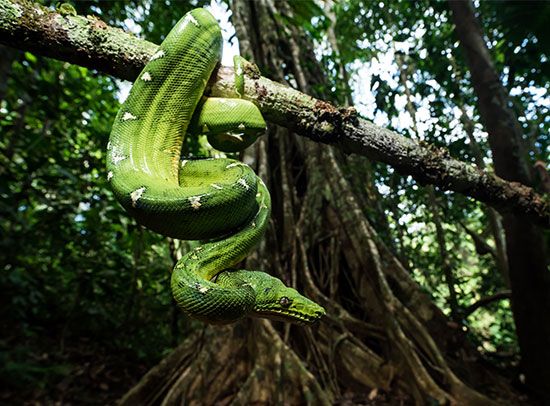
Pythons are found in the Old World tropics and subtropics, including sub-Saharan Africa, India, Southeast Asia, and Australia. Conversely, anacondas are native to South America, primarily inhabiting the Amazon and Orinoco River basins.1
Physical Characteristics
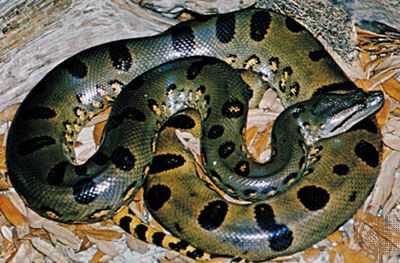
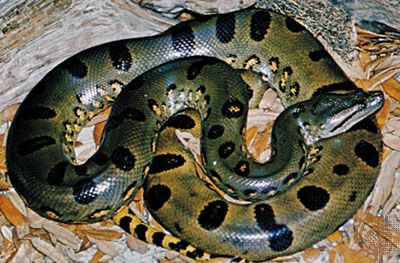
Anacondas are the heaviest snakes in the world, characterized by a robust, thick girth, whereas pythons are generally more elongated. While some pythons, such as the reticulated python, can grow longer than anacondas, they are typically lighter in weight.1
Reproductive Habits
The most distinct difference lies in how they reproduce:
- Pythons: These snakes are oviparous, meaning they lay eggs. Females often coil around their clutch to incubate them using muscle contractions to generate heat.1
- Anacondas: These snakes are viviparous. They retain their eggs internally until they hatch, giving birth to live young.1
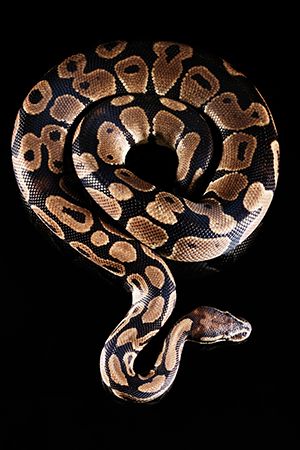
What are heat-sensing pits and how do they help snakes hunt?
Heat-sensing pits are specialized infrared receptors found on the heads of certain snakes, including pit vipers, boas, and pythons. These organs allow these reptiles to detect the thermal signatures of warm-blooded prey, such as mammals and birds, even in total darkness.34
In pit vipers, these organs consist of deep chambers separated by a thin membrane rich in nerves and blood vessels, located between the nostril and the eye. Pythons and boas possess analogous structures known as labial pits, which appear as depressions along their lip scales. These pits are lined with thin skin and supplied with dense networks of capillaries and nerve fibers.34
Functionally, these organs act as a form of binocular vision, enabling snakes to “see” heat images and accurately aim their strikes. By detecting temperature differences as small as 0.6 °C (1.1 °F), these pits help the snake confirm the identity of its prey and precisely target it during a strike.43
What does it mean for a snake to be oviparous versus viviparous?
In the study of snake reproduction, the terms oviparous and viviparous describe two distinct methods of bringing offspring to term.
Oviparous (Egg-Laying)
Oviparous snakes deposit their eggs in a protected environment, such as a damp, dark, or warm location, after fertilization.56
- Development: In most species, the embryo develops outside the mother’s body after the eggs are laid.56
- Parental Care: While many species abandon their eggs, some snakes remain with the clutch to protect them, and a few even assist in incubation by generating body heat through muscle contractions.56
- Hatching: When ready, the hatchling uses a specialized egg tooth to cut through the shell and membranes to emerge.6
Viviparous (Live-Bearing)
Viviparous snakes retain their developing young within the mother’s body, eventually giving birth to live neonates.56
- Development: This process ranges from the retention of unshelled eggs in the oviduct to the development of placentae that facilitate the exchange of nutrients, oxygen, and waste between the mother and the fetus.6
- Birth: The neonates are born live, often struggling to break free from their encapsulating membranes if they do not rupture during birth.6
Some species exhibit an intermediate state known as ovoviviparous development, where eggs are retained in the oviduct until they hatch, but without the complex placental connection seen in true viviparous species.57
How do large snakes like pythons and anacondas kill their prey?
Large snakes such as pythons and anacondas are nonvenomous constrictors that secure their food through a specialized physical method.89
When hunting, these snakes typically strike their prey and hold it firmly with their teeth. They then rapidly throw a series of body coils around the animal. These coils are tightened until the prey’s respiration becomes impossible, leading to death by suffocation. Contrary to popular belief, these snakes very seldom crush or break the bones of their prey.9
In the case of anacondas, they often hunt by ambushing prey from the water, seizing the animal by the neck before applying their coils. While constriction is the primary method for large prey, some snakes may also kill smaller animals, such as small turtles or birds, using only their mouths and sharp, backward-pointing teeth. Once the prey is immobilized, the snake consumes it whole.8109
Sources
- What are the differences between pythons and anacondas? — Encyclopædia Britannica
- What are the differences between pythons and boa constrictors? — Encyclopædia Britannica
- reptile - Chemoreception — Encyclopædia Britannica
- viper — Encyclopædia Britannica
- snake - Egg formation and laying — Encyclopædia Britannica
- Animal reproductive system - Provisions for the developing embryo — Encyclopædia Britannica
- reptile - Embryonic development and parental care — Encyclopædia Britannica
- What are the differences between anacondas and boa constrictors? — Encyclopædia Britannica
- anaconda — Encyclopædia Britannica
- snake - Specializations for securing food — Encyclopædia Britannica
- constrictors — Merriam-Webster
Published on · 3 min read