Yap Trench
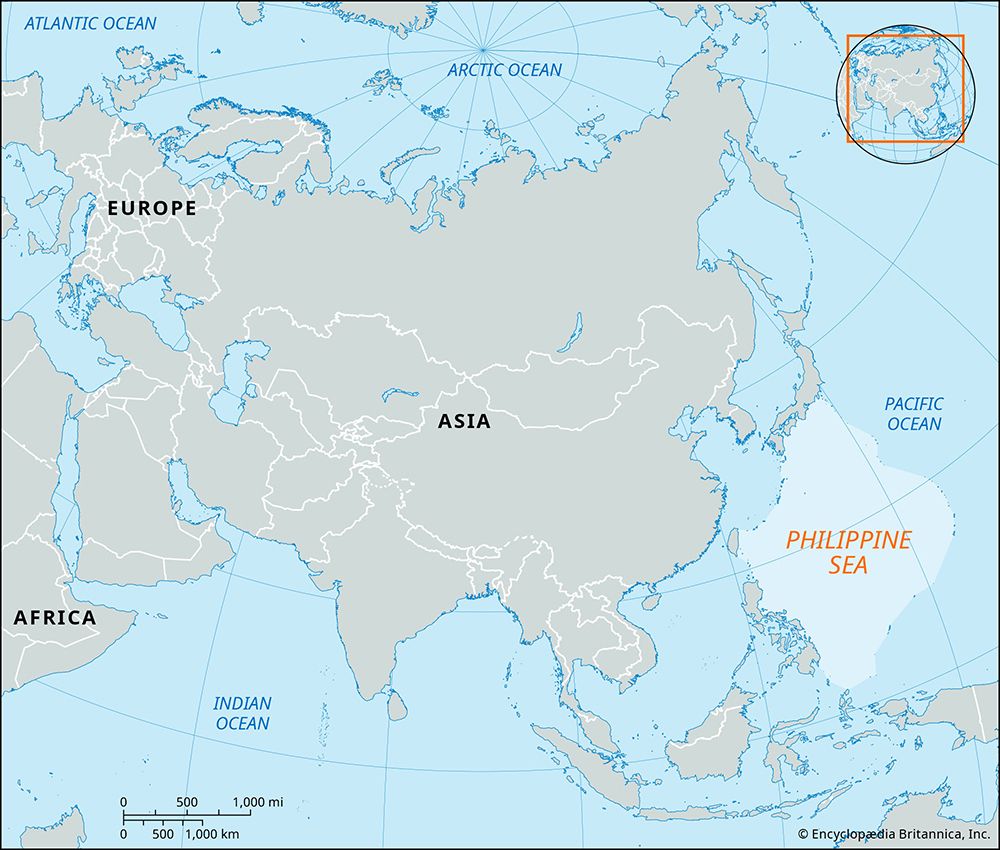
The Yap Trench is a deep submarine trench located in the western Pacific Ocean, situated east of the Yap Ridge and the Yap island group. Extending…
What is Yap Trench?
The Yap Trench is a deep submarine trench located in the western Pacific Ocean, situated east of the Yap Ridge and the Yap island group. Extending approximately 400 miles (650 km) from north to south, it reaches a maximum depth of 27,976 feet (8,527 m) northeast of the Palau Islands.1
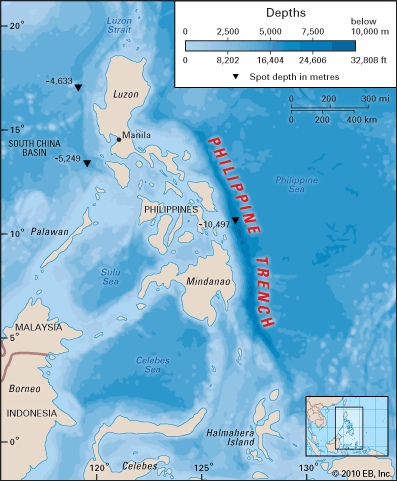
Geologically, the trench is part of a significant chain of deep-sea trenches that stretches from the southwestern edge of the Bering Sea southward toward the Philippine Trench. This chain also includes the Kuril, Japan, Izu, and Mariana trenches. Notably, the greatest known depth of the Pacific Ocean, the Trieste Depth, is found near the intersection of the Yap and Mariana trenches. The region is characterized by complex tectonic activity, contributing to the structural basin of the Philippine Sea.12
How are deep-sea trenches formed by tectonic plates?
Deep-sea trenches are formed through the process of subduction, which occurs at convergent plate boundaries where two tectonic plates collide.34
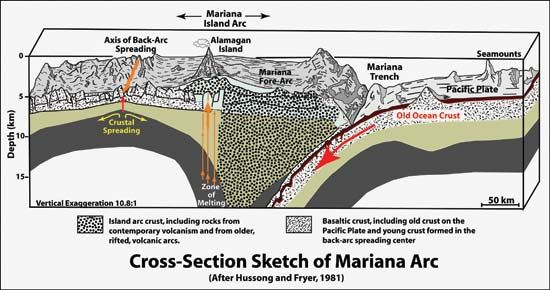
When an oceanic plate meets another plate—either another oceanic plate or a continental plate—the older, denser oceanic crust is forced downward into the Earth’s mantle. This descent is driven by gravity and the increased density of the cooling oceanic lithosphere. As the descending plate bends and slides beneath the overriding plate, it creates a deep, V-shaped topographic depression known as a deep-sea trench.54637
The formation of these trenches involves several key dynamics:
- Frictional Drag: As the subducting plate bends, frictional drag between the two plates contributes to the creation of the trench’s steep-sided, narrow profile.7
- Accretionary Wedges: The overriding plate often scrapes sediments and oceanic crust off the descending plate, forming a chaotic mixture of rocks called an accretionary wedge.7
- Volcanic Activity: As the subducting slab reaches depths of about 100 km, it releases volatile components that trigger melting in the mantle above it. This produces magma that rises to form volcanic arcs or island arcs parallel to the trench.38
What is the difference between the Yap Trench and the Mariana Trench?
The Yap and Mariana trenches are both significant features of the western Pacific’s system of oceanic trenches, formed by the subduction of tectonic plates1. While they are part of the same geological chain, they differ in scale and prominence:1
- Dimensions: The Mariana Trench is significantly larger, stretching over 1,580 miles (2,540 km) in length with a mean width of 43 miles (69 km). In contrast, the Yap Trench is much shorter, extending approximately 400 miles (650 km).910
- Depth: The Mariana Trench is the deepest known trench on Earth, containing the Challenger Deep, which reaches depths of approximately 36,201 feet (11,034 m). The Yap Trench reaches a maximum depth of 27,976 feet (8,527 m).910
- Location and Intersection: The two trenches are geographically distinct but intersect; the greatest known depth of the Pacific Ocean occurs near the point where the Mariana and Yap trenches meet.10
Both trenches are associated with volcanic island arcs created by the melting of subducting plates, though the Mariana Trench is more extensively documented regarding its formation and exploration history.93
What kinds of creatures live in the deepest parts of the ocean?
Life in the deepest parts of the ocean—specifically the aphotic zone and the hadal zone of deep-sea trenches—is uniquely adapted to extreme hydrostatic pressure, total darkness, and cold temperatures.111213
Because these regions lack sunlight, photosynthesis cannot occur. Consequently, organisms rely on two primary food sources:
- Marine Snow: Many creatures feed on organic matter, such as dead marine organisms and waste, that “rains down” from the upper, sunlit layers of the ocean.1213
- Chemosynthesis: Near deep-sea hydrothermal vents, life is supported by chemoautotrophic bacteria. These bacteria oxidize sulfides to produce energy, forming the base of a food web that includes mussels, large bivalve clams, vestimentiferan worms, and various crabs.14
Inhabitants of these depths, such as certain fish, crabs, clams, and ciliates, have evolved to survive high pressures by lacking air-filled compartments like lungs or swim bladders. Many species exhibit bioluminescence to navigate or attract prey in the darkness, and some have developed symbiotic relationships with bacteria to thrive in nutrient-poor environments.121514
Sources
- Yap Trench — Encyclopædia Britannica
- Philippine Sea — Encyclopædia Britannica
- How was the Mariana Trench formed? — Encyclopædia Britannica
- subduction zone — Encyclopædia Britannica
- plate tectonics - Subduction zones — Encyclopædia Britannica
- deep-sea trench - Types — Encyclopædia Britannica
- plate tectonics - Convergent margins — Encyclopædia Britannica
- plate tectonics - Island arcs — Encyclopædia Britannica
- Pacific Ocean: Top Questions — Encyclopædia Britannica
- Mariana Trench — Encyclopædia Britannica
- abyssal zone — Encyclopædia Britannica
- life - Temperature and desiccation — Encyclopædia Britannica
- Marine ecosystem - Organisms of the deep-sea vents — Encyclopædia Britannica
- Marine ecosystem - Geography, oceanography, and topography — Encyclopædia Britannica
- Biosphere - Hydrostatic pressure — Encyclopædia Britannica
Published on · 3 min read