Starfish Flower
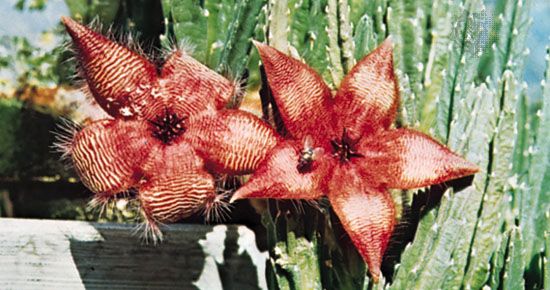
The starfish flower refers to plants within the genus Stapelia, a group of approximately 44 species of succulent plants belonging to the milkweed family…
What is Starfish flower?
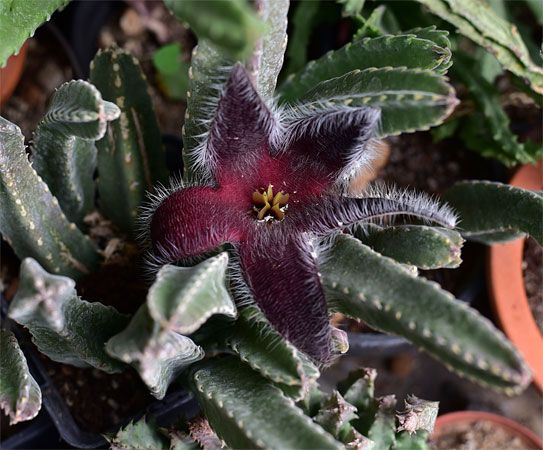
The starfish flower refers to plants within the genus Stapelia, a group of approximately 44 species of succulent plants belonging to the milkweed family (Apocynaceae). Native to tropical regions of southern Africa, these plants are often mistaken for cacti due to their thick, four-sided, and often leafless stems, though they are not botanically related.123
The plant is best known for its distinctive, star-shaped flowers, which frequently feature purple, red, or yellow markings and a hairy or textured surface. These flowers emit a putrid, carrion-like odor that serves an evolutionary purpose: it attracts flies, which then pollinate the plant and lay their eggs on the blooms. While some species are grown as ornamental plants, their unique scent makes them a notable curiosity in the botanical world.13
How do carrion flowers attract pollinators?
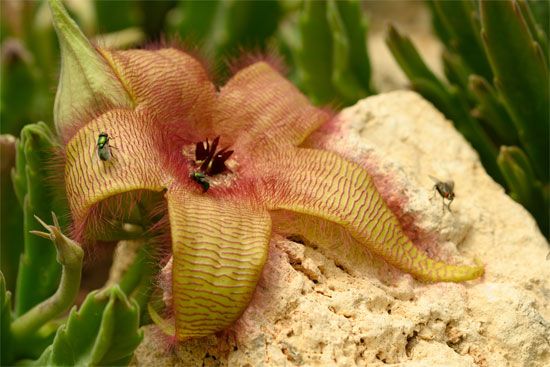
Carrion flowers attract pollinators by employing a strategy of deception, mimicking the sensory cues of rotting flesh or dung to lure scavenging insects, such as carrion beetles and flesh flies.45
These plants utilize several specific adaptations to ensure successful pollination:
- Olfactory Mimicry: They produce strong, malodorous fumes that replicate the scent of decaying organic matter, which serves as a natural guide for insects seeking sites for food or egg deposition.46
- Visual Deception: Many species, such as the titan arum and members of the genus Stapelia, feature mottled red or brown petals and textured, sometimes oozing surfaces that visually resemble rotting flesh.57
- Thermal Regulation: Some carrion flowers, like the cuckoopint, generate heat to increase the vaporization rate of their scent, allowing the odor to spread over a wider area.47
- Entrapment Mechanisms: Certain species use elaborate structures to temporarily trap visitors. For instance, the cuckoopint uses slippery oil droplets and spines to ensure an insect remains inside long enough to deposit or collect [pollen].47
What are some other examples of succulent plants?
Succulents are plants characterized by thick, fleshy tissues adapted for water storage, allowing them to thrive in arid or semiarid environments. While cacti are the most well-known group, many other plants exhibit succulent traits and are popular as houseplants.89
Common Non-Cactus Succulents
- Leaf Succulents: These plants store water primarily in their leaves. Examples include:8
- Aloe: Renowned for its medicinal properties.9
- Echeveria: Often called “hen and chickens” for their rosette growth habit.98
- Kalanchoe: Includes the panda plant (K. tomentosa).98
- Crassula: Commonly known as the jade plant8.
- Haworthia: Features rosettes with distinctively dotted leaves.9
- Sansevieria: Known as snake plants, these are highly durable and tolerate neglect.9
- Agaves: Another group that stores water in its leaves.8
- Stem Succulents: These plants store water in their stems, often appearing as angled or column-like structures. A primary example is the genus Euphorbia, which can visually resemble cacti.98
Many of these plants utilize crassulacean acid metabolism, a specialized form of photosynthesis that helps them minimize water loss by opening their stomata only at night.8
Why do some plants evolve to smell like rotting meat?
Some plants have evolved to smell like rotting meat as a specialized survival strategy known as sapromyiophily, or carrion-insect pollination. By mimicking the scent of dung or decaying flesh, these plants deceive specific insects—such as carrion beetles and flesh flies—that naturally seek these odors to locate food or sites for egg deposition.411
This evolutionary adaptation serves several functions:
- Attracting Pollinators: The malodorous scent acts as a powerful lure, drawing insects to the flower. Once the insect arrives, it inadvertently transfers [pollen] as it moves through the plant’s structures.114
- Enhancing Effectiveness: To maximize the reach of their scent, some species, such as the cuckoopint, generate heat to increase the vaporization rate of the odor, allowing it to spread over a wider area.114
- Ensuring Reproduction: In some cases, the deception is so convincing that insects may attempt to lay eggs on the plant, ensuring they remain in contact with the flower long enough to facilitate pollination.11
Sources
- Starfish flower — Encyclopædia Britannica
- starfish flower — Merriam-Webster
- stapelia — Merriam-Webster
- mimicry - Carrion flowers , stinkhorn mushrooms, and mosses — Encyclopædia Britannica
- Major types of pollinators - Beetles and flies — Encyclopædia Britannica
- Botanical Sex: 9 Alluring Adaptations — Encyclopædia Britannica
- Chemoreception - Attraction — Encyclopædia Britannica
- houseplant - Succulents — Encyclopædia Britannica
- Succulent — Encyclopædia Britannica
- houseplant — Encyclopædia Britannica
- mimicry - Orchids — Encyclopædia Britannica
- Chemoreception - Arthropods — Encyclopædia Britannica
Published on · 3 min read