Ceratopsian
Ceratopsians were a diverse group of plant-eating dinosaurs from the Cretaceous Period, defined by a bony neck frill and a unique beak bone called a rostral.…
What are some of the most well-known ceratopsian species?
Ceratopsians were a diverse group of plant-eating dinosaurs from the Cretaceous Period, defined by a bony neck frill and a unique beak bone called a rostral. They are generally categorized into three main lineages:12
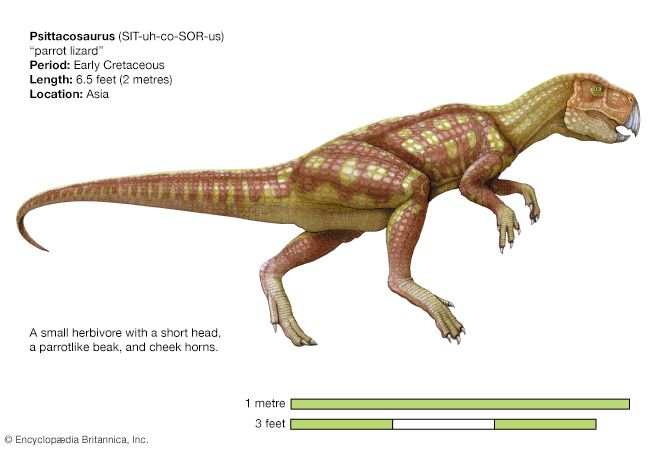
- Psittacosauridae: These were early, mostly bipedal dinosaurs, such as Psittacosaurus. They were relatively small, lacked horns, and possessed only a small frill.12
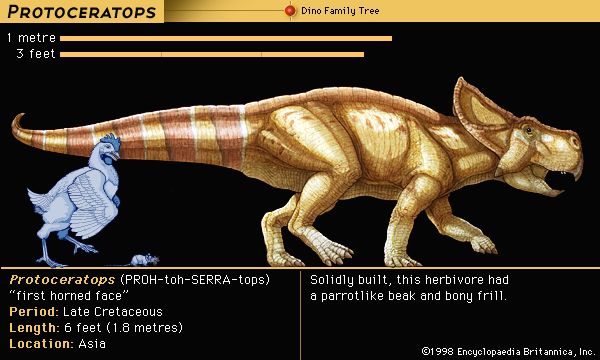
- Protoceratopsidae: Represented by the well-known Protoceratops and Leptoceratops, these were mostly quadrupedal and larger than psittacosaurids, though they still lacked the prominent horns of later species.12
- Ceratopsidae: This group includes the most advanced and famous horned dinosaurs, characterized by large frills and horns. Notable species include:12
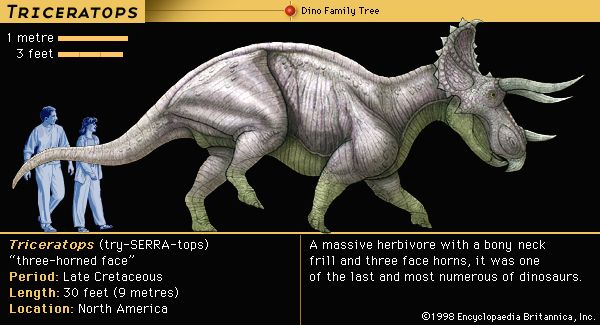
- Triceratops: The most iconic ceratopsian, known for its three horns and solid, short bony frill.13
- Torosaurus: Distinguished by an exceptionally large, thin, and perforated cranial frill.32
- Others: This lineage also includes Kosmoceratops, noted for its highly ornate skull, Utahceratops, Centrosaurus, Chasmosaurus, and Styracosaurus.12
When and where did ceratopsians live during the prehistoric era?
Ceratopsians, or “horned dinosaurs,” lived during the Cretaceous Period, which spanned from approximately 146 million to 66 million years ago. Their geographic distribution shifted as they evolved and diversified across the prehistoric landscape.51
- Early Cretaceous: The most primitive ceratopsians, such as the bipedal Psittacosauridae (e.g., Psittacosaurus), are known exclusively from Asia, specifically within the regions of modern-day Mongolia and China.51
- Early to Late Cretaceous: Protoceratopsidae members, including Protoceratops and Leptoceratops, expanded their range and are found in both Asia and North America.51
- Late Cretaceous: Advanced ceratopsids, such as Triceratops and Torosaurus, were primarily concentrated in North America, where the fossil record for the latest Cretaceous is most extensively documented.1
These dinosaurs survived until the “great extinction” at the end of the Cretaceous Period. While they varied in size and posture, their evolution reflects a clear trend of increasing specialization and geographic expansion throughout the Mesozoic Era.1
What are the defining characteristics of ceratopsian dinosaurs?
Ceratopsians, or “horn-faced” dinosaurs, were a group of plant-eating dinosaurs that lived during the Cretaceous Period. They are defined by several key anatomical characteristics:
- Rostral Bone: The most diagnostic feature of the group is the presence of a unique, toothless upper beak bone called a rostral, which opposed the lower predentary bone found in all ornithischians.14
- Skull and Frill: Ceratopsians are characterized by a bony frill extending from the back of the skull, which covered the neck and shoulders. While this structure varied from small, simple frills in early species to massive, ornate, and sometimes perforated shields in advanced forms, it is a hallmark of the group.14
- Dental Batteries: Their jaws were highly specialized, featuring massive lower jaws and batteries of teeth that functioned like self-sharpening shears, likely adapted for consuming tough, fibrous vegetation.4
- Posture: With the exception of the bipedal Psittacosaurus, most ceratopsians were obligate quadrupeds. They possessed a heavy, ponderous build with stout legs, and their first four neck vertebrae were fused to support their disproportionately large skulls.4
- Horns: While early members lacked them, advanced Ceratopsidae developed prominent horns on the nose and above the eyes, which were likely used for defense, species recognition, or intraspecific combat.14
How did ceratopsians defend themselves against predators?
The defensive strategies of ceratopsians remain a subject of scientific study, as their exact behaviors are difficult to determine from the fossil record alone. Paleontologists have proposed several ways these dinosaurs may have protected themselves:4
- Horns and Frills: The most distinctive features of advanced ceratopsids, such as Triceratops, were their horns and bony neck shields (frills). While some researchers suggest these structures served as defensive armor against predators like Tyrannosaurus rex, others argue they functioned primarily for species recognition or intraspecific combat (rutting) between males. The presence of horns in both sexes suggests that defense or social signaling were primary functions.43
- Physical Stance: Ceratopsians were obligate quadrupeds with a wide, stable stance provided by their bent forelegs. This posture likely allowed them to hold their ground, lower their heads, and direct their horns toward an opponent while resisting an attack.4
- Social Behavior: Fossil evidence, including mass assemblages, suggests that many ceratopsians lived in groups. Herding behavior may have provided a collective defense mechanism, as seen in many modern gregarious animals.7
- Direct Combat: Evidence of “fighting dinosaurs,” such as the famous fossil of a Velociraptor locked in combat with a small protoceratopsian, confirms that these dinosaurs engaged in physical confrontations with predators.8
Sources
- ceratopsian — Encyclopædia Britannica
- Protoceratops — Encyclopædia Britannica
- Triceratops — Encyclopædia Britannica
- dinosaur - Ceratopsia — Encyclopædia Britannica
- Ceratosaurus — Encyclopædia Britannica
- dinosaur - The plant eaters — Encyclopædia Britannica
- dinosaur - Tetanurae — Encyclopædia Britannica
- theropod — Encyclopædia Britannica
- dinosaur - Herding behaviour — Encyclopædia Britannica
Published on · 4 min read