Globeflower
A globeflower refers to any of approximately 20 species of perennial herbaceous plants that make up the genus Trollius within the buttercup family…
What is globeflower?
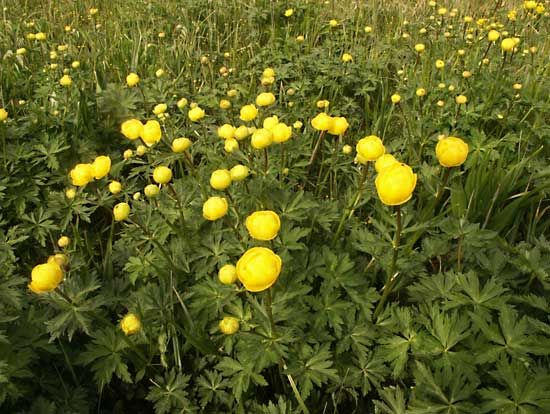
A globeflower refers to any of approximately 20 species of perennial herbaceous plants that make up the genus Trollius within the buttercup family (Ranunculaceae). These plants are primarily native to wetlands in the North Temperate Zone.1
Key characteristics include:
- Appearance: They typically feature dark green to bronzy leaves that are three- to five-lobed, resembling the fingers of a hand.1
- Flowers: Horticultural varieties often produce ball-shaped yellow to orange flowers measuring 2.5 to 5 cm (1 to 2 inches) across.1
- Varieties: The European globeflower (T. europaeus) is a popular garden plant often found near ponds, while the American spreading globeflower (T. laxus) is native to swamps in the eastern United States.1
What other plants belong to the buttercup family?
The Ranunculaceae family, commonly known as the buttercup family, is a diverse group comprising approximately 2,252 species across 62 genera. These plants are primarily herbaceous and are widely distributed throughout temperate and subtropical regions.23
Beyond the buttercup (Ranunculus), many well-known wildflowers and garden ornamentals belong to this family, including:
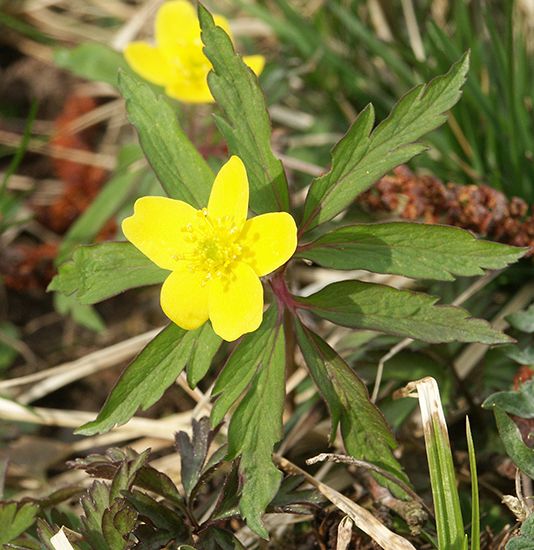
- Anemone: A genus of wild and cultivated flowers native to the North Temperate Zone.43
- Columbine: Known for their unique, beautiful flowers, these are popular North American wildflowers.43
- Larkspur: Members of the genus Delphinium, prized for their strikingly showy blooms.43
- Clematis: A large genus of over 300 species, often growing as vines.43
- Hellebore: Includes the Christmas rose, valued for midwinter blooms.43
- Monkshood: Also called wolfsbane, these perennials are known for their toxicity.43
- Marsh marigold: Wetland plants also known as cowslips or kingcups.43
- Meadow rue: A widely recognizable genus with over 300 species.43
- Hepatica, Baneberry, and Winter aconite: Additional examples of the family’s diversity.3
How do perennial plants survive through the winter?
Perennial plants survive the winter by employing various strategies to endure cold temperatures and environmental stress, primarily through a state of dormancy. This state allows plants to conserve energy and reduce metabolic activity when conditions are unfavorable.7
For herbaceous perennials, survival typically involves the death of aboveground parts in autumn, while the plant persists through underground modifications such as bulbs, corms, tubers, or rhizomes located at or below the soil surface.89
Woody plants, such as trees and shrubs, prepare for winter by ceasing shoot growth and forming resting buds. These buds contain a short axis surrounded by modified leaves that protect the stem from drying. Many deciduous trees also shed their leaves, a process triggered by declining day length and falling temperatures, which helps the plant avoid water loss and damage. These developmental changes are often regulated by environmental cues like photoperiod and the action of hormones such as abscisic acid.910
What kind of insects typically pollinate globeflowers?
Sorry, the Britannica knowledge base does not contain information regarding the specific insects that pollinate globeflowers. While the provided sources confirm that globeflowers belong to the buttercup family and discuss general pollination mechanisms and other insect pollinators, they do not identify the specific pollinators for the genus Trollius.
Sources
- globeflower — Encyclopædia Britannica
- Ranunculaceae — Encyclopædia Britannica
- Ranunculaceae — Merriam-Webster
- buttercup — Encyclopædia Britannica
- Ranunculales — Encyclopædia Britannica
- list of plants in the family Ranunculaceae — Encyclopædia Britannica
- Dormancy — Encyclopædia Britannica
- Perennial — Encyclopædia Britannica
- Leaf — Encyclopædia Britannica
- Plant development - Seasonal adaptations — Encyclopædia Britannica
- horticulture - Frost control — Encyclopædia Britannica
- Major types of pollinators - Beetles and flies — Encyclopædia Britannica
- Pollination — Encyclopædia Britannica
Published on · 2 min read