Marsh Marigold
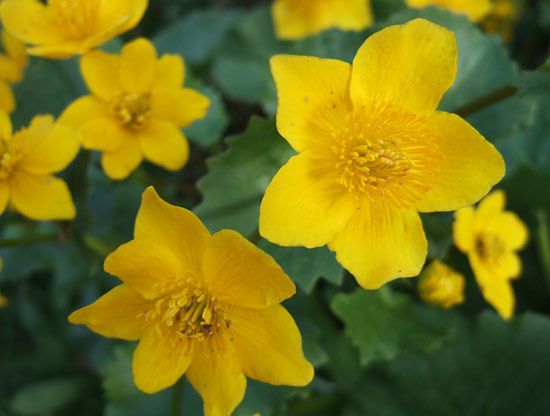
The marsh marigold (Caltha palustris) is a perennial herbaceous plant belonging to the buttercup family (Ranunculaceae). Native to wetlands across Europe and…
What is marsh marigold?
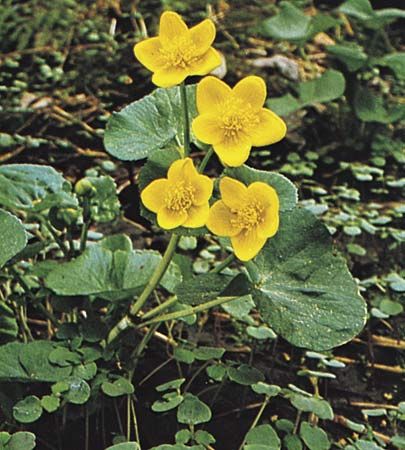
The marsh marigold (Caltha palustris) is a perennial herbaceous plant belonging to the buttercup family (Ranunculaceae). Native to wetlands across Europe and North America, it is often found in boggy gardens and is also known as a cowslip or kingcup.12
The plant features a hollow stem and leaves that are round, heart-shaped, or kidney-shaped. Its glossy flowers, which measure 2.5 to 5 cm across, lack petals and instead possess yellow, white, or pink sepals. While the raw plant is poisonous, its stems, leaves, and roots can be consumed if properly cooked, and its pickled flower buds are sometimes used as a substitute for capers.1
What other plants belong to the buttercup family?
The Ranunculaceae, commonly known as the buttercup family, is a diverse group comprising approximately 2,252 species of flowering plants across 62 genera. These plants are primarily herbaceous and are widely distributed throughout temperate and subtropical regions.34
Beyond the marsh marigold, the family includes many popular wildflowers and garden ornamentals, such as:34
- Anemone
- Baneberry
- Bugbane
- Buttercup
- Clematis
- Columbine
- Globeflower
- Goldenseal
- Hellebore (including the Christmas rose)
- Hepatica
- Larkspur
- Love-in-a-mist
- Meadow rue
- Monkshood
- Mousetail
- Pheasant’s-eye
- Winter aconite
How do wetland ecosystems support plant life?
Wetland ecosystems support plant life by providing essential access to water, though this environment presents unique challenges that dictate which species can thrive. Because wetlands are often waterlogged, the soil frequently lacks sufficient oxygen, forcing plants to adapt to anoxic conditions to survive5.5
Key ways these ecosystems support and shape plant life include:
- Hydrologic Adaptation: Plants in wetlands, often called hydrophytes, have evolved to tolerate submersion. For example, many swamp trees develop shallow, lateral root systems rather than deep roots, which helps them access oxygen near the surface and provides stability against water flow and wind. Some tropical trees also develop buttresses for additional support.6
- Nutrient Cycling: Wetlands act as “the kidneys of the landscape,” playing a vital role in nutrient cycling. Periodic flooding, known as pulse stability, introduces large volumes of water and nutrients into the system, which many wetland species have adapted to and even become dependent upon.78
- Niche Availability: As transition zones between terrestrial and aquatic systems, wetlands provide diverse habitats that support a wide range of biodiversity, including rare and endangered species.7
Why must some plants be cooked before they are safe to eat?
Some plants must be cooked or processed before consumption because they contain natural toxins that can cause illness or even death if ingested raw. These phytotoxins are chemical defense mechanisms evolved by plants to protect themselves from being eaten.
Common reasons for cooking or specific preparation include:
- Neutralizing Harmful Compounds: Certain plants, such as cassava, contain cyanophoric glycosides that can release toxic substances if not properly processed. Similarly, some plants contain alkaloids or other compounds that cause severe gastrointestinal or neurological distress.
- Reducing Natural Toxicants: Some vegetables develop toxins due to environmental factors. For example, solanine can accumulate in potatoes exposed to light or improper storage. While peeling or removing green areas helps, proper preparation is essential to minimize intake of these substances.
- Eliminating Contaminants: Beyond natural toxins, cooking and thorough washing help reduce exposure to pesticide residues, microbes, and other environmental contaminants that may be present on the surface of produce.11
It is important to note that while cooking reduces many risks, some toxins—such as mercury in certain fish—remain unaffected by heat.11
Sources
- marsh marigold — Encyclopædia Britannica
- marsh marigold — Merriam-Webster
- Ranunculaceae — Encyclopædia Britannica
- list of plants in the family Ranunculaceae — Encyclopædia Britannica
- Swamp — Encyclopædia Britannica
- Wetland - Origin of wetlands — Encyclopædia Britannica
- Wetland - Wetland functions and ecosystem benefits — Encyclopædia Britannica
- Wetland - Freshwater marshes — Encyclopædia Britannica
- Wetland - Community structure and ecosystem development — Encyclopædia Britannica
- Wetland - Climate — Encyclopædia Britannica
- poison - Plant poisons (phytotoxins) — Encyclopædia Britannica
- nutritional disease - Toxins in foods — Encyclopædia Britannica
Published on · 3 min read