Mexican Tulip Poppy
The Mexican tulip poppy (Hunnemannia fumariifolia) is a perennial plant belonging to the poppy family (Papaveraceae). Native to southwestern North America…
What is Mexican tulip poppy?
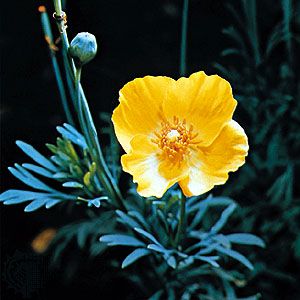
The Mexican tulip poppy (Hunnemannia fumariifolia) is a perennial plant belonging to the poppy family (Papaveraceae). Native to southwestern North America, it is the sole member of the genus Hunnemannia and is primarily cultivated as an ornamental.1
The plant typically reaches a height of 30 to 50 cm (12 to 20 inches) and features a somewhat woody base with bluish-green leaves composed of many blunt, narrow segments. Its flowers are distinct, characterized by four sulfur-yellow petals measuring 5 to 7.5 cm (2 to 3 inches) in width, surrounding a central cluster of orange stamens2. The plant produces its seeds within a long, narrow capsule. It is also known as the golden cup.12
How does the Mexican tulip poppy differ from the California poppy?
While both the Mexican tulip poppy (Hunnemannia fumariifolia) and the California poppy (Eschscholzia californica) belong to the Papaveraceae family, they are distinct species with notable differences in their physical characteristics and growth habits.
The Mexican tulip poppy is a perennial plant that features a somewhat woody base and grows to a height of approximately 30 to 50 cm (12 to 20 inches). In contrast, the Mexican tulip poppy is distinguished from the California poppy by its bright orange-colored stamens and the presence of two separate sepals. Furthermore, while the Mexican tulip poppy is the sole member of the genus Hunnemannia, the California poppy belongs to the genus Eschscholzia.243
The Mexican tulip poppy is also characterized by its bluish-green leaves composed of many blunt, narrow segments and its large, four-petaled sulfur-yellow [flowers].2
What are the defining characteristics of the Papaveraceae family?
The Papaveraceae family, commonly known as the poppy family, is a diverse group of flowering plants within the order Ranunculales. It comprises approximately 48 genera and 2,220 species, primarily distributed across the Northern Hemisphere.54
Key Characteristics
- Growth Habit: Most members are herbaceous plants, though the family also includes woody shrubs and a genus of small tropical trees.54
- Sap: A defining feature is the presence of latex in the stems, which is often brightly colored and frequently contains powerful [alkaloids].56
- Flowers: Flowers are typically bisexual and dish-shaped. Subfamily Papaveroideae features regular (radially symmetrical) flowers with two or three sepals and 4 to 12 or more separate petals. In contrast, the former Fumarioideae group exhibits bilaterally symmetrical flowers with two dissimilar pairs of petals.56
- Fruit: The fruit is characteristically a spherical or linear capsule that often releases seeds through openings when shaken by the wind.546
- Leaves: Foliage is generally deeply cut or divided into leaflets.5
What conditions are best for growing ornamental poppies?
Growing ornamental poppies successfully depends on understanding their specific life cycles and environmental needs. While many species are hardy, they generally thrive in conditions that mimic their natural habitats.
Key Growing Considerations
- Sunlight: Most poppies, such as the California poppy, require ample sunlight to bloom. Their flowers are often ephemeral, opening only when exposed to direct sun.8
- Soil and Germination: Many poppies, including the corn poppy, are adapted to disturbed soil. Their seeds can remain dormant in soil seed banks for years, germinating readily once the soil is turned or disturbed.89
- Life Cycle: It is important to distinguish between annuals, which complete their life cycle in one season, and perennials, such as the Oriental poppy, which return year after year. Choosing the right type for your climate is essential for long-term success.10
- Climate Adaptability: Species vary significantly in their requirements; for example, the Iceland poppy is adapted to the cooler conditions of Arctic North America, while other genera like Bocconia prefer mild climates.10
Sources
- Mexican tulip poppy — Merriam-Webster
- Mexican tulip poppy — Encyclopædia Britannica
- tulip poppy — Merriam-Webster
- list of plants in the family Papaveraceae — Encyclopædia Britannica
- Papaveraceae — Encyclopædia Britannica
- Ranunculales — Encyclopædia Britannica
- Papaveraceae — Merriam-Webster
- California poppy — Encyclopædia Britannica
- poppy — Encyclopædia Britannica
- corn poppy — Encyclopædia Britannica
Published on · 3 min read