Green Snake
The term "green snake" typically refers to several species within the family Colubridae, which are known for their slender bodies and docile, harmless…
What is green snake?
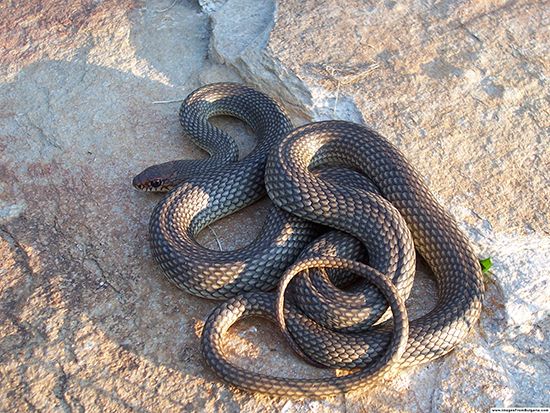
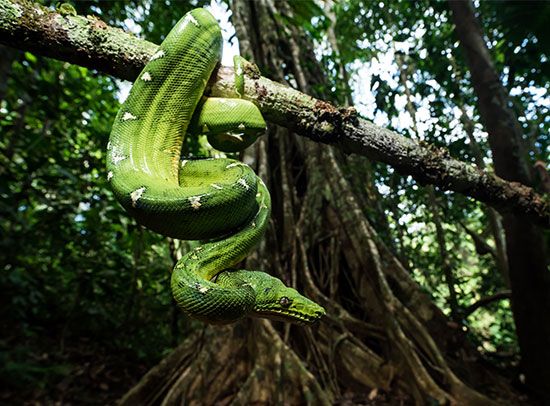
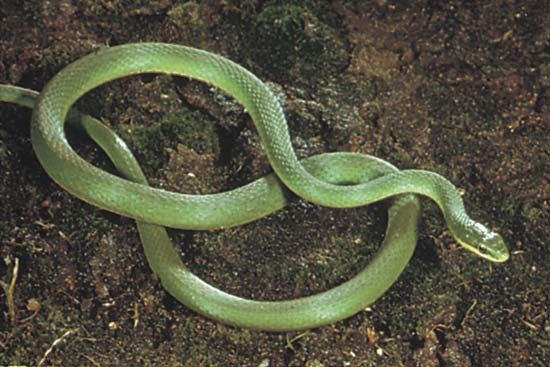
The term “green snake” typically refers to several species within the family Colubridae, which are known for their slender bodies and docile, harmless nature. In North America, this includes the smooth green snake (Opheodrys vernalis) and the rough or keeled green snake (O. aestivus), both of which are insectivores often found in gardens. Other species, such as the African green snakes (Chlorophis), are arboreal.1
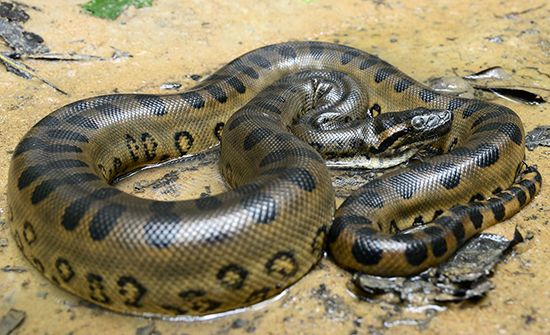
It is important to distinguish these small, harmless colubrids from the green anaconda, a large, nonvenomous, semiaquatic boa native to South America. Unlike the smaller green snakes, the green anaconda is among the heaviest snakes in the world, capable of reaching lengths of 9 meters (30 feet) and weighing over 250 kg (550 pounds). While green snakes are generally small and insectivorous, green anacondas are powerful carnivores that use constriction to hunt prey as large as deer and caimans.21
How do snakes use constriction to hunt their prey?
Constriction is a specialized hunting method employed by many boids and colubrids to secure and kill their prey.3
The process typically follows these steps:
- The Strike: The snake strikes its prey and secures a firm grip using its teeth.3
- Coiling: Once the prey is held, the snake rapidly throws a series of body coils around it.3
- Compression: The snake tightens these coils around the prey. Contrary to common belief, this process rarely results in crushed or broken bones.3
- Termination: The pressure from the coils prevents the prey from breathing, leading to suffocation. Additionally, this action cuts off blood flow, which can cause rapid organ failure.34
While both anacondas and boa constrictors utilize this method, they often target different types of prey based on their respective aquatic or terrestrial habitats.4
What are the main differences between venomous and nonvenomous snakes?
The primary difference between venomous and nonvenomous snakes lies in their method of subduing prey. While both groups use specialized behaviors to secure food, they rely on distinct biological adaptations to achieve this goal.4
Venomous Snakes
Venomous snakes possess specialized salivary glands that produce potent toxins, which are delivered through modified teeth known as fangs. These fangs vary by species:4
- Viperids: Feature long, tubular, rotatable fangs.45
- Elapids: Utilize short, hollow, fixed fangs.4
- Rear-fanged species: Use grooved teeth to inject toxins while biting and chewing.4
The venom itself is a complex mixture that can cause coagulation defects, tissue injury, or respiratory and cardiac failure, allowing the snake to immobilize prey rapidly or track it after a strike.4
Nonvenomous Snakes
Nonvenomous snakes lack venom-delivery systems and instead rely on physical methods to capture and kill prey. Many boids and colubrids utilize constriction, where the snake strikes and holds the prey with its teeth before rapidly coiling its body around the animal. The pressure from these coils prevents the prey from breathing and restricts blood flow, leading to death.46
It is a common misconception to label dangerous snakes as “poisonous.” In biological terms, venomous organisms inject toxins via bites or stings, whereas poisonous organisms are toxic only if ingested.3
What role do snakes play in maintaining a healthy ecosystem?
Snakes play a vital role in maintaining healthy ecosystems primarily by serving as effective natural pest control agents. As major predators of rodents, snakes help regulate populations that might otherwise grow unchecked and cause significant ecological or agricultural damage.78
The importance of this service is often highlighted when snake populations are decimated; for instance, the removal of rodent-eating snakes has been shown to lead to explosions in rodent numbers. Beyond their role as predators, snakes also function as secondary consumers within the trophic pyramid. They serve as a food source for various other animals, including birds of prey like hawks and owls, as well as mammals and other reptiles.7910
Additionally, scientific research into snake venom has provided significant contributions to human medicine, including the development of treatments for heart-attack patients and various pain-management drugs.78
Sources
- green snake — Encyclopædia Britannica
- green anaconda — Encyclopædia Britannica
- What are the differences between anacondas and boa constrictors? — Encyclopædia Britannica
- snake - Specializations for securing food — Encyclopædia Britannica
- viper — Encyclopædia Britannica
- What’s the Difference Between Venomous and Poisonous? — Encyclopædia Britannica
- What eats snakes? — Encyclopædia Britannica
- Black rat snake — Encyclopædia Britannica
- reptile - Importance — Encyclopædia Britannica
- reptile: Top Questions — Encyclopædia Britannica
Published on · 3 min read