Trophic Pyramid
Energy transfer between trophic levels occurs as organisms consume one another, forming a food chain. Primary producers, or autotrophs, harness energy from…
How does energy transfer occur between trophic levels and why is it not 100% efficient?
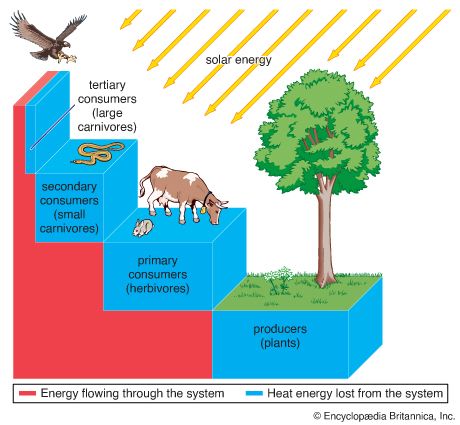
Energy transfer between trophic levels occurs as organisms consume one another, forming a food chain. Primary producers, or autotrophs, harness energy from the sun or chemical sources, which is then passed to heterotrophs (consumers) at higher levels.12
This process is not 100% efficient—averaging only about a 10 percent transfer rate—due to several factors:
- Metabolic Loss: Organisms expend the majority of their ingested energy (often 80 to 90 percent) on metabolic processes, such as maintaining body temperature and digestion, which is lost to the environment as heat.2
- Incomplete Consumption: Not all biomass at one level is eaten by the next. Much plant tissue remains uneaten and enters the detritus pathway instead of the primary food chain.1
- Assimilation Limits: Animals cannot digest or absorb all the energy in the food they ingest. Efficiency varies based on physiology and the type of food consumed; for instance, herbivores feeding on decaying wood have lower assimilation efficiencies than carnivores.1
This energy loss creates a pyramid structure where available energy decreases at each successive level.12
What is the 10% rule in energy transfer between trophic levels?
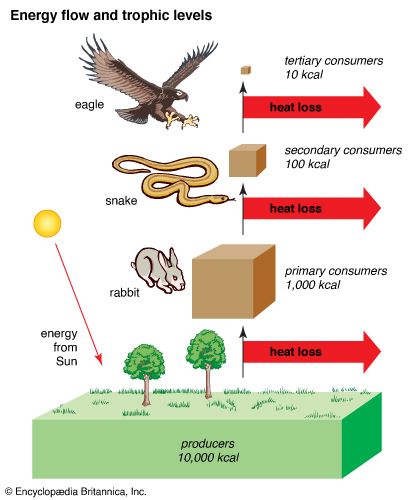
The 10% rule is a general ecological principle stating that, on average, only about 10 percent of the energy available at one trophic level is converted into biomass at the next higher level in a food chain.1
This limitation occurs because energy is lost as it moves through the ecosystem:1
- Consumption Gaps: Much of the plant tissue produced is not eaten by herbivores; instead, it enters the detritus pathway, where it is processed by decomposers rather than moving directly up the food chain.1
- Assimilation Efficiency: Animals cannot digest or absorb all the energy they ingest. While carnivores often have higher assimilation efficiencies (60–90%) because their food is easier to digest, herbivores vary significantly (15–80%) based on their diet and physiology.1
- Metabolic Loss: Organisms use a large portion of ingested energy for their own maintenance, growth, and reproduction, leaving only a fraction available for the next consumer.1
Because of these inefficiencies, energy availability decreases significantly at each successive level, creating a pyramid structure that limits the total number of organisms an ecosystem can support.1
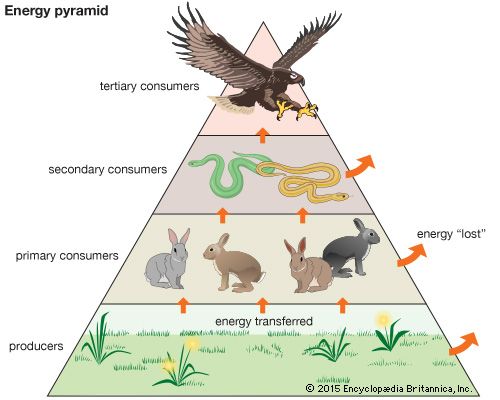
How does the concept of ecological efficiency relate to trophic pyramids?
Ecological efficiency is the rate at which energy is transferred from one trophic level to the next, and it is the fundamental driver behind the shape of trophic pyramids.1
Because energy is lost as heat during metabolic processes—often 80 to 90 percent at each step—only a small fraction of the energy available at one level is converted into biomass at the next. On average, this ecological efficiency is estimated at about 10 percent.14
This consistent loss of energy dictates the structure of the pyramid:
- Base Concentration: The largest amount of energy is concentrated in the primary producers (autotrophs) at the bottom of the food chain.14
- Diminishing Returns: As you move up the pyramid to primary, secondary, and tertiary consumers, the amount of available energy decreases significantly at each level.14
- Structural Limits: Due to these cumulative energy losses, food chains are typically limited to four or five trophic levels, as there is eventually insufficient energy to support additional populations.5
How can trophic pyramids be used to understand and predict ecosystem stability?
Trophic pyramids serve as a fundamental diagnostic tool for understanding ecosystem structure, though they are primarily descriptive of energy flow rather than predictive of stability in isolation. By mapping how energy moves from primary producers to various levels of heterotrophs, these pyramids reveal the metabolic constraints that limit the number of trophic levels in a food chain to typically three or four.56
While the provided information does not explicitly detail predictive models for stability, the structure of the pyramid highlights critical dependencies:
- Energy Bottlenecks: Because 80 to 90 percent of energy is lost as heat at each transfer, the pyramid demonstrates that higher-level consumers are inherently more vulnerable to fluctuations in the biomass of the levels below them.5
- Complexity vs. Simplicity: Real-world ecosystems are rarely simple chains; they form complex food webs where species often feed at multiple levels. This complexity suggests that stability is often derived from the interconnectedness of these feeding relationships rather than a rigid, linear hierarchy.5
Sources
- Biosphere - Energy transfers and pyramids — Encyclopædia Britannica
- community ecology - Autotrophs and heterotrophs — Encyclopædia Britannica
- life - Thermodynamic — Encyclopædia Britannica
- food chain — Encyclopædia Britannica
- trophic pyramid — Encyclopædia Britannica
- trophic level — Encyclopædia Britannica
Published on · 4 min read