Halysites
Halysites is an extinct genus of colonial corals commonly referred to as chain coral. These organisms lived during the Late Ordovician Period through the end…
What is Halysites?
Halysites is an extinct genus of colonial corals commonly referred to as chain coral. These organisms lived during the Late Ordovician Period through the end of the Silurian Period, approximately 461 million to 416 million years ago.123
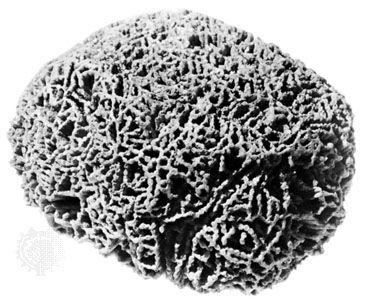
The name chain coral is derived from the unique growth pattern of the colony. Individual members of the colony constructed elliptical tubes that were joined side-by-side, creating a fossilized appearance that resembles the links of a chain.12
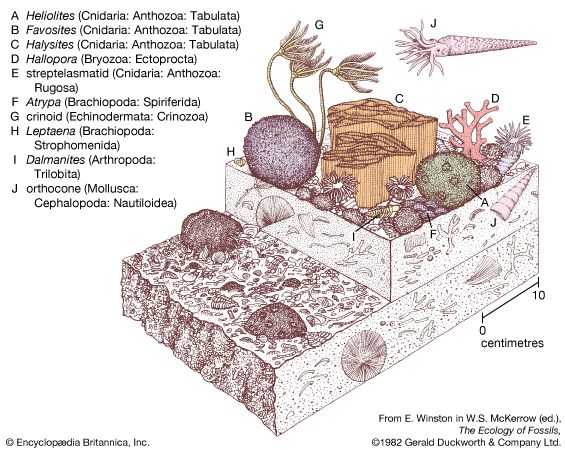
What are some other types of extinct corals?
Beyond the chain-forming Halysites, the fossil record contains several other significant groups of extinct corals:
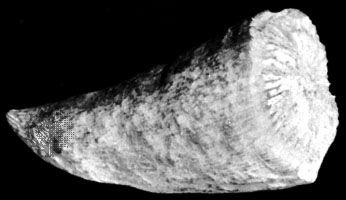
- Horn Corals (Order Rugosa): Named for their distinct hornlike shape, these corals appeared in the Ordovician Period and persisted until the end of the Permian Period. They existed as both solitary individuals and colonial forms. A notable genus within this group is Streptelasma, which lived as a single, horn-shaped animal from the Ordovician to the Devonian.56
- Tabulate Corals (Order Tabulata): This major division of extinct corals is characterized by the presence of internal horizontal platforms called tabulae and a general lack of vertical walls (septa). They were common from the Ordovician to the Jurassic. A well-known genus is Favosites, a colonial coral that formed long, narrow tubes, giving its colonies a distinctive honeycomb appearance in cross-section.789
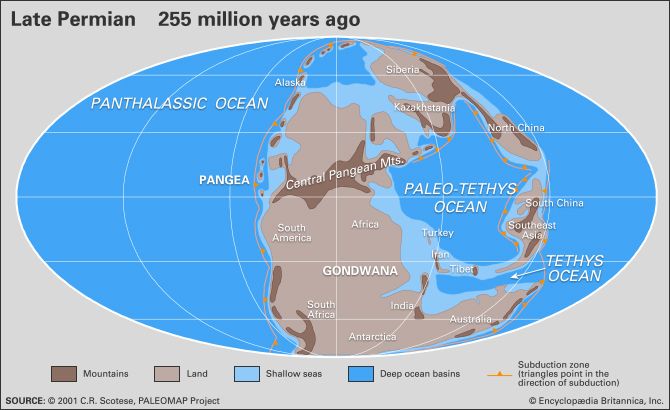
Many of these groups, particularly the colonial corals, suffered significant losses during the Devonian extinctions, a series of mass extinction events that eliminated a large percentage of marine species.10
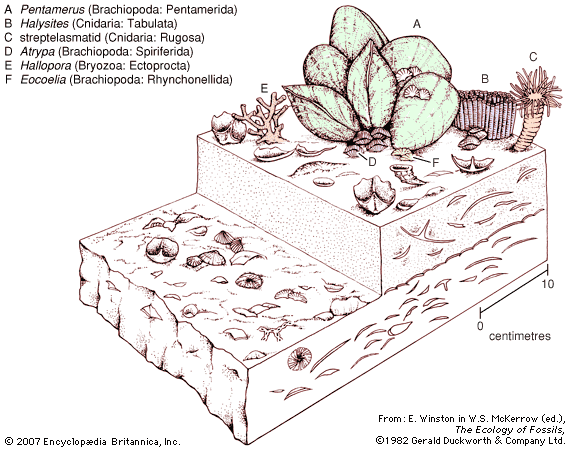
How do fossils help scientists understand ancient marine environments?
Fossils serve as vital indicators for scientists to reconstruct ancient marine environments and understand Earth’s history. By analyzing the fossil record, researchers can infer past conditions such as climate, water temperature, and salinity at the time of deposition.1314
Key ways fossils provide this environmental data include:
- Environmental Indicators: Certain organisms have specific habitat requirements. For example, specific species of coral thrive only in warm, shallow waters. Finding such fossils in regions that are now polar suggests that the Earth’s crust has shifted position over time.1314
- Isotopic Analysis: Scientists examine the ratio of oxygen isotopes (16^{16}O and 18^{18}O) in the calcium carbonate shells of marine microfossils. Because these ratios are influenced by water temperature and the volume of global ice sheets, they provide a continuous record of past glaciations and climatic cycles.15
- Stratigraphic Correlation: Index fossils allow geologists to assign relative ages to rock layers and correlate marine strata across different geographic locations, helping to build a consistent historical timeline of Earth’s oceans.161714
What characterizes the Ordovician and Silurian periods?
The Ordovician and Silurian periods represent critical intervals in the Paleozoic Era, defined by dramatic shifts in climate, sea levels, and biological diversity.
The Ordovician Period (485.4–443.8 million years ago)
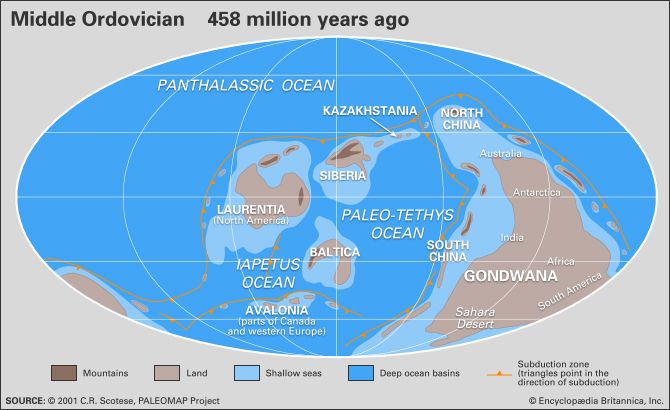
The Ordovician was characterized by high global sea levels caused by rapid seafloor spreading, which flooded continents like North America. Atmospheric carbon dioxide levels were significantly higher than today, fostering warm climates, though a brief, intense ice age occurred at the end of the period. This era saw the “Ordovician radiation,” an intense diversification of marine life, including brachiopods, trilobites, and the first fish. The period concluded with a massive extinction event that claimed roughly 85 percent of species.202122
The Silurian Period (443.8–419.2 million years ago)
Following the Ordovician, the Silurian began as glaciers melted, causing sea levels to rise dramatically. This recovery period allowed marine faunas to rebound from the previous mass extinction. The Silurian is noted for the prevalence of mound-type coral reefs and the continued expansion of fishes. On land, vascular plants began to colonize coastal lowlands, marking a significant step in terrestrial life.2324
Sources
- Halysites — Encyclopædia Britannica
- chain coral — Merriam-Webster
- Halysites — Merriam-Webster
- Coralliidae — Merriam-Webster
- horn coral — Encyclopædia Britannica
- Tabulata — Encyclopædia Britannica
- coral — Encyclopædia Britannica
- Streptelasma — Encyclopædia Britannica
- Favosites — Encyclopædia Britannica
- Tabulata — Merriam-Webster
- Devonian extinctions — Encyclopædia Britannica
- Coral Bleaching: A Threat to Our Reefs — Encyclopædia Britannica
- index fossil — Encyclopædia Britannica
- fossil record — Encyclopædia Britannica
- Tertiary Period - Correlation of Tertiary strata — Encyclopædia Britannica
- Pleistocene Epoch - Marine oxygen isotope record — Encyclopædia Britannica
- geochronology - Coral growth — Encyclopædia Britannica
- coral reef - Winds , currents, temperature, and salinity — Encyclopædia Britannica
- fossil — Encyclopædia Britannica
- A Journey Through Time Since the Precambrian - Ordovician Period: 485.4 million to 443.4 million years ago — Encyclopædia Britannica
- Silurian Period - Late Ordovician mass extinction — Encyclopædia Britannica
- Ordovician Period — Encyclopædia Britannica
- Silurian Period — Encyclopædia Britannica
- Ordovician Period - Paleoclimate — Encyclopædia Britannica
Published on · 3 min read