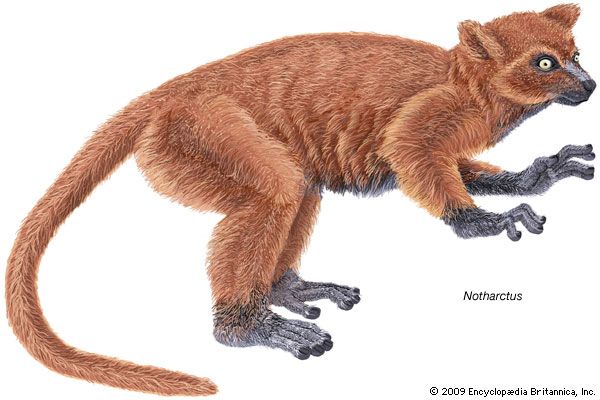
Notharctus
During the early Eocene Epoch, Notharctus thrived in the dense, subtropical forests that covered much of North America and Eurasia. These environments were…
How did climate changes during the Eocene epoch affect Notharctus and its habitat?
During the early Eocene Epoch, Notharctus thrived in the dense, subtropical forests that covered much of North America and Eurasia. These environments were supported by the warm global climate of the time, which allowed subtropical flora and fauna to flourish even at high latitudes.123
However, the climate began to shift during the middle and late Eocene, transitioning from the warmth of the Eocene Optimum toward a steady, long-term global cooling trend. This cooling accelerated significantly toward the Eocene-Oligocene boundary, approximately 33.9 million years ago. As the climate cooled, these once-widespread subtropical forests retracted, fundamentally altering the habitat upon which Notharctus depended.2314
Unable to adapt to these changing environmental conditions, Notharctus and its close relatives became extinct by the end of the Eocene. This cooling trend ultimately led to the disappearance of all primates from North America by the end of the epoch.14
How has our understanding of Notharctus changed since its first discovery?
Our understanding of Notharctus has evolved significantly as paleontologists have refined its classification and paleobiology within the broader context of adapiforms.
Historically, Notharctus was recognized as a primitive, lemur-like primate from the Eocene Epoch. While early descriptions emphasized its superficial similarities to modern lemurs, modern research has clarified its position within the family Notharctidae. Scientists now distinguish Notharctus from modern lemurs based on specific dental features, such as its four premolars and non-procumbent incisors, which differ from the specialized toothcombs found in living lemurs.16
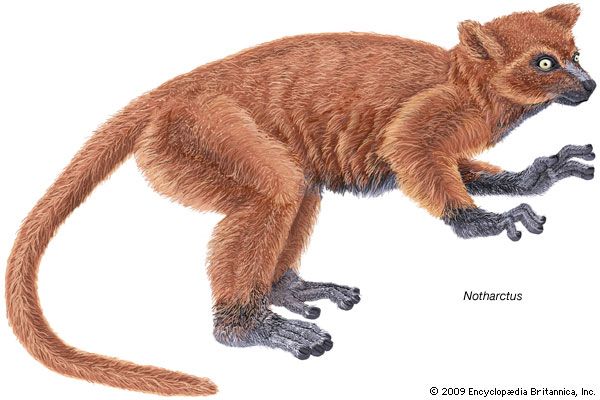
Furthermore, detailed analysis of its skeletal anatomy has provided a clearer picture of its lifestyle. We now understand that Notharctus was an agile, arboreal climber capable of vertical clinging and leaping, a mode of locomotion shared with many living strepsirrhines. Additionally, the identification of sexual dimorphism in the canine teeth of species like N. venticolus has provided insights into its social structure, suggesting behavioral patterns comparable to those of some living monkeys and apes. While some early theories explored potential evolutionary links between various adapiforms and anthropoids, these are now largely understood as examples of evolutionary convergence.17
What was the likely habitat and diet of Notharctus based on fossil evidence?
Based on fossil evidence, Notharctus was an agile climber that inhabited the dense, subtropical forests that covered much of North America and Eurasia during the early Eocene Epoch, approximately 54 million years ago.1
Regarding its diet, while the provided fossil evidence does not explicitly detail its specific food sources, the presence of a prominent muzzle and long canine teeth suggests it was a specialized feeder, likely adapted to the diverse resources available within its forest habitat. Its physical anatomy, including hands and feet with potentially opposable digits, indicates it was well-suited for navigating an arboreal environment to forage.1
What other prehistoric primate genera were contemporaries of Notharctus?
During the Eocene Epoch, Notharctus coexisted with a diverse array of other primate genera. These contemporaries occupied various ecological niches across North America, Europe, and Asia.
North American Contemporaries
Within the same North American fossil deposits, such as the Bridger Basin in Wyoming, Notharctus lived alongside:
- Smilodectes: A fellow member of the family Notharctidae.1
- Rooneyia: An omomyid primate known from later Eocene deposits, which possessed a mix of primitive and advanced features.8
European and Asian Contemporaries
Across the Atlantic and in Asia, other primates flourished during the same period:
- Adapids: This family included genera such as Adapis, Europolemur, Anchomomys, and Pronycticebus. Adapis is particularly notable as the first fossil primate ever described.17
- Omomyids: Represented by various forms across North America, Europe, Egypt, and Asia.1
- Tarsiids: The European species Necrolemur antiquus and the Egyptian Afrotarsius chatrathi are key examples of Eocene tarsiers.1
- Early Simiiformes: Fossil evidence from Asia includes the tiny Eosimias, as well as the Burmese genera Pondaungia and Amphipithecus.1
- Sivaladapids: Found in Asia, this group included genera like Sivaladapis, Guangxilemur, and Paukkaungia.7
Sources
- Notharctus — Encyclopædia Britannica
- Climate change - Cenozoic climates — Encyclopædia Britannica
- Tertiary Period - Primates — Encyclopædia Britannica
- Miocene Epoch — Encyclopædia Britannica
- Tertiary Period - Paleoclimate — Encyclopædia Britannica
- adapiform — Encyclopædia Britannica
- Notharctus — Merriam-Webster
- primate - Eocene — Encyclopædia Britannica
- primate - Oligocene — Encyclopædia Britannica
Published on · 3 min read