Scoter
Scoters are a genus of diving duck primarily found in marine environments, except during their breeding season. They are generally distributed across the…
Where are scoters typically found, and what are their preferred habitats?
Scoters are a genus of diving duck primarily found in marine environments, except during their breeding season. They are generally distributed across the Northern Hemisphere, with some species exhibiting a nearly circumpolar range north of the Equator.1
Regarding their preferred habitats:
- Breeding: Scoters typically breed in inland areas, such as the boreal forests and tundra regions of Canada and Alaska.1
- Wintering: During the winter months, they migrate to coastal waters. For instance, the surf scoter winters along the North American coasts, ranging from Nova Scotia to Florida in the east and from the Aleutian Islands to southern California in the west.1
These birds are highly adapted to aquatic life, functioning as skilled swimmers and divers that forage primarily for marine animals like clams.1
How do scoters feed, and what is their primary diet?
Scoters are specialized diving ducks that forage by swimming to the bottom of lakes, bays, and coastal waters to reach their food. Unlike dabbling ducks that feed at the surface, scoters are physically adapted for underwater foraging with streamlined bodies and rear-set legs, allowing them to dive to significant depths to exploit resources on the seabed.123
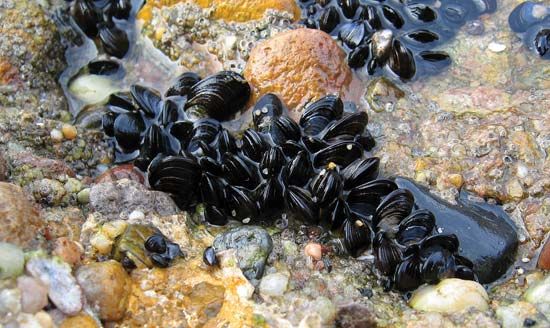
Their diet is primarily carnivorous, consisting mainly of marine animals such as clams, crabs, and mussels. Plant material makes up only about 10 percent of their total diet. Because they share similar feeding strategies, these three species are often observed foraging together in mixed flocks.13
What are the different species of scoters, and how do they differ?
There are three primary species of scoter, all belonging to the genus Melanitta and the diving duck group:
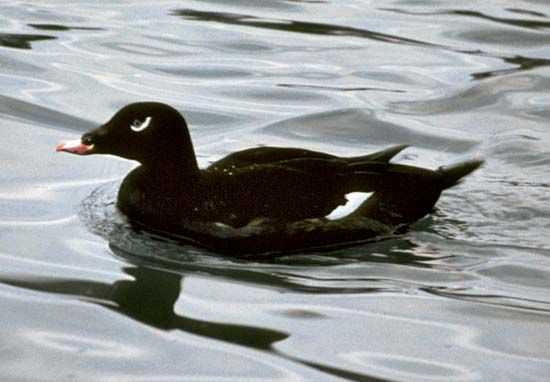
- Surf scoter (Melanitta perspicillata): Native to North America, this species breeds in the boreal forests and tundra of Canada and Alaska. It is known for its distinct appearance and winters along both the Atlantic and Pacific coasts of North America.1
- White-winged scoter (M. deglandi or fusca): Also known as the velvet scoter, this species has a nearly circumpolar distribution across the Northern Hemisphere.1
- Black scoter (M. nigra or Oidemia nigra): This species is also circumpolar in distribution but is considered the least abundant of the three in the New World. Adult males are characterized by their completely black plumage, while females and young birds are largely dark brown above with mottled brown and white undersides.15
While these species share similar diets—consisting primarily of marine animals like clams—they are distinguished by their specific geographic ranges and plumage variations.1
What are the breeding habits and nesting behaviors of scoters?
Scoters are diving ducks that are primarily marine, except during their breeding season when they move to inland habitats. Their reproductive behaviors follow general patterns observed in many waterfowl:1
- Nesting Sites: Scoters typically nest on land, often near water. While they do not usually nest in colonies, they may be found in higher densities in areas that are particularly safe, such as islands.6
- Nest Construction: The female is primarily responsible for selecting the nest site and building the nest. Because waterfowl are generally unable to carry materials in their bills, they construct nests using vegetation within reach of the site, pulling material toward them and dropping it over their shoulders to form a pile.6
- Incubation: The female typically incubates the eggs alone. As incubation progresses, she lines the nest with down plucked from her own breast, which helps keep the eggs warm and conceals them from predators when she leaves the nest to feed.6
- Egg Laying: Scoters generally lay one egg per day. The white-winged scoter is noted for having a particularly long laying period, taking up to 15 days to complete a typical clutch of nine eggs.6
Sources
- Scoter — Encyclopædia Britannica
- Bird - Swimming and diving — Encyclopædia Britannica
- What do ducks eat? — Encyclopædia Britannica
- scorpaeniform - Ecology — Encyclopædia Britannica
- black scoter — Merriam-Webster
- Anseriform - Reproductive behaviour — Encyclopædia Britannica
- Reproductive behaviour - Parental care — Encyclopædia Britannica
- Charadriiform - Shorebirds (suborder Charadrii) — Encyclopædia Britannica
Published on · 3 min read