Simakobu
The provided search results do not contain specific information regarding the methodologies used by researchers to study simakobu populations in the wild.
How do researchers study simakobu populations in the wild?
The provided search results do not contain specific information regarding the methodologies used by researchers to study simakobu populations in the wild.
While the available literature confirms that simakobu are primates native to the Mentawai Islands and notes that they face threats from habitat loss and hunting, it does not detail the specific field techniques—such as observational studies, census methods, or tracking—employed to monitor them. Scientific research on nonhuman primates generally involves observation and experimentation in fields like endocrinology, neurology, and sociology, but these broader practices are not explicitly linked to simakobu field studies in the provided data.
How does the social structure of simakobu groups compare to other primate species?
The social structure of the simakobu (Simias concolor) is notably flexible compared to many other primates. While many primate species exhibit highly complex, rigid social systems, simakobu groups vary by location: they may live in monogamous pairs or in groups consisting of one male and several females.1
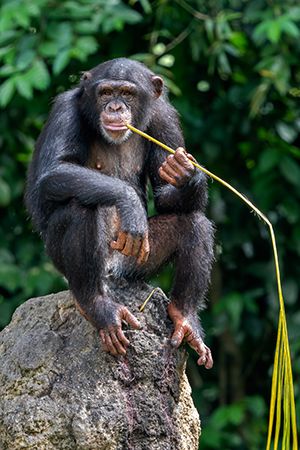
This contrasts sharply with the social organization of species like chimpanzees. Chimpanzees live in large, fluid “communities” of up to 100 or more individuals, characterized by unstable subgroups, complex dominance hierarchies, and strategic alliances involving grooming and meat-sharing. While chimpanzee social life is defined by intense competition, territoriality, and sophisticated political maneuvering, the simakobu appears to maintain a simpler, more localized social arrangement.41
Generally, primate social complexity is thought to correlate with brain size and the duration of the juvenile period, which allows for the learning of intricate social behaviors. While the simakobu’s social system is less elaborate than the fission-fusion communities of chimpanzees, it remains a distinct adaptation within the Cercopithecidae family.51
What is the scientific name of the simakobu and what does it mean?
The scientific name of the simakobu is Simias concolor.1
The genus name, Simias, is derived from the New Latin Simias, which originates from the Latin word simia, meaning “ape”. The term simia itself is the root for “simian” and historically referred to various primates.67
How does the simakobu’s diet and behavior differ from other primates?
The simakobu (Simias concolor) exhibits distinct dietary and behavioral patterns that set it apart from many other primates.
Diet
While the simakobu is classified as a leaf-eating monkey within the subfamily Colobinae, it is not exclusively a leaf eater. Like other langurs and colobus monkeys, its diet is seasonally flexible and includes flowers, fruit, and seeds in addition to leaves. Unlike many other primates that are broadly omnivorous, the simakobu’s dietary habits are specialized to its ecological niche on the Mentawai Islands.18
Behavior
The simakobu is notably more terrestrial than most other leaf-eating monkeys, which typically spend the majority of their time in the canopy. Its social behavior also differs from the complex, large-scale communities seen in many other primate species; simakobu groups are relatively small, consisting of either monogamous pairs or a single male with several females.1
Sources
- simakobu — Encyclopædia Britannica
- primate - Distribution and abundance — Encyclopædia Britannica
- primate - Historical background of primate studies — Encyclopædia Britannica
- chimpanzee - Social behaviour — Encyclopædia Britannica
- primate - Reproduction and life cycle — Encyclopædia Britannica
- Simia — Merriam-Webster
- Simias — Merriam-Webster
- primate - Diet — Encyclopædia Britannica
- Feeding behaviour - Food-directed activities in social situations — Encyclopædia Britannica
Published on · 2 min read