Suid
A suid is a member of the biological family Suidae, which comprises various types of swine. These animals are characterized by their classification within…
What is suid?
A suid is a member of the biological family Suidae, which comprises various types of swine. These animals are characterized by their classification within the order Artiodactyla.1
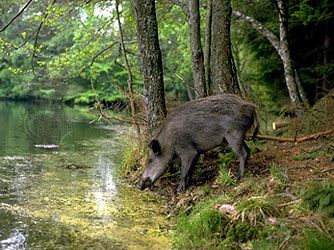
What animals belong to the Suidae family?
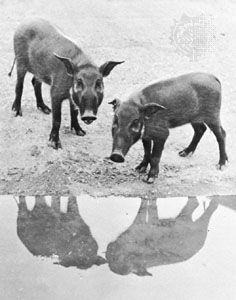
The family Suidae consists of hoofed, omnivorous mammals commonly known as pigs. These animals are native to the Old World and include both wild and domestic species.23
Members of the Suidae family include:
- Pigs: Including both domestic and wild varieties.2
- Boars: Wild swine often characterized by their tusks.2
- Warthogs: Known for their distinct facial features and tusks](https://www.britannica.com/animal/warthog):** Known for their distinct facial features and tusks.2
- Babirusas: A unique group of wild suids.2
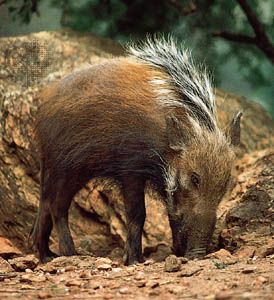
- Bush pigs: Another wild member of the family.2
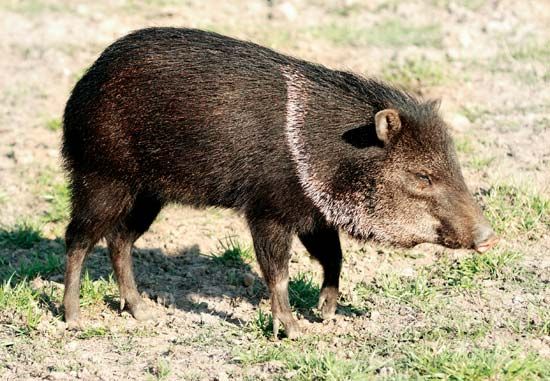
In modern biological classifications, the Suidae family is distinct from the Tayassuidae family, which contains the peccaries. While both groups belong to the suborder Suina, they differ in dental structure, stomach complexity, and other physical characteristics.43
What are the physical characteristics of wild boars?
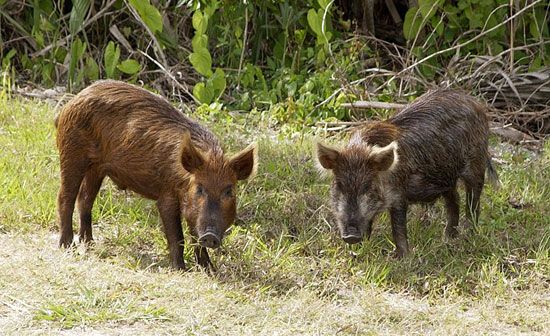
The wild boar, also known as the European wild boar, is the largest member of the wild pig species Sus scrofa.56
Its physical characteristics include:
- Size: They can stand up to 90 cm (35 inches) tall at the shoulder.5
- Coat: They are covered in bristly hair that is typically blackish or brown in color and has a grizzled appearance.5
- Tusks: A defining feature of the animal is its set of sharp tusks.5
- Build: They are known for their great strength and speed, which have historically made them a popular subject for hunting.5
While they are generally unaggressive, their physical capabilities and tusks can make them dangerous when threatened.5
How do pigs differ from other hoofed mammals?
Pigs belong to the order Artiodactyla, a group of even-toed ungulates that includes diverse animals such as camels, deer, and cattle. While they share the characteristic of being hoofed mammals, pigs differ from many other artiodactyls in several key ways:27
- Diet and Dentition: Unlike the specialized herbivores in the order, pigs are omnivorous. They possess a complete set of teeth, including bunodont (low-cusped) molars, which are distinct from the selenodont (crescent-shaped) molars found in ruminants.48
- Digestive System: While many artiodactyls have evolved complex, multi-chambered stomachs to ferment plant cellulose, pigs have a simpler stomach structure with only a single pouch near the cardiac orifice. They lack the specialized rumination process—regurgitating and re-chewing food—that defines ruminants.9
- Physical Features: Pigs are characterized by a stout build, short legs, and a muzzle ending in a rounded cartilage disk, which they use for digging. Unlike many other artiodactyls that have evolved to be highly specialized for running, pigs retain a more generalized, four-toed foot structure.104
Sources
- suid — Merriam-Webster
- suid — Encyclopædia Britannica
- Suidae — Merriam-Webster
- artiodactyl - Annotated classification — Encyclopædia Britannica
- boar — Encyclopædia Britannica
- wild boar — Encyclopædia Britannica
- artiodactyl — Encyclopædia Britannica
- artiodactyl - Digestive system — Encyclopædia Britannica
- artiodactyl - Teeth — Encyclopædia Britannica
- ungulate — Encyclopædia Britannica
- hoof — Encyclopædia Britannica
- artiodactyl - Critical appraisal — Encyclopædia Britannica
Published on · 2 min read