Toucan
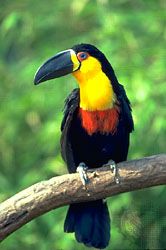
Toucans are birds belonging to the family Ramphastidae that are primarily found in the tropical forests of the Americas. Their range extends from the…
In which regions of the world are toucans primarily found?
Toucans are birds belonging to the family Ramphastidae that are primarily found in the tropical forests of the Americas. Their range extends from the lowlands of southern Mexico and Brazil to the high Andes Mountains.12
While they are often associated with the Amazon region, these birds inhabit various tropical environments across the New World, where they play a vital role in maintaining forest diversity by dispersing seeds. Although they superficially resemble the hornbills found in the Old World, toucans are distinct and unrelated to that group.1
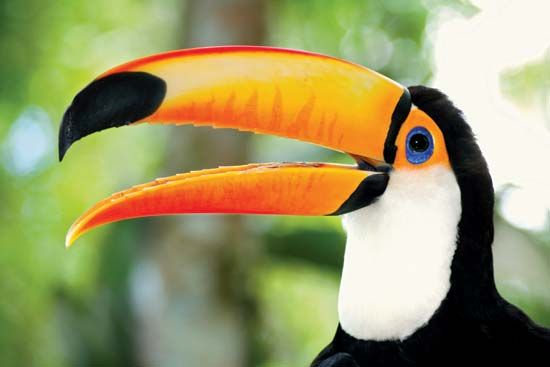
How do toucans use their large, colorful beaks?
Toucans utilize their large, lightweight, and serrated bills for a variety of essential functions:
- Feeding: The bill is used to obtain a diverse diet, including fruits, insects, snakes, frogs, and small mammals. Toucans often use the saw-edged bill to pluck food, which they then toss back into their mouths to swallow. They also use the bill to raid songbird nests for eggs and nestlings.31
- Communication and Display: The striking color patterns on the bill serve as important signals for species recognition, helping toucans distinguish between similar-looking species in the same habitat. During displays, these colors and ritualized head movements accompany loud vocalizations, such as barks and croaks, which act as rallying calls to attract other birds to foraging sites.31
- Defense: The size and appearance of the bill are believed to have a frightening effect on potential threats, including hawks.1
- Structural Integrity: Despite their size, the bills are remarkably strong due to an internal structure of fine, crisscrossing bony fibers, allowing the birds to manipulate food or potentially pluck young birds from nests without the bill being unwieldy.31
How have toucans been represented in popular culture and media?
The provided search results do not contain information regarding the representation of toucans in popular culture or media. The available data focuses on the biological classification, physical characteristics, habitat, and behaviors of the family Ramphastidae.
Sorry, the Britannica knowledge base does not contain this information.
What are some interesting behaviors or adaptations unique to toucans?
Toucans (family Ramphastidae) exhibit several fascinating adaptations and behaviors that allow them to thrive in tropical forest environments:
- Specialized Bill Structure: Although a toucan’s bill can account for one-third of its total length, it is remarkably lightweight because it is composed of thin, crisscrossing bony fibers covered in keratin. This structure provides significant strength for its size, allowing the birds to manipulate food, secure insects, or pluck nestlings from songbird nests.13
- Foraging and Diet: Toucans are primarily fruit eaters but are also opportunistic predators that consume insects, snakes, frogs, and small mammals. They often form mixed-species associations to search for fruiting trees, and they play a vital role in forest ecology by consuming and dispersing the seeds of various plant species.1
- Communication: These birds are among the noisiest in the forest, using a repertoire of barks, bugling calls, and harsh croaks. These vocalizations, often accompanied by ritualized head and bill movements, serve as rallying calls to attract others to foraging sites and assist in species recognition.1
- Nesting Habits: Toucans do not excavate their own nest cavities. Instead, they are secondary cavity nesters, often occupying abandoned woodpecker nests or natural holes in trees.17
Sources
- Toucan — Encyclopædia Britannica
- Toucanet — Encyclopædia Britannica
- Piciform - Form and function — Encyclopædia Britannica
- Beak — Encyclopædia Britannica
- Thermoreception - Birds — Encyclopædia Britannica
- toucan — Merriam-Webster
- Apartments in the rainforest — Encyclopædia Britannica
- Passeriform - Territoriality and courtship — Encyclopædia Britannica
Published on · 3 min read