Whooping Crane
The whooping crane (Grus americana) is the tallest bird in North America and one of the world's most rarest species. Standing nearly 150 cm (5 feet) tall…
What is Whooping crane?
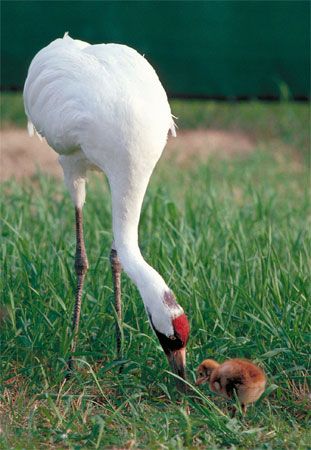
The whooping crane (Grus americana) is the tallest bird in North America and one of the world’s most rarest species1. Standing nearly 150 cm (5 feet) tall with a 210 cm (7 feet) wingspan, it is characterized by white plumage, black-tipped wings, black legs, and a bare red face. It is well known for its loud, whooping call, which can be heard up to 2 miles away.12
These birds are part of the crane family and have faced significant population declines due to habitat loss, hunting, and low reproductive rates. Conservation efforts, including the use of ultralight aircraft to teach captive-raised chicks migration routes, have been employed to help recover their numbers. Historically, their population was so low that fewer than 300 individuals remained in the wild at the start of the 21st century.13
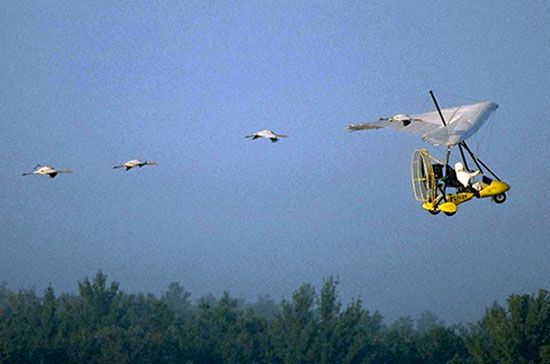
How do scientists use ultralight aircraft to teach cranes to migrate?
To establish a new migratory flock of whooping cranes, ornithologists utilize ultralight aircraft to guide the birds along a safe route from Wisconsin to their wintering grounds in Florida. This process involves several critical steps:
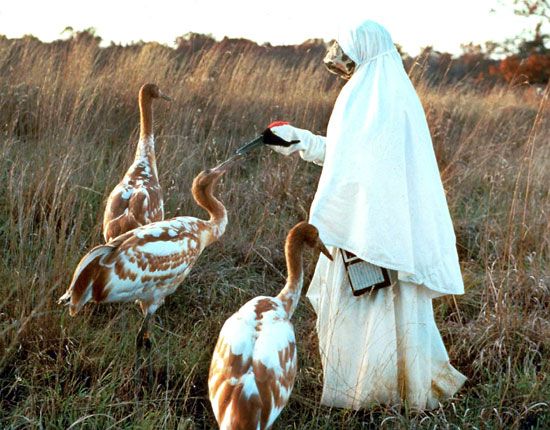
- Human Imprinting Prevention: Hatchlings are raised by scientists wearing costumes that resemble adult cranes. This ensures the birds identify with their own species rather than becoming accustomed to humans.
- Training: The young cranes are taught to follow the ultralight aircraft, which acts as a surrogate leader for the migration path.
- Migration: Once the birds have successfully followed the aircraft to their winter destination, they are capable of navigating the return journey northward on their own the following spring.
This method has proven successful in creating a self-sustaining migratory population, as the birds learn the route and eventually complete the migration independently in subsequent years.1
What are the main differences between whooping cranes and sandhill cranes?
While both the whooping crane and the sandhill crane are members of the family Gruidae, they exhibit distinct physical and behavioral differences:
Physical Characteristics
- Size: The whooping crane is the tallest bird in North America, standing nearly 150 cm (5 feet) tall with a 210 cm (7 feet) wingspan. In contrast, the sandhill crane is smaller, typically measuring 90–110 cm (35–43 inches) in length.
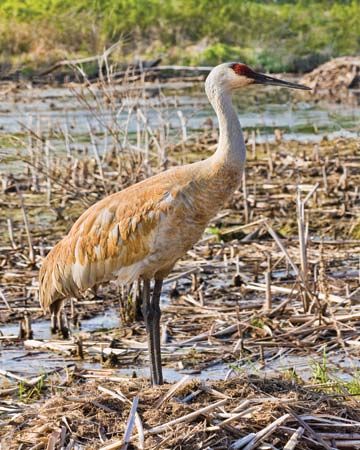
- Plumage and Coloration: Whooping cranes are primarily white with black-tipped wings, black legs, and a bare red face and crown. Sandhill cranes have a bluish or brownish-gray body often tinged with sandy yellow, and they also feature a red crown.
Vocalization
- Whooping Crane: Known for a loud, distinct “whooping” call that can be heard up to 2 miles (3.2 km) away.
- Sandhill Crane: Characterized by a long, harsh, and penetrating call.
Conservation Status
The whooping crane is one of the world’s rarest bird species, with populations historically pushed to the brink of extinction by hunting and habitat loss. Sandhill cranes have been used as surrogate parents in conservation efforts to help save the whooping crane from extinction.
Why is the whooping crane’s low reproduction rate a challenge for conservation?
The whooping crane’s low reproduction rate presents a significant challenge to conservation because it severely limits the population’s ability to recover from decline. These birds typically produce only one to three eggs per nest, a reproductive output that is insufficient to offset high rates of infant mortality.1
When a species exists in such small numbers, this slow reproductive pace makes the population highly vulnerable. Mathematical models of small populations demonstrate that even when breeding pairs successfully produce young, there is a statistical risk that offspring may be of the same sex or that genetic issues from inbreeding may occur, further threatening the species’ long-term viability. Because the whooping crane’s natural recovery is retarded by these biological constraints, conservationists have turned to aviculture and captive breeding programs to help bolster native populations and prevent extinction.516
Sources
- Whooping crane — Encyclopædia Britannica
- whooping crane — Merriam-Webster
- Crane — Encyclopædia Britannica
- Sandhill crane — Encyclopædia Britannica
- Aviculture — Encyclopædia Britannica
- conservation - Inexorable declines — Encyclopædia Britannica
Published on · 3 min read